


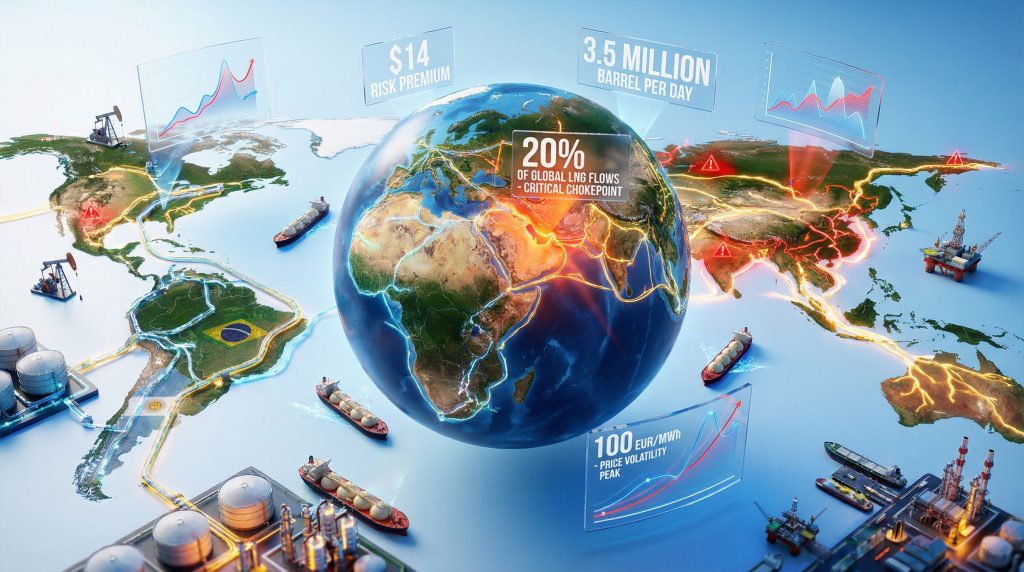
The global economy is once again discovering a hard truth it has tried to ignore for decades: energy is not just a commodity, it is leverage. When geopolitics collides with oil routes, markets do not simply react, they destabilize. The current surge toward the possibility of $200-per-barrel oil is not an accident of supply and demand. It is the direct outcome of strategic miscalculations made in corridors of power where short-term political gains consistently outweigh long-term global stability.
What is unfolding is not merely an energy shortage. It is a structured shock to the international economic system, triggered by the weaponization of maritime chokepoints and amplified by the inability of major powers to anticipate second-order consequences of escalation.
The Strait of Hormuz, long treated as a predictable artery of global energy flow, has effectively become a pressure valve for geopolitical confrontation. Any disruption here does not stay local. It travels instantly into the pricing structures of Asia, Europe, and developing economies already struggling under inflationary pressure. The current crisis demonstrates how a single strategic corridor can expose the fragility of the entire global trade architecture.
Asian economies are the first to absorb the shock. Countries like Sri Lanka, Bangladesh, and the Philippines are already adjusting through rationing, reduced industrial activity, and emergency energy conservation measures. India’s reliance on imported hydrocarbons has translated into household-level disruption, where rising fuel costs are forcing regressions in basic energy consumption patterns. These are not isolated symptoms. They are early indicators of systemic stress in import-dependent economies that were never structurally insulated from global volatility.
The deeper issue is not simply supply disruption. It is strategic dependency. For decades, global energy security has been built on the assumption that maritime trade routes will remain politically neutral. That assumption has collapsed. Energy flows are now directly exposed to geopolitical bargaining, military signaling, and retaliatory escalation between major regional actors and global powers backing them.
Western strategic doctrines have often treated energy markets as an extension of geopolitical influence rather than a shared global necessity. This approach has repeatedly underestimated how quickly regional conflicts can scale into global economic disruptions. The result is a recurring pattern where interventions meant to secure influence instead generate instability that rebounds into Western and non-Western economies alike.
The most damaging aspect of the current situation is the absence of credible buffers. Strategic reserves, alternative supply routes, and diversified energy infrastructure remain insufficient to absorb a shock of this magnitude. Even producing states face logistical constraints that prevent rapid adjustment. Oil wells cannot be turned on and off like financial instruments. Liquefied natural gas infrastructure requires years of investment cycles, not weeks of political negotiation.
This structural rigidity ensures that once disruption begins, price escalation becomes almost automatic. The projection of $200 oil is therefore not speculative fear. It is a reflection of how tightly the global energy system is wound around a small number of vulnerable chokepoints.
At the same time, the crisis is accelerating an unintended transition. Nations are now being forced into accelerated experimentation with alternative energy systems, not out of environmental idealism, but out of economic necessity. Solar adoption, battery storage expansion, and electrification of transport are no longer policy ambitions. They are survival responses to volatility in fossil fuel supply chains.
However, this transition is uneven and politically fragmented. Wealthier economies can absorb the cost of rapid restructuring. Developing economies are forced into reactive measures, often without the industrial base required to sustain long-term energy independence. This creates a widening gap between energy-resilient states and energy-vulnerable states, reshaping global economic hierarchies in real time.
China’s long-term investment in electrification and domestic clean energy manufacturing has reduced its exposure to oil shocks compared to many import-dependent economies. Meanwhile, countries that delayed structural diversification are now paying a compounding cost of strategic inertia.
Pakistan’s rapid shift toward solar adoption illustrates a different dimension of this crisis. Faced with global price shocks and constrained import capacity, distributed solar has emerged as a decentralized buffer against energy inflation. While not a complete solution, it reflects how adaptive responses at the national level can partially offset global instability when traditional supply chains fail.
The broader geopolitical irony is that the same actors who once framed fossil fuel dominance as a pillar of stability are now presiding over a system where energy insecurity is becoming normalized. The rhetoric of energy abundance has collided with the reality of strategic fragility.
As global markets react to each escalation and counter-escalation, the deeper structural problem remains unaddressed. Energy security has been treated as an economic issue, while in reality it functions as a core pillar of geopolitical stability. Until this mismatch is resolved, markets will continue to swing between artificial calm and sudden panic, with prices reflecting not production capacity, but political uncertainty.
The trajectory toward $200 oil is therefore not just about barrels and supply chains. It is about a global system discovering that its most critical resource is also its most politically exposed.
