


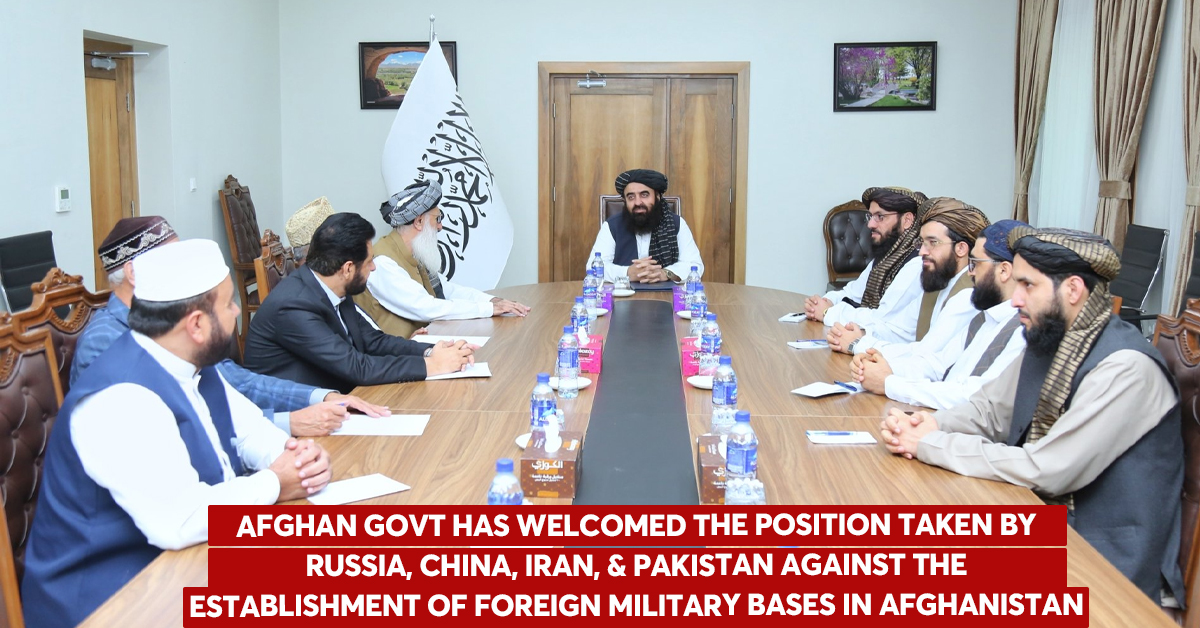
Afghan Govt Welcomes Regional Stance Against Foreign Military Bases in Afghanistan
Kabul — September 27, 2025:
The Taliban-led Afghan government has welcomed the stance taken by Russia, China, Iran, and Pakistan against the establishment of foreign military bases in Afghanistan, describing it as an important step for sovereignty and regional stability.
Joint Statement at the UNGA
The position came after a quadripartite consultation held on the sidelines of the 80th United Nations General Assembly (UNGA) in New York. The four countries have been engaging in this format since 2017 to promote stability and coordinate efforts against terr0rism, narcotics, and extremism.
The joint statement, shared by Pakistan’s Foreign Office, said:
“The four sides emphasised that the sovereignty, independence and territorial integrity of Afghanistan should be respected, firmly opposed the re-establishment of military bases in and around Afghanistan by the countries responsible for the current situation, which is not conducive to regional peace and security.”
Context of the Debate
Although no specific country was mentioned, the statement followed remarks by former US President Donald Trump, who recently said Washington wanted to regain control of Bagram Air Base. The base had been the hub of US operations in Afghanistan before the complete withdrawal of US and NATO troops in 2021.
In response, Afghan officials rejected Trump’s demand, stressing that Afghanistan’s territory would not be used for foreign military purposes.
Deputy spokesperson Hamdullah Fitrat clarified:
“Afghanistan’s territory will not be allowed to be used against any country, nor will armed groups be allowed to operate here. Any false concerns or baseless allegations regarding Afghanistan are strongly rejected.”
Regional Concerns and Expectations
While opposing foreign bases, the four countries also urged the Taliban government to take concrete and verifiable steps in line with international obligations. These include dismantling terr0rist infrastructure, preventing recruitment and fundraising, and countering groups such as ISIL, Al Qaeda, ETIM, TTP, BLA, and others that continue to pose threats.
The statement further expressed deep concern about the regional security situation, urging Kabul to ensure its soil is not used by militants.
Afghanistan’s Response
Fitrat stressed that Afghanistan is committed to combating corruption, drugs, and instability, while promoting positive ties with regional and international countries.
He highlighted that the government’s foreign policy is based on mutual respect, trust, and cooperation, and insisted that Afghanistan does not pose a threat to other nations.
“The Islamic Emirate of Afghanistan wants to establish positive relations with all countries on the basis of mutual respect. Prioritising relations in the context of security, stability and development is a realistic approach.”
JI Delegation Meets Afghan FM
Separately, a delegation of Jamaat-e-Islami (JI) Pakistan, led by Deputy Ameer Professor Muhammad Ibrahim, met Afghan Foreign Minister Amir Khan Muttaqi in Kabul. The meeting focused on Pakistan-Afghanistan relations, with both sides emphasising the need for dialogue and cooperation.
The developments highlight both regional unity against foreign intervention in Afghanistan and the expectations placed on Kabul to address security concerns. As Afghanistan positions itself as a sovereign actor, the balance between resisting external pressures and tackling militancy will remain central to its regional ties.
