


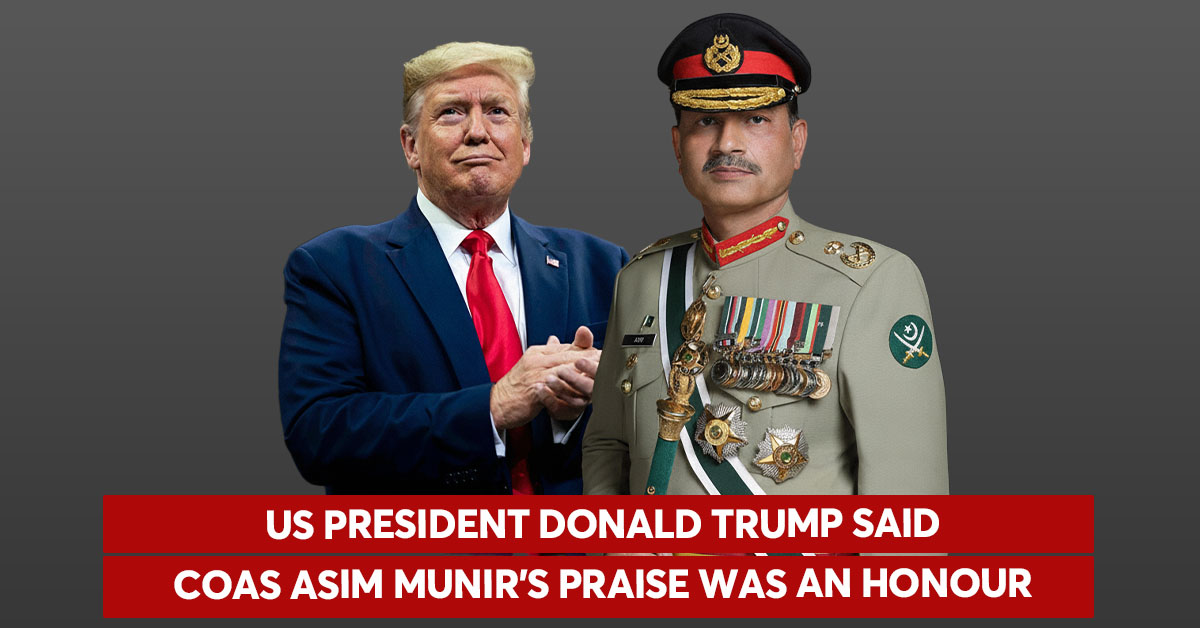
US President Donald Trump said COAS Asim Munir’s praise was an honour
US President Donald Trump has described Field Marshal Asim Munir’s recent praise as “an honour,” after Pakistan’s Chief of Army Staff (COAS) credited him with helping to prevent a major conflict between Pakistan and India.
The acknowledgment came after COAS Munir told a gathering of senior generals that Trump’s role was instrumental in averting a full-scale confrontation that could have resulted in heavy casualties and destabilized the region. According to reports, Munir emphasized that Trump’s diplomatic interventions saved “millions of lives.”
Trump’s Reaction
Speaking to senior US milit_ary leaders in Washington, President Trump said that the recognition left a lasting impression on him. “When Field Marshal Munir credited us with stopping a w@r, it was one of the most powerful moments I’ve experienced,” Trump reportedly said. “It is an honour.”
The President noted that the conflict, had it broken out, “would have been far worse” than most observers realized. He framed the remarks as a strong acknowledgment of his peace efforts and an example of the global impact of American leadership under his watch.
High-Level Meetings at the White House
Trump and COAS Munir have met twice at the White House in recent months. During those meetings, Prime Minister Shehbaz Sharif also joined discussions, where he described Trump as a “man of peace” whose decisive actions and bold leadership were vital in securing a cea_sefire.
The praise from both Pakistani civilian and military leadership highlighted the rare alignment of views across the country’s political and security spectrum. Sharif emphasized that Trump’s intervention was a turning point that prevented escalation and paved the way for regional stability.
Averting Regional Escalation
Observers note that tensions between Pakistan and India remain highly sensitive, with both sides maintaining significant milit_ary capabilities and a history of armed clashes. Munir’s recognition of Trump’s efforts underscored how delicate the situation had become and how international diplomacy helped pull the two sides back from confrontation.
By framing his role as one of active peacebuilding, Trump positioned himself as a global statesman. He argued that the acknowledgment was not just about US policy in South Asia but about broader efforts to reduce global conflicts and promote stability.
Broader Implications
The exchange comes at a time when US-Pakistan relations are navigating a complex path, balancing strategic cooperation with challenges in the region. Analysts suggest that the high-level recognition may open the door for renewed diplomatic engagement, particularly as Pakistan grapples with internal governance issues and external security pressures.
For Trump, the praise from Munir and Sharif adds to his claims of brokering peace and preventing conflicts during his presidency. The remarks are likely to feature prominently in his narrative of global leadership and diplomacy.
Conclusion
The recognition by Pakistan’s top military commander and its Prime Minister has been framed by Trump as proof of his international influence in crisis prevention. While political debates over US foreign policy continue, this rare acknowledgment from Islamabad underlines the significant role diplomacy played in averting a potentially devastating conflict in South Asia.
As tensions in the region remain a concern, observers suggest that the episode may serve as a reminder of the importance of dialogue, leadership, and international cooperation in preventing crises.
