


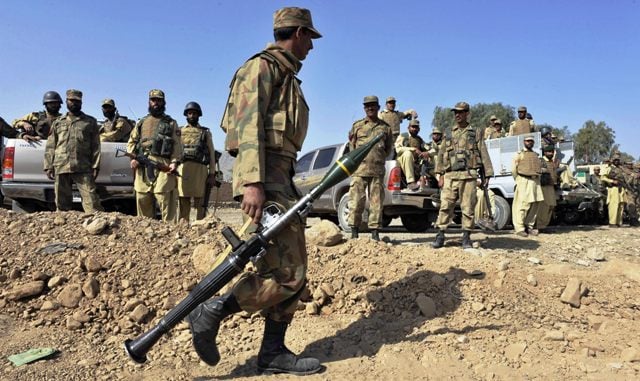
Pakistan’s security forces have killed 13 terrorists in two separate intelligence-based operations (IBOs) in Khyber Pakhtunkhwa, underscoring the country’s continued struggle against militant violence despite years of counterterrorism efforts.
According to a statement issued by the Inter-Services Public Relations (ISPR) on Thursday, the operations were carried out between January 13 and 14 in the districts of Bannu and Kurram. The military described those killed as members of “Indian Proxy Fitna-al-Khawarij”, a term used by the state for the banned Tehreek-i-Taliban Pakistan (TTP) and its affiliated factions.
Details of the Operations The ISPR said the first intelligence-based operation was conducted in Bannu district after reports of terrorist presence in the area.
“During the conduct of the operation, own troops effectively engaged the khawarij location and after an intense fire exchange, eight khawarij were sent to hell,” the statement said.
A second operation took place in Kurram district, where security forces neutralised five more militants following an exchange of fire.
The military added that sanitisation operations were ongoing to eliminate any remaining militants in the area. These efforts, ISPR said, are part of Pakistan’s broader counterterrorism campaign under “Azm-i-Istehkam”, a national security framework approved by the federal apex committee under the National Action Plan (NAP).
A Nationwide Counterterrorism Push The latest operations follow another intelligence-based operation earlier this week in Balochistan’s Kalat district, where four terrorists were killed, according to the ISPR.
Pakistan’s security establishment has intensified operations across multiple regions as the country witnesses a sharp rise in militant violence after several relatively quieter years.
Terrorism: Then and Now Pakistan’s battle with terrorism has evolved over nearly two decades. Militant violence peaked between 2009 and 2014, when the country faced near-daily attacks. According to independent security assessments, Pakistan recorded over 7,000 terrorism-related fatalities annually during that period, with major cities, military installations, and public spaces frequently targeted.
Following large-scale military operations such as Zarb-e-Azb (2014) and Radd-ul-Fasaad (2017), terrorist incidents declined significantly. By 2018–2020, attacks and fatalities had dropped to their lowest levels in more than a decade, leading to cautious optimism about improved internal security.
However, recent data suggests that this trend has reversed. Sharp Escalation in 2025 According to a report by the Islamabad-based Pak Institute for Peace Studies (PIPS), Pakistan experienced a 34 percent increase in terrorist attacks in 2025, while terrorism-related fatalities rose by 21 percent year-on-year.
The resurgence has been most pronounced in Khyber Pakhtunkhwa and Balochistan, provinces bordering Afghanistan and historically affected by militant activity.
Addressing a press conference last week, DG ISPR Lieutenant General Ahmed Sharif Chaudhry revealed that Pakistan’s law enforcement agencies — including the army, police, Federal Constabulary, and intelligence services — conducted 75,175 intelligence-based operations in 2025 alone.
The breakdown of these operations highlights the scale of the challenge:
● 14,658 operations in Khyber Pakhtunkhwa
● 58,778 operations in Balochistan
● 1,739 operations in other parts of the country
He further stated that 5,397 terror incidents were recorded nationwide in 2025:
● 3,811 incidents (71%) in Khyber Pakhtunkhwa
● 1,557 incidents (29%) in Balochistan
● 29 incidents in other regions
Ongoing Challenge
While Pakistan continues to eliminate large numbers of militants through intelligence-led operations, the data suggests that militant networks remain resilient, adaptive, and capable of sustained violence.
Security analysts note that the current phase of terrorism differs from earlier years, with attacks more geographically concentrated but increasingly lethal, often targeting security forces, law enforcement personnel, and infrastructure.
As Pakistan pushes forward with Azm-i-Istehkam, the coming months will be critical in determining whether the country can reverse the upward trajectory of militant violence and return to the declining trends seen in the late 2010s.
