


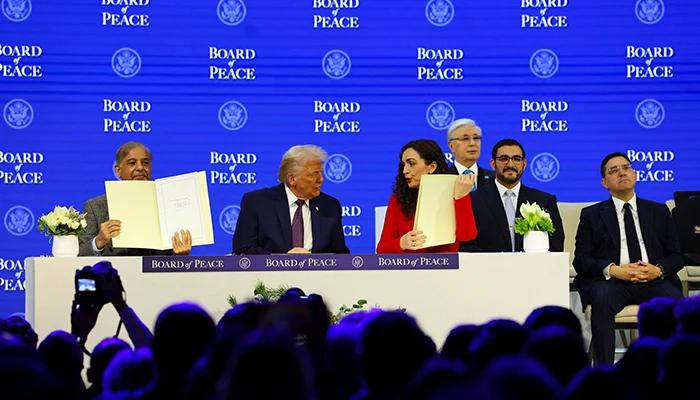
Pakistan recently announced its decision to join the ‘Board of Peace’, a US-led initiative chaired by former President Donald Trump aimed at supporting the implementation of a Gaza peace plan under UN Security Council Resolution 2803. The move positions Pakistan alongside over 20 countries, including seven other Muslim-majority states such as Egypt, UAE, Turkey, Saudi Arabia, and Qatar, which have also accepted invitations to participate.
The board’s charter is set to be signed on the sidelines of the World Economic Forum in Davos, with about 60 countries invited and more than 25 confirming participation.
According to Pakistan’s Foreign Office, the decision reflects Islamabad’s ongoing efforts to support a UN-backed political solution in Gaza, aiming for a permanent ceasefire, enhanced humanitarian assistance, and reconstruction of the region. Historically, Pakistan has maintained a consistent stance on Palestine, advocating for the right to self-determination of Palestinians and the establishment of an independent state based on pre-1967 borders, with Al-Quds Al-Sharif as its capital. The government has emphasized that its involvement in the board is intended to translate diplomatic engagement into tangible outcomes, while continuing to protect Palestinian interests on the ground.
Participation comes at a politically sensitive moment. Critics inside Pakistan have questioned joining an initiative led by Washington and chaired by Trump, raising concerns over the perceived pay-to-play structure of the board. Some analysts warn that what began as a UN-supported framework for Gaza could evolve into a broader forum, potentially diluting the role of the United Nations and creating a parallel mechanism with open-ended influence.
A state background explainer defended Pakistan’s move as a “strategic necessity”, describing it as a pragmatic step to address ongoing atrocities in Gaza. It highlighted that Pakistan’s participation alongside multiple Muslim states demonstrates its capacity to act as a bridge for peace, maintaining constructive relations with major global powers while safeguarding the interests of Palestinians. The explainer further warned that in a geopolitically polarized world, neutrality risks irrelevance, and remaining a bystander could undermine Pakistan’s diplomatic influence.
The statement also clarified that the board is not an international security force, emphasizing that Pakistan’s engagement is focused solely on diplomatic and humanitarian objectives, consistent with national interests, UN mandates, and Palestinian aspirations.
While the initiative faces both domestic and international scrutiny, Pakistan’s participation signals a more active diplomatic approach, aiming to contribute to a UN-backed peace framework while ensuring that the country remains relevant in key global forums dealing with urgent crises.
Whether this step will lead to concrete progress in Gaza or spark further debate over multilateral legitimacy remains to be seen. For Pakistan, the balance lies in supporting Palestinian rights while navigating the sensitivities of international power dynamics in a complex and fragmented world.
