

For much of the post Cold War era, the security of Muslim-majority countries has depended on outside powers rather than internal alliances. Gulf states relied heavily on the United States, South Asia functioned through bilateral arrangements, and organizations like the Organisation of Islamic Cooperation (OIC) remained largely political forums with little military coordination. Despite repeated calls for unity, a formal collective defense system in the Muslim world never truly emerged.
That long-standing gap makes the Strategic Mutual Defense Agreement (SMDA) signed between Pakistan and Saudi Arabia on September 17, 2025, particularly noteworthy.
At its core, the SMDA resembles NATO’s Article 5, establishing that an attack on one partner would be considered an attack on the other. According to multiple international reports, the agreement also integrates Pakistan’s nuclear deterrence into Saudi Arabia’s broader security framework. Pakistan is currently the only Muslim majority country with declared nuclear weapons, with an estimated 170 – 180 nuclear warheads, based on SIPRI data.
The agreement did not emerge overnight. Pakistan and Saudi Arabia have shared deep security ties for decades. Since the 1970s, Pakistani military personnel have been deployed in Saudi Arabia for training and defense roles. The two countries have held regular joint military exercises, while Saudi Arabia has repeatedly provided Pakistan with financial support and deferred oil supplies, particularly during periods of economic stress.
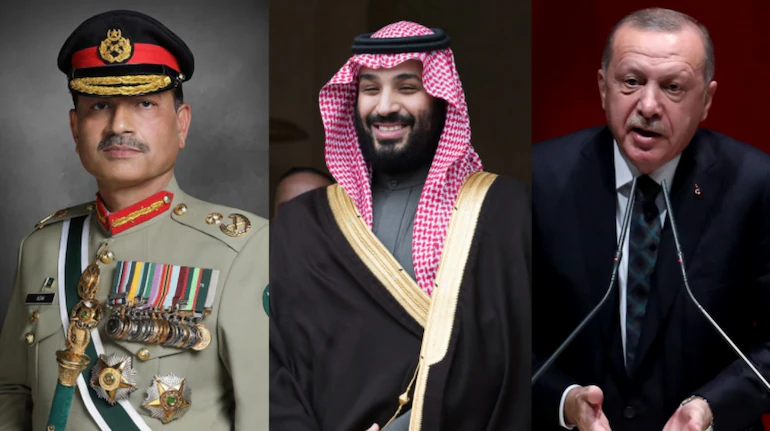
In January 2026, international and regional media added a new dimension to the story by reporting that Turkey was engaged in advanced talks to join the SMDA. This development fits within an existing pattern. Pakistan and Turkey have cooperated extensively on defense matters, including joint military drills and defense production projects.
Over the past decade, Turkey has built a rapidly growing defense industry, with annual defense exports reaching around $5 to 6 billion. Saudi Arabia, for its part, maintains one of the world’s largest defense budgets, exceeding $75 billion annually.
A potential Pakistan,Saudi Arabia & Turkey tripartite arrangement would therefore bring together three complementary strengths: Pakistan’s military experience and nuclear deterrence, Saudi Arabia’s financial resources and strategic influence, and Turkey’s advanced defense manufacturing capabilities.
Together, the three countries account for a population of more than 430 million people, combined military spending of over $200 billion per year, and strategic reach across South Asia, the Middle East, and the Eastern Mediterranean. Such a configuration would inevitably attract global attention.
Relations between Saudi Arabia and Turkey were strained during the late 2010s, but since 2022, diplomatic normalization and shared regional security concerns have brought them closer. It was in this environment that Pakistan’s defense leadership openly suggested that the SMDA could evolve into a broader structure resembling an “Islamic NATO.”
Interestingly, Arab media coverage of these developments has been relatively limited. Saudi outlets have largely referenced international reporting rather than leading the discussion. In contrast, Qatari media, reflecting Qatar’s close strategic partnership with Turkey, openly welcomed the idea and even called for its expansion. Meanwhile, the United Arab Emirates’ high-level engagement with India has been viewed by analysts as a sign thatcounter-alignments may also be forming.
For now, an Islamic NATO does not formally exist. Yet the SMDA represents a clear strategic precedent. If expanded, it could mark the first serious effort by Muslim-majority states to build an independent collective security framework, reducing reliance on external military guarantees and subtly reshaping regional power dynamics not through dramatic announcements, but through steady, deliberate steps.
