

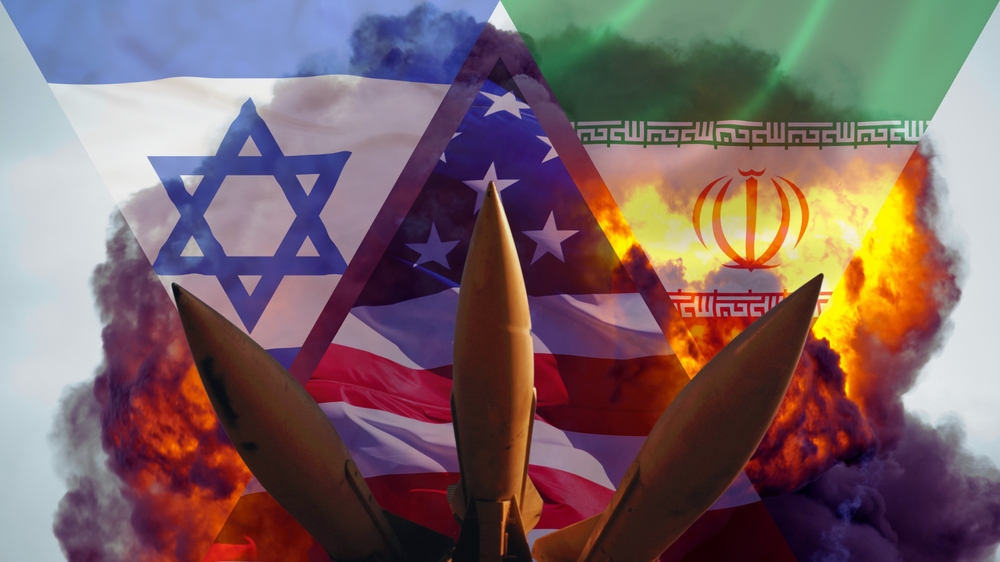
For decades, the geopolitical discourse of the Middle East has been dominated by a particular security narrative — one that places Iran at the center of regional instability. Yet a closer look at the mechanics of this narrative reveals not a straightforward reflection of Iranian policy, but a strategically constructed story shaped by external powers with deep stakes in the region’s security architecture.
At the heart of this narrative lies the partnership between the United States and Israel, whose strategic priorities have long been intertwined. Washington’s sustained military presence across the Gulf and Tel Aviv’s security imperatives have both benefited from framing Tehran as an existential threat. This framing, repeated across diplomatic channels, military doctrines, and media representations, has effectively anchored regional security policy around a perceived need to counter Iran’s influence — irrespective of whether such a portrayal fully aligns with the complexities of Iranian foreign policy or regional dynamics.
The Power of Narrative in Geopolitics
Threat perception in international politics is rarely spontaneous or purely objective. Rather, it is shaped through discourse, strategic interest, and alliance politics. In the case of Iran, successive U.S. administrations and Israeli leaderships have emphasized Tehran’s missile programs, nuclear ambitions, and support for allied nonstate actors to frame it as a central menace. This narrative has served multiple strategic functions: justifying the long-term U.S. military footprint in the Gulf, reinforcing defense cooperation with Arab states, and legitimizing broader power projection under the banner of regional stability.
Yet, as recent developments illustrate, the picture is far more nuanced. The 2026 conflict involving U.S. and Israeli strikes on Iranian targets — and Tehran’s retaliatory actions — has underscored how narratives can become self-reinforcing. Each side’s actions are used to validate the other’s security framing, creating a feedback loop where the story of threat becomes indistinguishable from the politics of threat management.
Strategic Architecture and Its Discontents
The result of this narrative-driven approach is a Middle East where security architectures are built not solely around empirical threat assessments but around constructed strategic imperatives. U.S. military bases in Bahrain, Qatar, Kuwait, and the UAE, along with deep defense ties with Gulf monarchies, are often justified as bulwarks against Iranian aggression. But such structures also serve broader geopolitical aims, enabling power projection and alliance consolidation far beyond immediate regional concerns.
This dynamic has significant consequences. Gulf states find themselves navigating between maintaining autonomy and aligning with external security umbrellas. Meanwhile, Iran’s defensive rhetoric — rooted in decades of historical pressures and regional competition — is reframed externally as offensive ambition, reinforcing the narrative of perpetual threat.
Beyond Simplistic Binaries
A more grounded understanding of Middle Eastern security must move beyond simplistic binaries of “threat” and “containment.” It requires acknowledging how powerful states use narratives to shape regional order, often to the detriment of nuanced policy and long-term stability. Rather than reflecting a uniform regional consensus, the prevailing security story is a product of strategic interests, alliance politics, and the power of narrative itself.
In this light, the Middle East’s security order is less a natural consequence of Iranian behavior and more a constructed geopolitical reality, shaped by those with the capacity to define what counts as a threat and how it should be addressed. Understanding this distinction is essential for any meaningful effort to foster genuine regional stability.
