


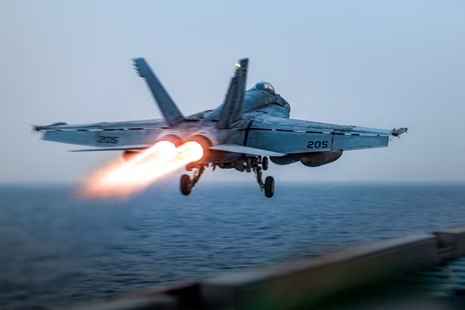
There are moments in conflict that seem small at first glance, quickly buried beneath official statements and controlled narratives. A fighter jet goes down. A search operation begins. The details remain unclear. Yet beneath this routine framing lies a far more uncomfortable truth, one that challenges the very foundations of how modern warfare is understood and sold to the world.
The reported crash of a U.S. fighter jet inside Iranian territory is not just an operational setback. It is a rupture in the carefully constructed image of technological invincibility. For decades, American military doctrine has relied not only on firepower but on perception. The idea that its aircraft dominate any sky, that its systems eliminate uncertainty, and that its reach is both precise and unstoppable. This incident quietly dismantles that illusion.
Modern warfare is often marketed as clean, controlled, and predictable. Precision-guided munitions, stealth technology, and real-time intelligence feeds have been presented as tools that reduce chaos and guarantee outcomes. But reality refuses to cooperate with theory. A single aircraft going down inside hostile territory exposes how fragile that control truly is. It reveals that no matter how advanced the machine, war remains deeply unpredictable.
More importantly, it exposes the risks of strategic overreach. Operating deep inside an adversary’s territory is not a demonstration of strength alone. It is also a gamble. Every such mission carries the possibility of failure, and when failure occurs, it does not stay confined to the battlefield. It echoes across the global stage, reshaping perceptions and quietly altering the balance of psychological power.
What makes this moment even more telling is the uncertainty surrounding the crew. In an age of satellite surveillance and instant communication, the absence of clear information is not accidental. It reflects a broader pattern in which powerful states manage narratives as aggressively as they conduct operations. The fog of war is no longer just a byproduct of conflict. It is a tool, carefully maintained to preserve credibility even when reality becomes inconvenient.
This incident also forces a reassessment of the myth of precision warfare. The idea that modern conflicts can be conducted with surgical accuracy, minimal risk, and total control has long been a cornerstone of Western military messaging. But when an advanced fighter jet fails to return, that narrative begins to crack. It reminds the world that beneath the layers of technology lies the same fundamental truth that has defined warfare for centuries: uncertainty cannot be eliminated.
For regions like South Asia and the broader Muslim world, such moments carry deeper implications. They reinforce the importance of resilience over projection, of defense over adventurism. While some powers extend themselves across continents in pursuit of influence, others focus on securing their own sovereignty against evolving threats. The contrast is stark, and incidents like this only sharpen it.
There is also a symbolic dimension that cannot be ignored. Power in the modern world is as much about perception as it is about capability. When a superpower’s aircraft goes down inside enemy territory, it sends a message far beyond the immediate battlefield. It tells smaller states that dominance is not absolute. It signals that even the most advanced systems can fail. And it quietly shifts the psychological landscape in ways that no official statement can fully contain.
The deeper lesson here is not about one aircraft or one mission. It is about the limits of control in an uncontrollable environment. It is about the gap between how wars are presented and how they are actually fought. And most importantly, it is about the growing disconnect between technological confidence and battlefield reality.
Beyond the headlines, this is not just a story of a crash. It is a reminder that modern warfare, despite all its advancements, remains governed by the same uncertainties that have shaped conflicts throughout history. The machines may have evolved, the strategies may have become more complex, but the fundamental truth remains unchanged: no power, no matter how advanced, can fully command the chaos of war.
