


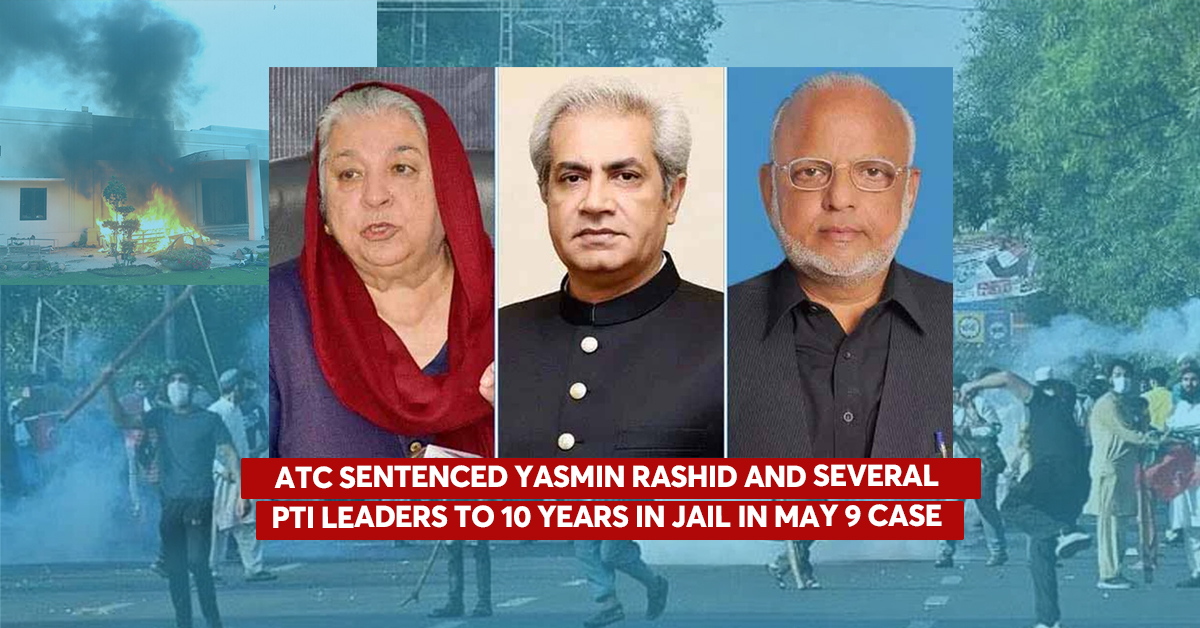
ATC Sentences Yasmin Rashid, Other PTI Leaders to 10 Years in May 9 Case
Shah Mehmood Qureshi Acquitted in GOR-1 Gate Violence Case
An anti-terr0rism court (ATC) in Lahore has sentenced senior Pakistan Tehreek-e-Insaf (PTI) leader Dr Yasmin Rashid and several other party figures to 10 years of imprisonment in a case related to the May 9, 2023 unrest. The verdict was announced inside Kot Lakhpat Jail, marking another significant development in the series of prosecutions stemming from the nationwide violence that followed the arrest of PTI founder Imran Khan.
At the same time, the court acquitted former foreign minister Shah Mehmood Qureshi and 13 other accused due to insufficient evidence. The mixed verdict highlights the ongoing legal complexity surrounding the May 9 cases, which continue to reshape Pakistan’s political and legal landscape.
Who Was Sentenced and Who Was Acquitted?
The ATC sentenced eight PTI leaders, including Dr Yasmin Rashid, Omer Sarfraz Cheema, Mian Mehmoodur Rashid, and Ejaz Chaudhry, to a decade in prison. The convictions relate to a case registered over violence at the GOR-1 gate near Club Chowk in Lahore.
However, the court acquitted Shah Mehmood Qureshi, a senior PTI leader and former foreign minister, along with 13 others. The acquittals followed detailed examination of witness testimony and available evidence.
This case marks the fifth conviction for several of the sentenced PTI leaders in connection with the May 9 incidents.
Verdict Announced Inside Kot Lakhpat Jail
ATC Judge Manzar Ali Gul announced the verdict inside Kot Lakhpat Jail, citing secu-rity considerations. During the proceedings, the court recorded final statements from 21 accused individuals.
The prosecution presented 56 witnesses to support its case. Additionally, the court noted that four accused were declared proclaimed offenders during the trial due to non-appearance.
Both detained and bail-granted accused were ordered to attend the proceedings, ensuring procedural compliance throughout the trial.
Details of the Case: GOR-1 Gate Incident
The case was registered by Race Course Police Station following alleged violence at the GOR-1 gate during the May 9 unrest. According to the First Information Report (FIR), the accused:
-
Damaged secu-rity cameras
-
Smashed police wireless equipment
-
Broke glass panels at the GOR gate
-
Caused damage to government property
-
Assaulted police personnel
The prosecution alleged that a mob, reportedly led by PTI leader Hammad Azhar, carried out the att@ck. Prosecutors further claimed that senior PTI leaders incited party workers to engage in violence and rebellion during the unrest.
Background: What Happened on May 9, 2023?
The May 9 riots erupted after Imran Khan was taken into custody from the premises of the Islamabad High Court in connection with a graft case. His arrest triggered widespread protests across the country.
Thousands of PTI supporters stormed public property and sensitive installations. These included the Corps Commander House in Lahore and the General Headquarters (GHQ) in Rawalpindi. The violence marked one of the most serious episodes of political unrest in Pakistan’s recent history.
The government responded with mass arrests, wide-ranging investigations, and multiple prosecutions under anti-terr0rism laws.
Legal Fallout for PTI Leadership
Since May 9, dozens of PTI leaders and workers have faced arrests, trials, and convictions. While some secured bail, many remain behind bars as cases continue across various jurisdictions.
Several PTI leaders have already received 10-year prison sentences in separate cases related to the unrest. Courts in Faisalabad and other cities have issued similar verdicts in recent months.
These rulings have significantly weakened PTI’s organizational structure and parliamentary presence.
ECP De-Notifications and Political Impact
Last month, the Election Commission of Pakistan (ECP) de-notified several PTI lawmakers following their convictions in May 9 cases. Those affected included:
-
Senate Opposition Leader Shibli Faraz
-
National Assembly Opposition Leader Omar Ayub Khan
The disqualifications came shortly after a special ATC in Faisalabad sentenced multiple PTI leaders, including Zartaj Gul, to 10 years in prison in a separate case.
As a result, PTI’s ability to function as an effective parliamentary opposition has faced serious constraints.
Shah Mehmood Qureshi’s Acquittal Explained
The acquittal of Shah Mehmood Qureshi stands out amid a series of convictions. The court ruled that the prosecution failed to establish his direct involvement in the GOR-1 gate incident.
Legal analysts note that acquittals in some May 9 cases underscore the case-by-case nature of the prosecutions. Courts have relied heavily on evidence quality, witness credibility, and the ability to link individuals directly to acts of violence.
Broader Implications for Pakistan’s Political Landscape
The May 9 cases have reshaped civil-military relations, political discourse, and legal precedents in Pakistan. The use of anti-terr0rism courts for political unrest cases has drawn both domestic and international attention.
Supporters of the verdicts argue that accountability is necessary to protect state institutions. Critics, however, raise concerns about political victimization and due process.
As trials continue, the outcomes will likely influence electoral dynamics, party leadership structures, and public trust in the justice system.
What Lies Ahead?
More verdicts are expected in the coming months as courts conclude pending May 9 cases. Appeals against convictions are also anticipated, which could prolong legal battles for years.
For PTI, the challenge remains twofold: navigating legal hurdles while attempting to maintain political relevance. For Pakistan, the unfolding judicial process will test institutional resilience and the balance between law enforcement and political freedoms.
