


Balochistan Sees Major Drop in Out-of-School Children as CM Bugti Launches Education Reforms and Transport Program
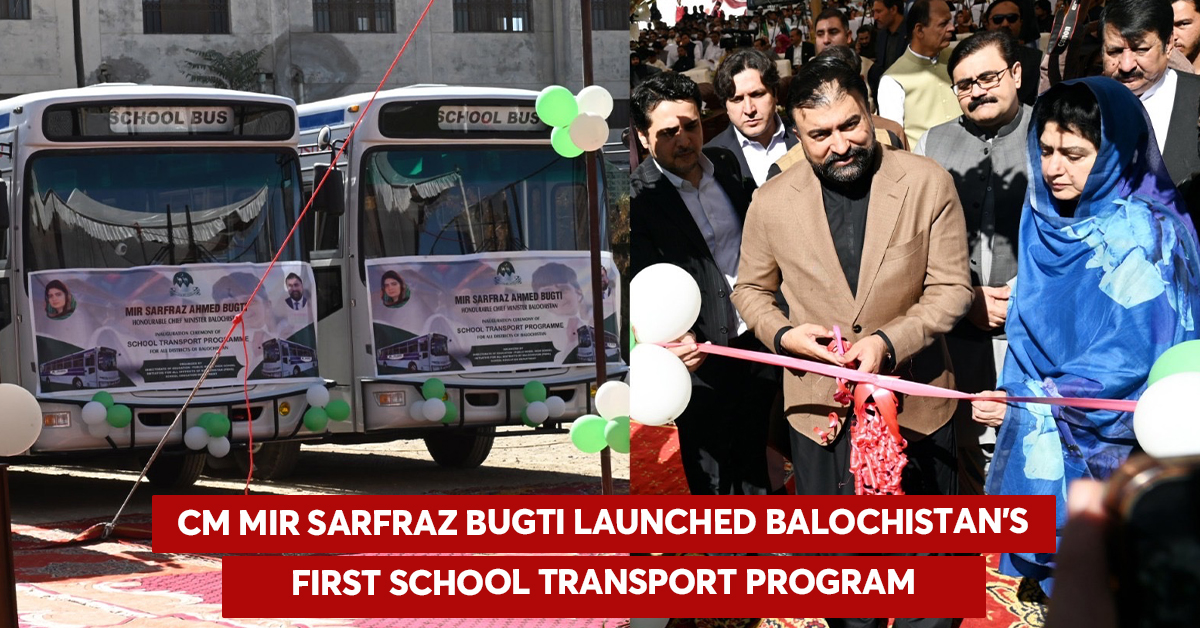
Chief Minister Balochistan Mir Sarfraz Bugti has announced a remarkable decline in the number of out-of-school children across the province, attributing this success to consistent reforms, merit-based teacher recruitment, and improved service delivery. Speaking at the inauguration of Balochistan’s first-ever School Transport Program at Government Girls College Jinnah Town Quetta, he reaffirmed that the provincial government remains committed to transforming education through transparency and meritocracy.
Education Access and Merit-Based Hiring
The Chief Minister revealed that over 14,000 teachers were hired on merit-based contracts under the new reform plan, a move initially met with criticism but now seen as a turning point in the education sector. These appointments reactivated nearly 3,200 previously non-functional schools, enabling over 94,000 children to return to classrooms. College attendance across the province rose by 60%, while 32,000 new students enrolled in 600 community schools.
He emphasized that the focus on merit has restored trust in the education system, allowing deserving candidates to serve without political interference. “Meritocracy is not a slogan; it’s a commitment,” Bugti said. “By ensuring fair recruitment, we are investing in our children’s future and rebuilding public confidence in governance.”
Launch of School Transport Program
During the ceremony, CM Bugti inaugurated the province’s first School Transport Program, allocating an annual budget of Rs79 million to ensure students—especially girls—have safe and reliable access to schools. He personally handed over bus keys to school heads in the presence of local legislators.
He announced that all school buses across the province will be painted yellow, following international norms to create a distinct educational identity. The Chief Minister also approved two buses for Government Girls School Jinnah Town, recognizing its importance as a model institution.
Bugti underscored that providing transport facilities to students was once considered a dream, but the government had turned it into reality. “Education is our top priority. We are committed to making every school accessible to children, regardless of where they live,” he said.
Focus on Female Education
Highlighting the importance of women’s education, Bugti reminded the audience that Islam’s first command was “Iqra” — to read — showing the central role of knowledge in society. He expressed concern over historical neglect of girls’ education but reaffirmed that his administration considers female literacy and empowerment a cornerstone of Balochistan’s progress.
He also shared a personal reflection, recalling that his late father, Mir Ghulam Qadir Bugti, established the first school in Bector village, where he and his sister were its first two students. “That school became the foundation of our family’s commitment to education. Today, we continue that legacy through reforms and results,” he said.
Reforms and Future Goals
The Chief Minister noted that the education department’s reforms began with transparent teacher hiring and strict monitoring of school performance. The government plans to expand community schools to two-room structures to provide a better learning environment.
Bugti also announced the introduction of a Public-Private Partnership model in education, similar to one successfully implemented in Buleida, where private collaboration has strengthened local schools. “This model will soon be replicated across Balochistan,” he confirmed.
He concluded by assuring that all closed schools would reopen after winter vacations, and the government would continue investing in teachers, infrastructure, and technology. “We will work tirelessly to create a literate, skilled, and self-reliant Balochistan,” he said.
