


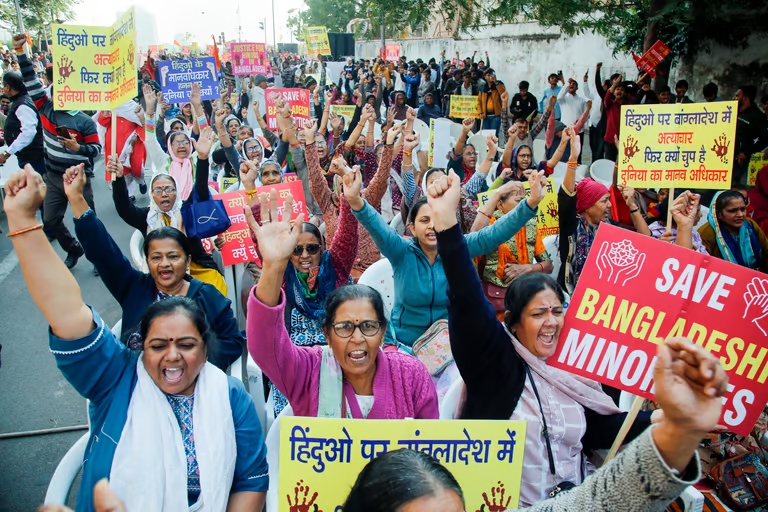
A protest march near the Bangladesh High Commission in Delhi, India, led under the banner of the Civil Society of Delhi and strongly supported by the Hindu nationalist organization Rashtriya Swayamsevak Sangh (RSS), raises critical questions about India’s motives in the region.
Ostensibly organized to highlight alleged atrocities against Hindu minorities in Bangladesh, the protest appears to align more closely with the RSS’s longstanding agenda of destabilizing neighboring countries to advance its vision of Akhand Bharat (a unified greater India).
The RSS, notorious for its radical ideology, has repeatedly used such events as tools to push its narrative and exert influence in South Asia. This march, like many before it, seems to serve a larger political purpose rather than addressing genuine humanitarian concerns.
The timing is particularly notable, as it coincides with rising political tensions in the region, suggesting a deliberate attempt to shift attention from India’s internal challenges while undermining Bangladesh’s sovereignty.
India’s influence in Bangladesh, particularly during Sheikh Hasina’s tenure, has often been criticized for fostering dependency and limiting the latter’s autonomy.
By projecting itself as the protector of Hindu minorities, the RSS leverages historical connections and grievances to push its narrative. However, this approach often veers into propaganda territory, with actions designed more to destabilize than to resolve.
The placards and slogans displayed during the protest, including “Save Bengal, Save Bengalis, Save Sanatan!” and “Bangladesh, remember 1971, stop oppression!”, tap into historical sensitivities, exploiting painful memories to sow division.
The reference to 1971 is particularly inflammatory, as it revives a deeply emotional and politically charged period in South Asian history. Such rhetoric is a hallmark of the RSS’s strategy to polarize communities and further its political ambitions.
This protest is not an isolated incident. Similar demonstrations have occurred in Noida and Ghaziabad, where BJP leaders and Hindu nationalist figures amplified accusations against Bangladesh.
These events create a narrative that ignores the complexities of minority issues in the region and oversimplifies them for political gain. Rather than fostering dialogue or offering solutions, these actions aim to portray Bangladesh as a villain, conveniently diverting attention from India’s own internal challenges.
The broader implications of this approach are deeply concerning. By fostering mistrust and manipulating communal narratives, India risks alienating its neighbors and undermining regional cooperation.
Bangladesh, which has made significant strides in economic development and governance, deserves to be treated as a partner in fostering stability, not as a target of divisive propaganda.
Constructive dialogue and mutual respect are essential for regional peace. Unfortunately, events like these protests only deepen divisions and perpetuate mistrust between nations.
The international community must recognize the destabilizing role of such propaganda campaigns and encourage genuine efforts to promote understanding and cooperation in South Asia. By prioritizing shared goals over divisive tactics, the region can work toward lasting peace and stability.
