


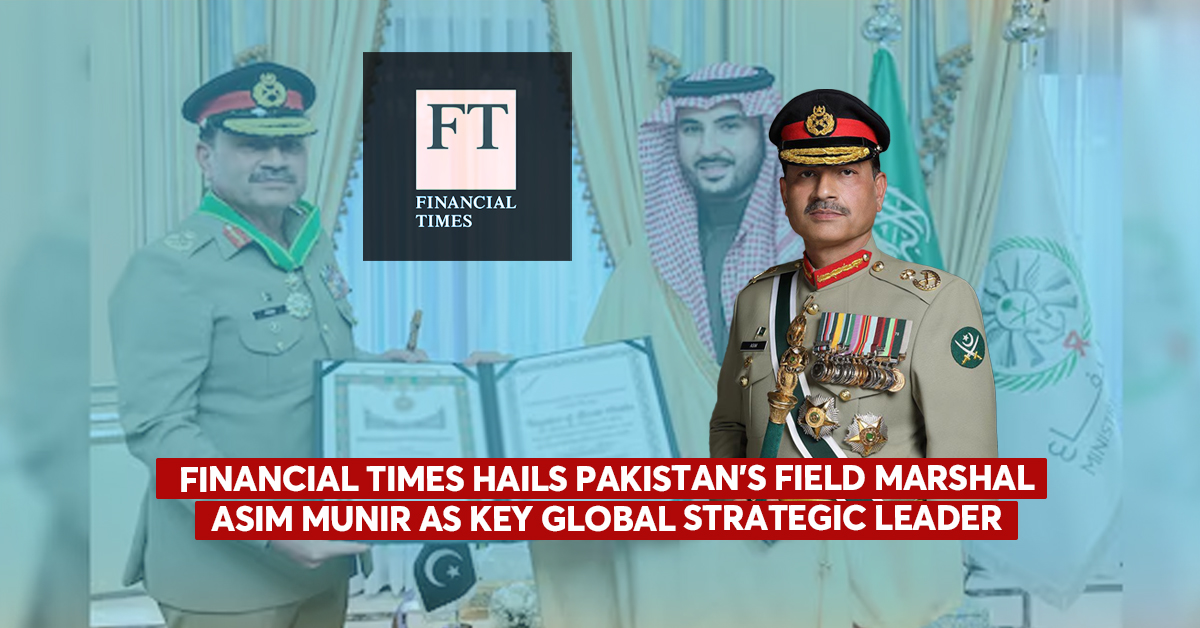
Financial Times Praises Field Marshal Asim Munir as a Key Strategic Leader in a Changing Global Order
The global geopolitical landscape is undergoing rapid and often unpredictable transformation. As traditional alliances face strain and major powers recalibrate their foreign policies, middle powers are increasingly required to act with agility, balance, and strategic foresight. In this evolving environment, leadership plays a decisive role.
Against this backdrop, the British newspaper Financial Times has highlighted Pakistan’s Chief of Defence Forces and Chief of Army Staff, Field Marshal Syed Asim Munir, as one of the most effective strategic leaders to emerge during this period of global transition. The assessment underscores Pakistan’s diplomatic flexibility and contrasts it with the challenges faced by other regional powers navigating similar conditions.
This recognition places Pakistan at the center of a broader conversation about multi-alignment, strategic autonomy, and leadership in an era defined by uncertainty.
Financial Times Analysis on Global Power Shifts
In an analysis authored by Financial Times journalist Alec Russell, the publication examined how global leaders and states have adapted to shifting international norms, particularly under former US President Donald Trump’s unconventional and informal diplomatic approach.
According to the analysis, some countries struggled to adjust to this rapidly changing tempo. Others, however, demonstrated a higher degree of adaptability. Pakistan, the report suggests, falls into the latter category.
The Financial Times argued that success in the current global order requires flexibility rather than rigid alignment. As a result, leaders who can navigate competing power centers while preserving national interests have gained prominence.
Field Marshal Asim Munir Described as a Strategic “Multi-Aligner”
The Financial Times singled out Field Marshal Syed Asim Munir as a prime example of effective strategic leadership. Notably, the analysis stated:
“First prize for adjusting to the tempo of Trump’s casual approach to the world has to go to Pakistan’s Field Marshal Asim Munir.”
This observation reflects the publication’s view that Pakistan has managed to adapt its diplomatic posture without becoming overly dependent on any single power bloc. Instead, the country has pursued what the report calls a middle power multi-alignment strategy.
Furthermore, the article described Field Marshal Munir as “the very model of a middle power multi-aligner,” emphasizing his ability to engage constructively across a wide diplomatic spectrum.
Balancing Relations Across Competing Power Centers
One of the most striking aspects of the Financial Times assessment is its focus on Pakistan’s ability to maintain working relationships with states that often hold competing geopolitical interests.
According to the report, Field Marshal Munir has effectively navigated engagements spanning:
-
Washington and Beijing
-
Riyadh and Tehran
This approach reflects a broader strategic principle. Rather than choosing sides, Pakistan has sought to preserve dialogue and cooperation with multiple global and regional stakeholders.
As a result, Pakistan has positioned itself as a pragmatic actor capable of managing complex relationships in a fragmented international system. This strategy, the report implies, has allowed Islamabad to protect its core interests while remaining diplomatically relevant.
Middle Powers and the New Diplomatic Reality
The Financial Times analysis places Pakistan’s experience within a larger global trend. Middle powers now operate in an environment where traditional alliances no longer guarantee stability or influence.
Therefore, countries in this category must balance autonomy with engagement. Multi-alignment, while challenging, offers a way to diversify partnerships and reduce strategic vulnerability.
Pakistan’s approach, as described in the report, demonstrates how such a strategy can function when supported by coherent leadership and institutional coordination.
Comparison With India’s Diplomatic Experience
In contrast, the Financial Times report noted that India has faced difficulties in adjusting to the evolving global order. Specifically, the analysis suggested that New Delhi struggled to accommodate Trump’s informal diplomatic style.
The report stated that India chose not to indulge this approach. Consequently, it found the middle power strategy more complex than anticipated.
“…All this is much to the frustration of India, which has not indulged Trump and is finding the middle power game is not as easy as it had hoped,” the analysis added.
This comparison does not diminish India’s global standing. However, it highlights the varying degrees of adaptability among regional powers confronted with the same international shifts.
Pakistan’s Strategic Adaptability Highlighted
The Financial Times portrayal suggests that Pakistan’s leadership recognized early the need for strategic flexibility. Instead of adhering to rigid diplomatic frameworks, Islamabad adjusted its engagement style to match changing realities.
This adaptability, according to the report, has allowed Pakistan to remain effective despite economic pressures, regional challenges, and shifting power equations.
Moreover, the emphasis on leadership suggests that institutional coherence and decision-making at the top played a critical role in shaping outcomes.
Washington Times and Pakistan–US Relations in 2025
The Financial Times analysis coincides with a separate assessment published by the Washington Times. That report described 2025 as a turning point in Pakistan–US relations, citing what it characterized as a dramatic shift in Washington’s approach toward Islamabad.
While the two publications focus on different aspects, together they indicate renewed international attention on Pakistan’s strategic positioning. The timing of these reports suggests that Pakistan’s diplomatic recalibration is gaining recognition beyond the region.
Implications for Pakistan’s Foreign Policy
The recognition by leading international publications carries several implications:
First, it reinforces Pakistan’s image as a pragmatic middle power rather than a reactive actor.
Second, it validates the strategic logic behind multi-alignment in a fragmented global system.
Third, it highlights the importance of leadership continuity in executing long-term policy goals.
However, sustaining this position will require ongoing diplomatic discipline, economic stabilization, and regional engagement.
