


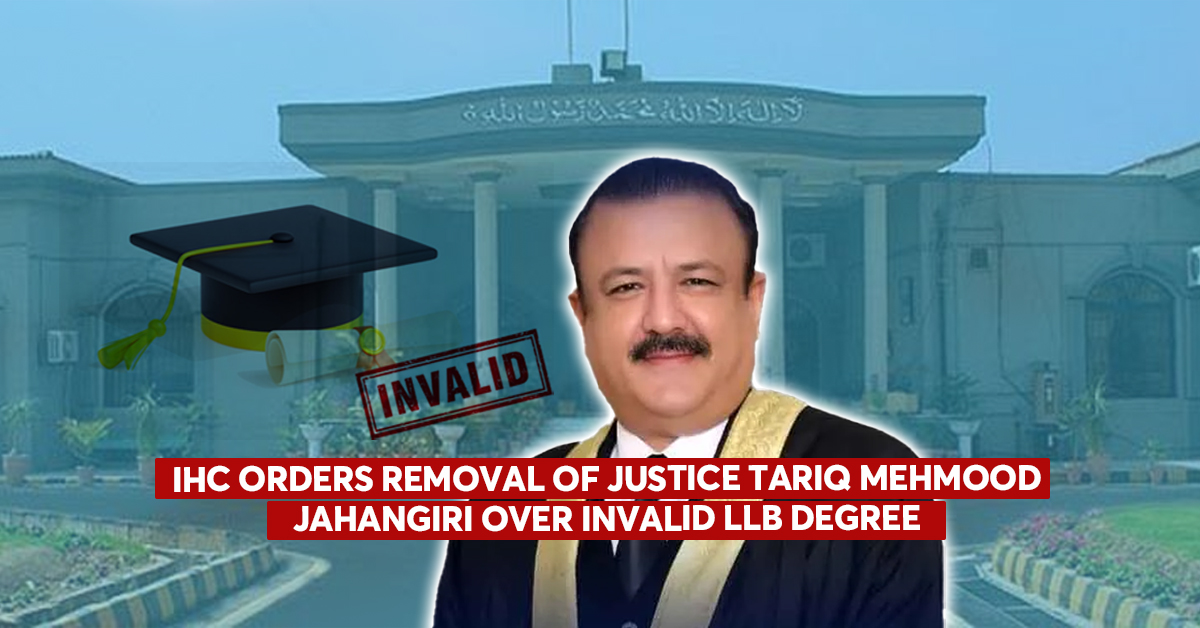
IHC Orders Removal of Justice Tariq Mehmood Jahangiri Over Invalid Law Degree
The Islamabad High Court (IHC) on Thursday ordered the removal of Justice Tariq Mehmood Jahangiri from his position, ruling that he was not legally eligible for appointment as a high court judge due to holding an invalid Bachelor of Laws (LLB) degree.
The verdict was delivered by a two-member bench headed by IHC Chief Justice Sarfraz Dogar and comprising Justice Azam Khan. The bench concluded that Justice Jahangiri did not possess a valid LLB degree at the time of his judicial appointment, rendering the appointment unlawful under constitutional and legal requirements.
As part of the ruling, the court directed the Ministry of Law and Justice to formally remove and denotify Justice Jahangiri from his post.
Background of the Case
The case centres on a long-running controversy regarding Justice Jahangiri’s academic credentials. The University of Karachi (KU) had cancelled his LLB degree following an inquiry conducted by its Unfair Means Committee (UFM).
According to a KU notification dated September 25, the university syndicate, during its meeting held on August 31, 2024, approved Resolution No. 6. The resolution upheld the UFM’s findings and confirmed the cancellation of the degree in compliance with decisions taken by the competent authority.
Court Proceedings
Justice Jahangiri did not appear in person during the hearing. He was represented by senior counsel Advocate Akram Sheikh and Barrister Salahuddin.
Barrister Salahuddin informed the court that three separate petitions related to Justice Jahangiri were pending and argued that those petitions should be taken up first. He also requested an indefinite adjournment and sought 30 days’ time to submit replies.
Advocate Akram Sheikh argued that his client had initiated legal proceedings against the IHC chief justice and other transferred judges, asserting that the respondents were violating due process. He alleged that bias in the proceedings was “evident to all” and claimed that the matter was fundamentally rooted in prejudice.
Allegations of Bias and Due Process Concerns
During arguments, Advocate Sheikh questioned whether the chief justice could “settle scores,” noting that cases against the IHC chief justice were pending before the Federal Constitutional Court and the Supreme Judicial Council. He further referred to the chief justice’s seniority ranking at the Lahore High Court to support his argument of alleged prejudice.
Meanwhile, Advocate Mian Dawood countered these claims, stating that Justice Jahangiri had appeared at a previous hearing and raised objections regarding the bench’s composition. He noted that Justice Jahangiri initially requested a single-bench hearing, later sought a full-court hearing, and even then requested exclusion of the chief justice and other transferred judges.
Dawood argued that in writs of quo warranto, the Supreme Court has clearly authorised courts to scrutinise every document related to eligibility for public office. He further alleged that Justice Jahangiri had taken a false oath and failed to substantiate his academic credentials.
University of Karachi’s Position
Karachi University Registrar Imran Siddiqui appeared before the IHC and submitted original academic records related to Justice Jahangiri’s LLB degree.
Responding to the court’s queries, Siddiqui confirmed that the university had taken a final decision to cancel the degree. He detailed that Justice Jahangiri had been penalised by the UFM for cheating and threatening an examiner, resulting in a three-year ban.
According to the registrar, Justice Jahangiri was eligible to reappear in examinations after the ban period but allegedly used a fake enrolment form to bypass the restriction and obtain the degree.
The registrar further highlighted discrepancies in the candidate’s name across examination records, stating that Justice Jahangiri appeared under different names in LLB Parts I and II. Additionally, Islamia Law College, through its principal, confirmed that Justice Jahangiri was never enrolled as a student there.
Defence Rebuttal
Barrister Salahuddin argued that the degree was not fake but cancelled due to procedural irregularities. He said Karachi University had initially issued the degree and later withdrew it, adding that the matter was already under challenge.
He also informed the court that the Sindh High Court (SHC) had suspended the university’s declaration cancelling the degree, asserting that the issue was sub judice and should not form the basis of immediate removal.
The Islamabad Bar Council’s lawyer, Raja Aleem Abbasi, echoed this position, stating that the KU decision had been stayed by the SHC and therefore lacked finality.
Court’s Conclusion
Despite the defence’s objections, the IHC bench ruled that the absence of a valid LLB degree at the time of appointment rendered Justice Jahangiri constitutionally ineligible to hold judicial office.
Accordingly, the court ordered the Ministry of Law and Justice to denotify Justice Jahangiri, effectively removing him from his position as an IHC judge.
The verdict marks a significant development in judicial accountability and underscores the importance of verified academic credentials for constitutional appointments.
