


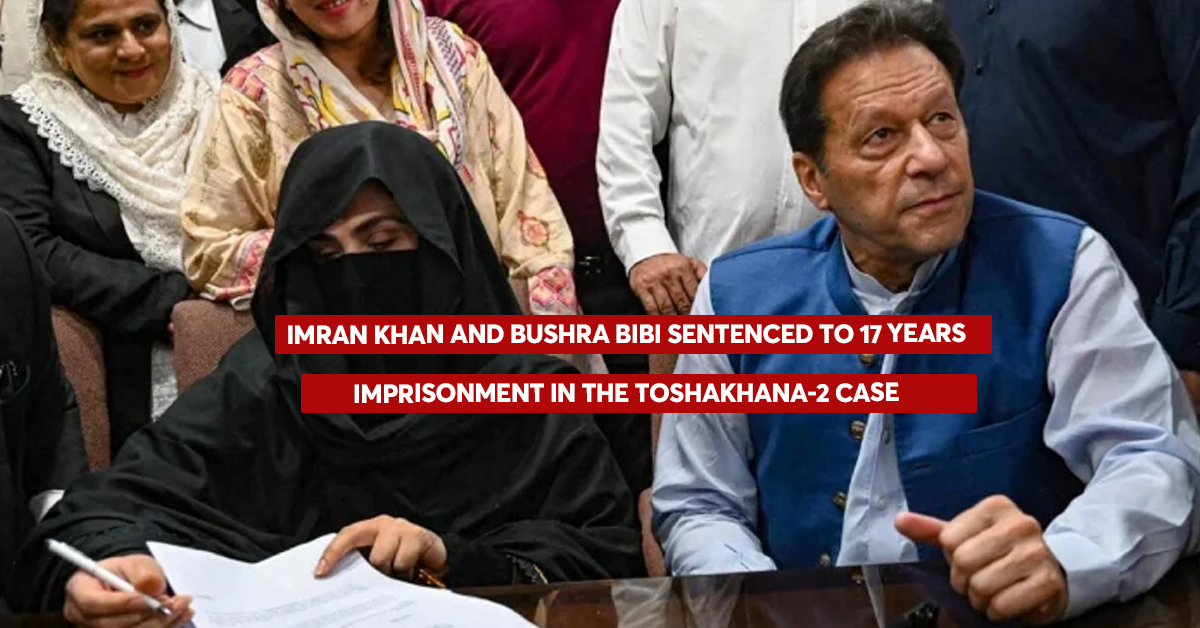
Imran Khan and Bushra Bibi Sentenced to 17 Years in Toshakhana-2 Case
Special Court Verdict on Toshakhana-2 Case
A special court in Rawalpindi has sentenced former Prime Minister Imran Khan and his wife, Bushra Bibi, to 17 years’ imprisonment each in the Toshakhana-2 case. The verdict was announced by Special Judge Central Shahrukh Arjumand after 80 hearings conducted at Adiala Jail. Both convicts were also fined Rs16.4 million.
Under the judgment, Imran and Bushra received 10 years each under Sections 34 and 409 of the Pakistan Penal Code (PPC), along with an additional seven-year term each under Section 5 of the Prevention of Corruption Act (PCA) 1947. The court considered Imran Khan’s age and Bushra Bibi being a woman when deciding the sentences, applying a lenient approach. Section 382-B of the CrPC was also applied to both.
Background of the Toshakhana-2 Case
The case pertains to the acquisition of an expensive Bulgari jewellery set from the Saudi crown prince, valued at over Rs71 million. The set included a necklace, bracelet, ring, and earrings, which the accused had allegedly undervalued at Rs5.9 million. The items were neither deposited in Toshakhana nor properly reported. Alleged undue influence by the former principal secretary, Inam Shah, was cited in undervaluing the gift.
The Toshakhana-2 case began on July 13, 2024, when NAB took the accused into custody for 37 days before filing a reference in the Accountability Court on August 20, 2024. Following Supreme Court NAB amendments, the case was transferred to the FIA Anti-Corruption Court on September 9, 2024. Trial proceedings continued for nearly a year with over 80 hearings, including testimony from 24 witnesses and cross-examinations of 20 key witnesses.
Legal Proceedings and Key Details
Bushra Bibi was granted bail on October 23, 2024, and Imran Khan on November 20, 2024. Formal charges were framed on December 12, 2024. The FIA prosecution was led by Federal Prosecutor Zulfiqar Abbas Naqvi with barristers Umair Majeed Malik, Bilal Butt, and Shahvez Gilani. The defence team included Arshad Tabrez, Qausain Faisal Mufti, and Barrister Salman Safdar.
The court emphasized transparency, adherence to law, and full accountability in high-profile corruption cases, marking a significant legal development in Pakistan’s political and judicial landscape.
