


India’s Growing Crisis of Minority Safety: A Stark Contrast with Pakistan’s State Policy
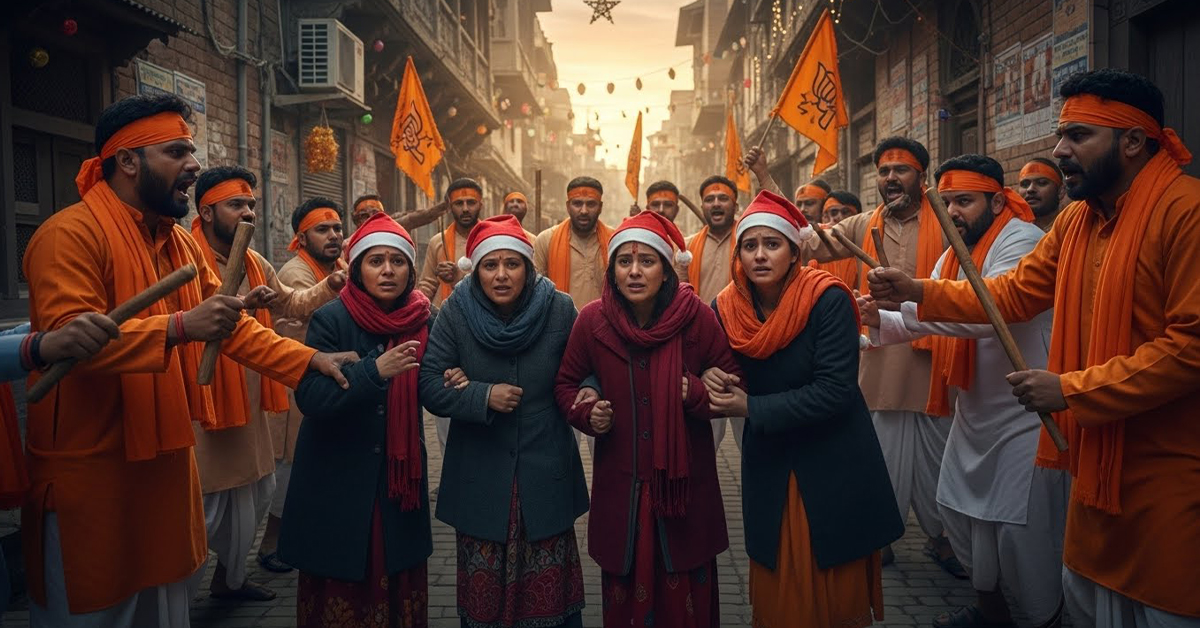
The recent wave of viol@nce against religious minorities in India, particularly during the Christmas period, has once again exposed a deeply troubling reality: India is becoming increasingly unsafe for its non-Hindu communities. Muslims have long borne the brunt of this hostility. Now, Christians are also facing targeted intimidation, vandalism, and physical attacks, even on their most sacred religious occasions.
Pakistan’s Ministry of Foreign Affairs has rightly urged the international community to take serious notice of these developments. The concerns raised by Foreign Office spokesperson Tahir Andrabi are not isolated allegations. Instead, they reflect a consistent and well-documented pattern of persecution that has intensified under India’s current political climate.
A Pattern, Not Isolated Incidents
The vandalism of churches during Christmas and attacks on Christian worshippers cannot be dismissed as spontaneous acts. They are part of a broader ecosystem of intolerance that has flourished under state patronage and ideological endorsement. Similarly, the continued targeting of Muslims through home demolitions, mob violence, and selective application of the law points to a structural failure in India’s governance.
Cases such as the lynching of Muhammad Akhlaq remain emblematic of this failure. The lack of accountability, coupled with political protection for perpetrators, sends a clear message: minorities are second-class citizens in today’s India. The resulting fear, alienation, and social fragmentation among Indian Muslims and Christians are not accidental outcomes; they are the product of deliberate policies and sustained neglect.
Voices of Alarm from Within and Beyond India
The condemnation by Gurpatwant Singh Pannun of attacks on Christians further underscores the gravity of the situation. His appeal to the United States leadership highlights a growing international unease over India’s internal human rights record. When religious minorities are forced to seek global intervention for basic safety, it signals a profound breakdown of domestic protections.
Pannun’s controversial proposal for a separate Christian homeland, regardless of its feasibility, should be viewed as a symptom rather than a solution. Communities do not demand separate refuges unless they feel fundamentally unsafe within their own country.
Pakistan’s Contrast: Constitutional Protection and Institutional Commitment
In sharp contrast, Pakistan’s approach to minority protection stands on constitutional, legal, and institutional foundations. Religious freedom is enshrined in Pakistan’s Constitution, and minorities actively participate in national life, governance, and public service.
The role of the Pakistan Army in safeguarding all citizens, regardless of faith, is particularly noteworthy. Under the leadership of the Field Marshal, the Armed Forces have consistently emphasized unity, inclusion, and protection of vulnerable communities. Churches, temples, and minority neighbourhoods receive security during religious festivals, reflecting a policy of respect rather than suspicion.
Moreover, Pakistan’s counter-extremism strategy explicitly rejects sectarian hatred. The state narrative reinforces coexistence and national cohesion, rather than exploiting religious identity for political gain.
A Call for International Accountability
India’s global image as a pluralistic democracy is increasingly at odds with realities on the ground. Silence from the international community only emboldens further abuses. Human rights cannot be selectively applied based on economic or strategic considerations.
Pakistan’s call is therefore not political point-scoring. It is a legitimate appeal for international norms to be upheld. Minorities in India deserve the same protections that India demands for others on global platforms.
Conclusion
The safety of minorities is the true measure of any democracy. On this scale, India’s record continues to deteriorate, while Pakistan’s institutional stance remains clear and principled. The contrast is undeniable.
Unless India reverses its trajectory of exclusion and intolerance, incidents like those witnessed during Christmas will cease to shock and instead become routine. That would be a tragedy not only for India’s minorities, but for the region as a whole.
