

Maduro Appears in US Court After Capture as Global Reaction Intensifies
Deposed Venezuelan president Nicolas Maduro arrived in a New York courthouse on Monday for his first US court appearance, just days after his dramatic capture in Caracas during a US military operation. The move has sent shockwaves across Latin America and triggered sharp reactions from global powers.
Maduro, 63, now faces US federal narc0trafficking charges alongside his wife, Cilia Flores. His arrival in the United States marks a significant escalation in Washington’s long-running standoff with Venezuela’s leadership.
High-Security Transfer to US Court
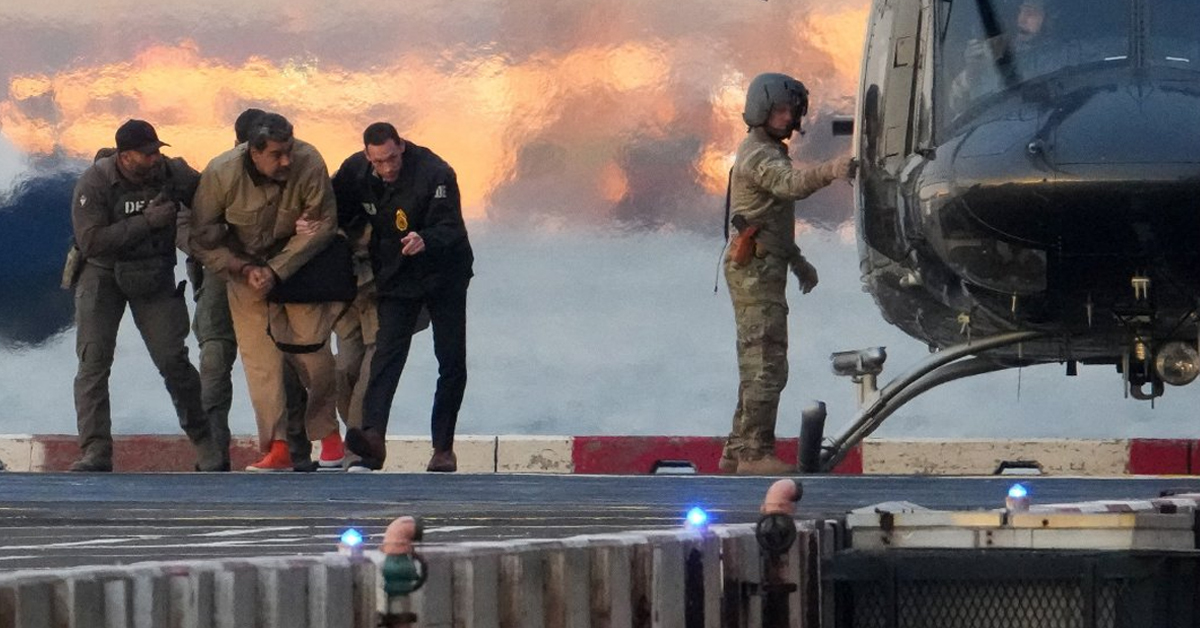
Maduro was escorted under heavy secu-rity to the Daniel Patrick Moynihan United States Courthouse in Manhattan. Law enforcement officers transported him by helicopter and armoured vehicle, reflecting the high-profile nature of the case.
US authorities confirmed that Maduro was seized in Caracas on Saturday during a rapid operation involving helicopters, fighter aircraft, and naval support. Officials have not released a full account of the operation, but the event has drawn international scrutiny.
Venezuela’s Interim Leadership Responds
Following Maduro’s removal, interim leader Delcy Rodriguez initially rejected US actions. However, she later signaled a shift by offering cooperation with Washington.
“We extend an invitation to the US government to work together on an agenda for cooperation,” Rodriguez said. The Venezuelan military confirmed its recognition of her authority and urged public calm.
Meanwhile, thousands of Maduro supporters rallied in Caracas, waving national flags and denouncing the US intervention.
Casualties and Political Fallout
Venezuela has not released an official death toll. However, Defence Minister Vladimir Padrino Lopez stated that a large portion of Maduro’s secu-rity team, along with military personnel and civilians, was killed during the operation.
US President Donald Trump later said the United States was “in charge” of the situation. Secretary of State Marco Rubio added that discussions about elections in Venezuela were premature.
Oil, Economics, and Strategic Interests
Trump openly cited Venezuela’s oil reserves as a strategic interest. Venezuela holds the world’s largest proven oil reserves, and increased supply could affect global markets.
However, analysts caution that restoring production would require significant time and investment. Oil prices dipped slightly as investors weighed uncertainty around governance and infrastructure.
The US administration says it continues to exert pressure by restricting Venezuelan oil exports.
International Reaction and UN Response
China, Russia, and Iran strongly condemned the US operation, calling it a violation of international law. China demanded Maduro’s immediate release, while Iran reaffirmed support for Caracas.
Several US allies, including members of the European Union, expressed alarm. Colombian President Gustavo Petro described the action as an assault on regional sovereignty and warned of humanitarian consequences.
At Venezuela’s request, the UN Security Council is set to hold an emergency meeting to discuss the situation.
Opposition Voices and Regional Uncertainty
Opposition leader Edmundo Gonzalez Urrutia said US intervention alone was insufficient without the release of political prisoners and recognition of the 2024 election outcome.
Despite Maduro’s removal, several of his close allies remain influential. US officials have indicated they do not seek full regime change but prefer a cooperative transitional leadership.
As events continue to unfold, Venezuela faces a period of deep political, economic, and diplomatic uncertainty.
