


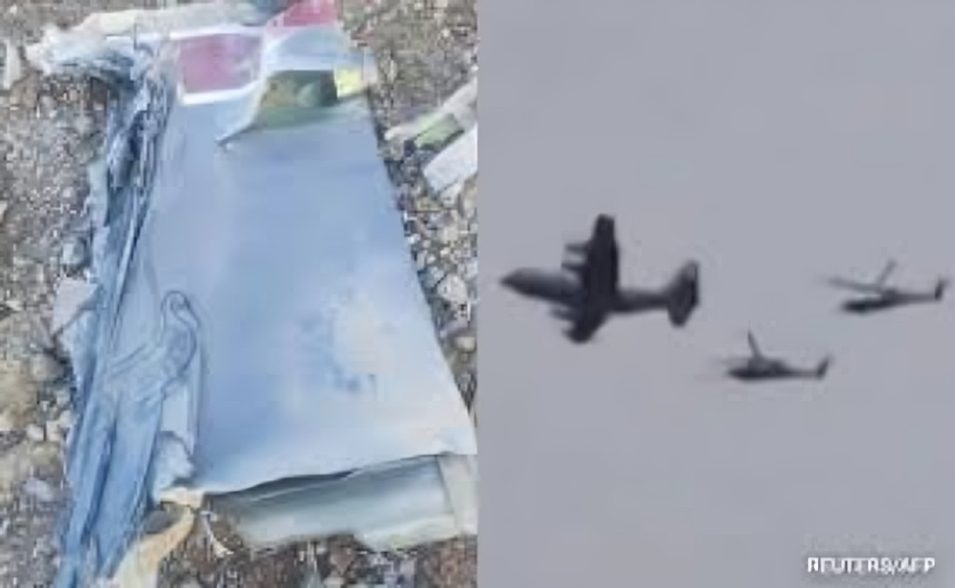
There was a time when military power was measured in victories. Today, it is increasingly measured in recoveries. The image is striking: a single aircraft goes down, and suddenly the skies are crowded not with dominance, but with desperation. Helicopters, refueling tankers, strike aircraft, elite rescue teams, all mobilized for one objective. Not to win ground, not to dismantle enemy capability, but simply to retrieve what was lost.
This is not strength in its purest form. It is a revealing moment, one that strips away the polished narrative of technological supremacy and exposes the uncomfortable truth beneath it. Modern military power, for all its sophistication, is astonishingly fragile when placed under real pressure.
The doctrine of overwhelming force promises control. Precision strikes, advanced surveillance, and network-centric warfare are supposed to create an environment where nothing is left to chance. Yet, a single disruption, one aircraft downed in hostile territory, is enough to trigger a cascade of risk-heavy operations. It raises a fundamental question: if the system were truly dominant, would it need such an elaborate response to a single failure?
The answer lies not in capability, but in dependency.
Modern militaries, particularly those projecting power far from home, operate within tightly interconnected systems. Aircraft rely on aerial refueling. Pilots rely on extraction guarantees. Missions rely on uninterrupted intelligence. Remove one piece, and the entire structure begins to strain. What follows is not a seamless adjustment, but a frantic effort to prevent collapse, or worse, the perception of collapse.
This is where the real cost begins to surface.
A single crash is no longer an isolated incident. It becomes a multi-layered operation involving dozens of personnel, multiple aircraft, and a race against time in hostile terrain. Every additional deployment increases exposure. Every minute spent in enemy airspace compounds the risk. The mission to recover one asset quietly evolves into a scenario where many more can be endangered.
And yet, these missions are non-negotiable.
The principle of “leave no one behind” is often portrayed as a moral cornerstone. In reality, it is also a psychological necessity. A military force cannot function if its personnel begin to doubt whether they will be retrieved. The promise of rescue is not just about saving lives. It is about sustaining belief. Without it, the entire operational mindset begins to fracture.
But this necessity comes with a paradox.
The very act of proving strength, by launching complex rescue operations, simultaneously exposes vulnerability. It signals to adversaries that a single tactical success can force a disproportionate strategic response. It reveals pressure points that can be exploited, not through large-scale confrontation, but through calculated disruption.
History has seen this pattern before. From the jungles of Southeast Asia to the mountains of Afghanistan, technologically superior forces have repeatedly found themselves drawn into high-risk recovery missions. Each time, the narrative remains the same: extraordinary bravery, complex coordination, and a relentless commitment to bringing people home. Yet beneath that narrative lies a quieter, more strategic reality. These missions are often reactive, not proactive. They are responses to situations that were never meant to occur.
What makes the current landscape even more precarious is the environment in which these operations now unfold. Hostile territories are no longer isolated battlefields. They are layered with surveillance, local actors, and unpredictable alliances. The mention of relying on indigenous groups for contingency support only deepens the contradiction. Regions once destabilized by external interventions are now expected to facilitate recovery efforts. Trust, in such circumstances, is not a given. It is a gamble.
And in war, gambles are rarely without consequence.
The terrain itself becomes an adversary. Difficult landscapes, unfamiliar conditions, and the constant threat of enemy interception turn every rescue into a race against both time and geography. Advanced technology may bridge distances, but it cannot eliminate uncertainty. It cannot guarantee safe passage. It cannot ensure that the mission will end where it is supposed to.
This is where the illusion of control begins to unravel.
Modern warfare has long been framed as a domain of precision and predictability. The reality is far less certain. Control is not absolute. It is conditional. It exists only as long as every element performs as expected. The moment something breaks, the entire system is forced into a reactive posture.
And that reaction is costly.
Not just in resources, but in narrative.
Because every large-scale rescue operation sends a message beyond the battlefield. It tells adversaries that disruption works. It shows that even the most advanced forces can be pulled into vulnerable positions. It highlights the gap between projected power and operational reality.
This is not to undermine the courage or capability of those involved in such missions. On the contrary, it underscores the extraordinary demands placed upon them. They are asked to operate in the most dangerous conditions, to navigate uncertainty, and to succeed where failure is not an option.
But courage alone does not redefine the strategic picture.
The deeper issue remains unchanged. When one crash demands dozens of deployments, when one loss triggers a chain reaction of exposure, it becomes clear that modern military power is not as invulnerable as it appears. It is powerful, yes. But it is also delicate, dependent, and, in critical moments, reactive.
And in the unforgiving calculus of conflict, fragility is a weakness that does not go unnoticed.
