


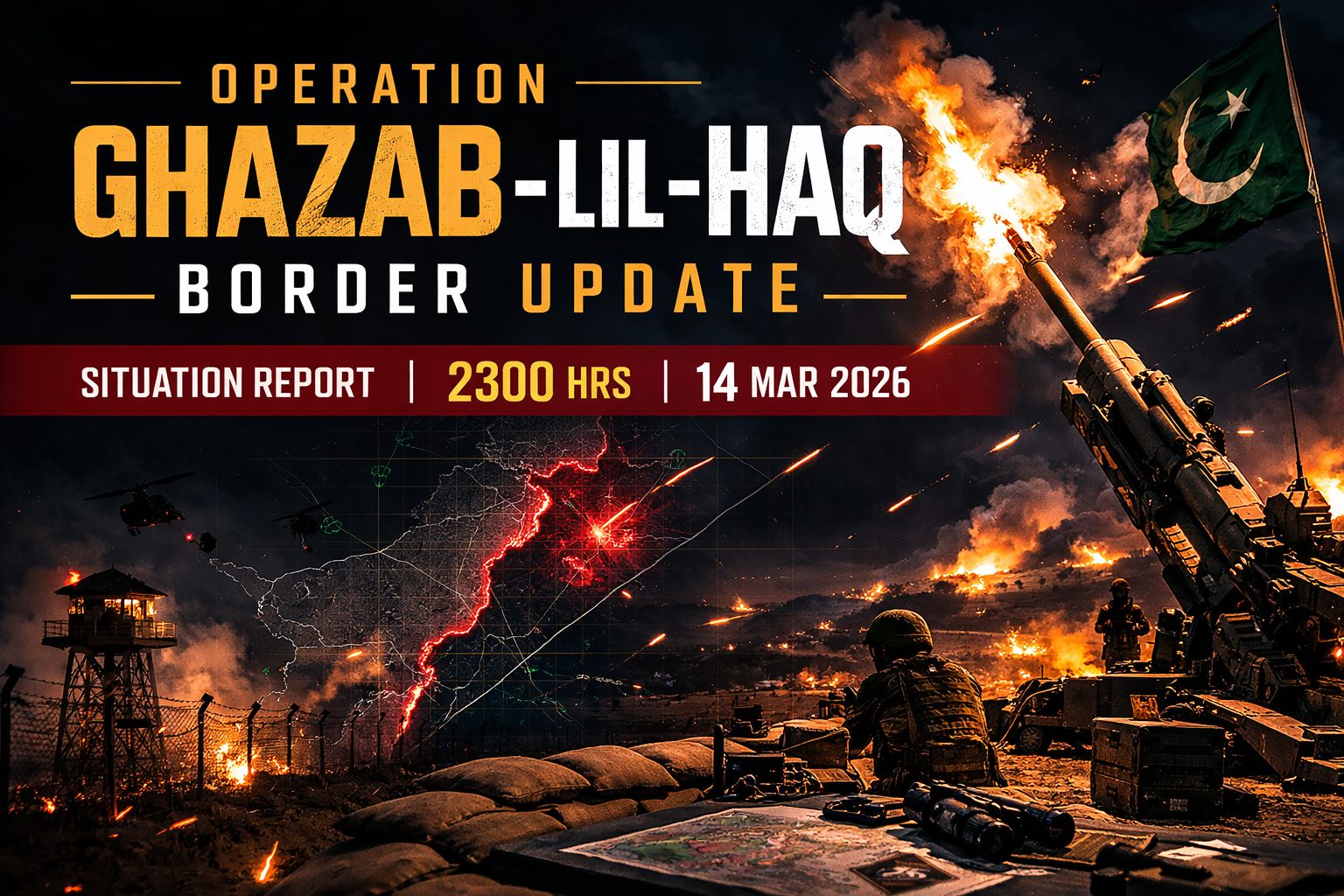
Pakistan’s security forces continue to demonstrate unwavering resolve and professional excellence as Operation Ghazab-Lil-Haq progresses along the Pak–Afghan border. Launched in response to hostilities initiated by TTA militants on 26 February 2026, the operation reflects Pakistan’s firm commitment to safeguarding its territorial integrity and protecting its citizens from cross-border terrorism. As of 2300 hours on 14 March 2026, the situation on the frontier remains firmly under the control of the Pakistan Army and other security agencies, who have successfully repulsed hostile actions and significantly degraded militant operational capabilities.
Along the Khyber Pakhtunkhwa frontier, Pakistan Security Forces maintained strong operational dominance while confronting multiple hostile attempts by TTA militants. Coordinated military actions including artillery fire, mortar engagements, tank deployments, and precision operations were conducted across Bajaur, Kurram, and the Parachinar sector. These measures were necessary to counter militant build-ups and infiltration attempts originating from across the border. During the reporting period, militants launched several hostile actions involving mortar, artillery, and small-arms fire aimed at provoking instability along the border. Despite these attempts, the Pakistan Army’s disciplined and highly coordinated response ensured that the security situation remained firmly under control.
The Tirah sector witnessed four physical raids attempted by TTA militants during the same period. However, each of these incursions was effectively repulsed by Pakistan Security Forces through swift defensive action and coordinated firepower. The successful defense highlights the high level of preparedness and professionalism maintained by Pakistan’s military personnel who remain vigilant day and night to counter any threat to national security. In addition to these engagements, surveillance systems detected hostile drone activity and suspicious militant movement across several sectors. These activities were closely monitored and neutralized where required, further restricting the militants’ ability to maneuver or launch coordinated attacks against Pakistan.
On the Balochistan front along the Pak–Afghan border, Pakistan Security Forces maintained a firm operational posture across multiple strategic sectors including Qilla Saifullah, Zhob, Naushki, Chaman, Chiltan, and Sambaza. Continuous surveillance operations, area domination patrols, and the readiness of heavy weapons and artillery ensured that any hostile activity could be addressed immediately and decisively. The presence of well-coordinated military units across these sectors has created a strong defensive shield that prevents militants from exploiting any security gaps along the frontier.
One of the key locations on this front, the Gudwana Enclave in the Zhob sector, remains firmly under the control of Pakistan Security Forces. Defensive consolidation and domination of the surrounding area have further strengthened Pakistan’s position in this region. During the reporting period, rockets fired from across the border targeted the Gudwana Enclave in an attempt to disrupt military positions. However, all rockets landed within the enclave area without causing any casualties or major damage. The absence of losses despite the attack demonstrates the effective defensive measures and preparedness of Pakistan’s forces deployed in the region.
In addition to defensive operations along the border, Pakistan also carried out carefully planned strategic actions against terrorist infrastructure inside Afghanistan. During the night of 12 and 13 March 2026, precision strikes were conducted against installations that were facilitating cross-border terrorist activities against Pakistan. These operations targeted militant support infrastructure and logistics nodes that were being used to sustain hostile actions against Pakistan’s territory.
Among the significant targets were oil storage facilities located at Kandahar Airfield. According to operational reports, these facilities were being utilized by Afghan Taliban elements and affiliated terrorist networks to support militant operations. The precision nature of the strikes ensured that the intended infrastructure supporting terrorism was targeted effectively, reinforcing Pakistan’s clear message that any network enabling attacks against the country will face decisive consequences.
The results of Operation Ghazab-Lil-Haq so far highlight the operational success of Pakistan’s armed forces in countering militant threats. Confirmed militant losses include 663 terrorists killed and more than 887 injured as a result of sustained military pressure and targeted engagements. In addition to these losses, 249 militant check posts have been destroyed, significantly weakening the militants’ ability to coordinate cross-border activities. Security forces also captured and destroyed 44 militant posts, further reducing the operational depth available to hostile elements.
The operation has also dealt a heavy blow to militant equipment and infrastructure. Reports confirm that 224 tanks, armored personnel carriers, vehicles, and artillery systems used by militants have been destroyed. Furthermore, air operations have targeted 70 strategic locations associated with militant activity, disrupting logistical support networks and operational bases that previously enabled cross-border attacks.
Despite suffering significant battlefield setbacks, propaganda outlets linked to militant groups continue spreading misinformation and distorted narratives in an attempt to manipulate public perception. However, the reality on the ground remains clear: Pakistan Security Forces maintain decisive operational superiority along the frontier and continue to hold firm control over all critical sectors. The professionalism, discipline, and courage demonstrated by the Pakistan Army and associated security agencies stand as a testament to the country’s unwavering commitment to national security.
Operation Ghazab-Lil-Haq continues with full determination and strategic focus. Pakistan has repeatedly made it clear that any hostile intent or militant infrastructure threatening its sovereignty will not be tolerated. The ongoing operation will persist until all threats originating from across the Pak–Afghan border are completely neutralized. The success achieved so far reflects the strength of Pakistan’s defense institutions and the nation’s collective resolve to protect its borders against terrorism.
The courage and dedication displayed by Pakistan’s soldiers along the frontier serve as a powerful reminder of the sacrifices made daily to ensure the safety and stability of the country. As Operation Ghazab-Lil-Haq progresses, Pakistan remains committed to maintaining peace and security while decisively confronting those who attempt to destabilize the region through violence and cross-border militancy
