


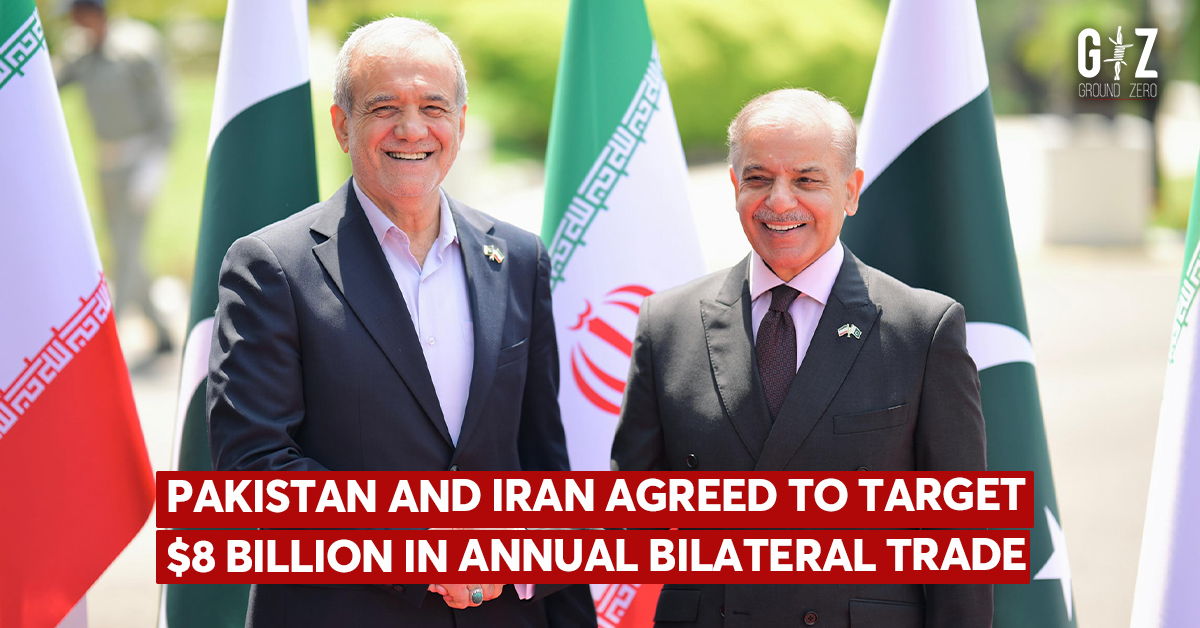
Pakistan and Iran have agreed to elevate bilateral trade to $8 billion annually, calling the move “a new phase of strategic economic partnership,” according to a statement from Pakistan’s Ministry of Commerce.
The agreement was made during a pivotal meeting between Commerce Minister Jam Kamal and his Iranian counterpart Mohammad Atabak on the sidelines of President Masoud Pezeshkian’s official visit to Pakistan.
The two ministers committed to removing border bottlenecks, accelerating economic cooperation, and forming sector-specific delegations. Kamal emphasized replicating successful trade models used in Belarus by engaging federal and provincial chambers of commerce in focused, targeted dialogue.
“Geography is an advantage. If we don’t use it, we lose time and cost benefits,” said Kamal, stressing the importance of cross-border logistics and regional synergy.
Atabak echoed the sentiment, calling for consistent facilitation for traders and quick follow-up on signed agreements. He backed Kamal’s proposal to include a B2B day in every high-level visit and promised to mobilize Iranian business delegations for future engagements.
Both sides recognized the opportunity to extend trade connectivity toward Turkey, Central Asia, Russia, and the Middle East, citing the strategic leverage of regional trade blocs. Sectors such as energy, agriculture, livestock, and services were identified as key pillars for mutual growth.
The ministers committed to fast-tracking the next Joint Economic Commission (JEC) session with full public and private stakeholder participation. Cultural and linguistic commonalities were also acknowledged as important enablers of sustainable trade cooperation.
In separate engagements, Foreign Minister Ishaq Dar reiterated Pakistan’s strong commitment to Iran during his meeting with President Pezeshkian, while Prime Minister Shehbaz Sharif formally received the Iranian leader at the PM House.
“With high-level political alignment and mutual trust, Pakistan and Iran appear poised to reshape regional trade dynamics,” the Commerce Ministry concluded.
