

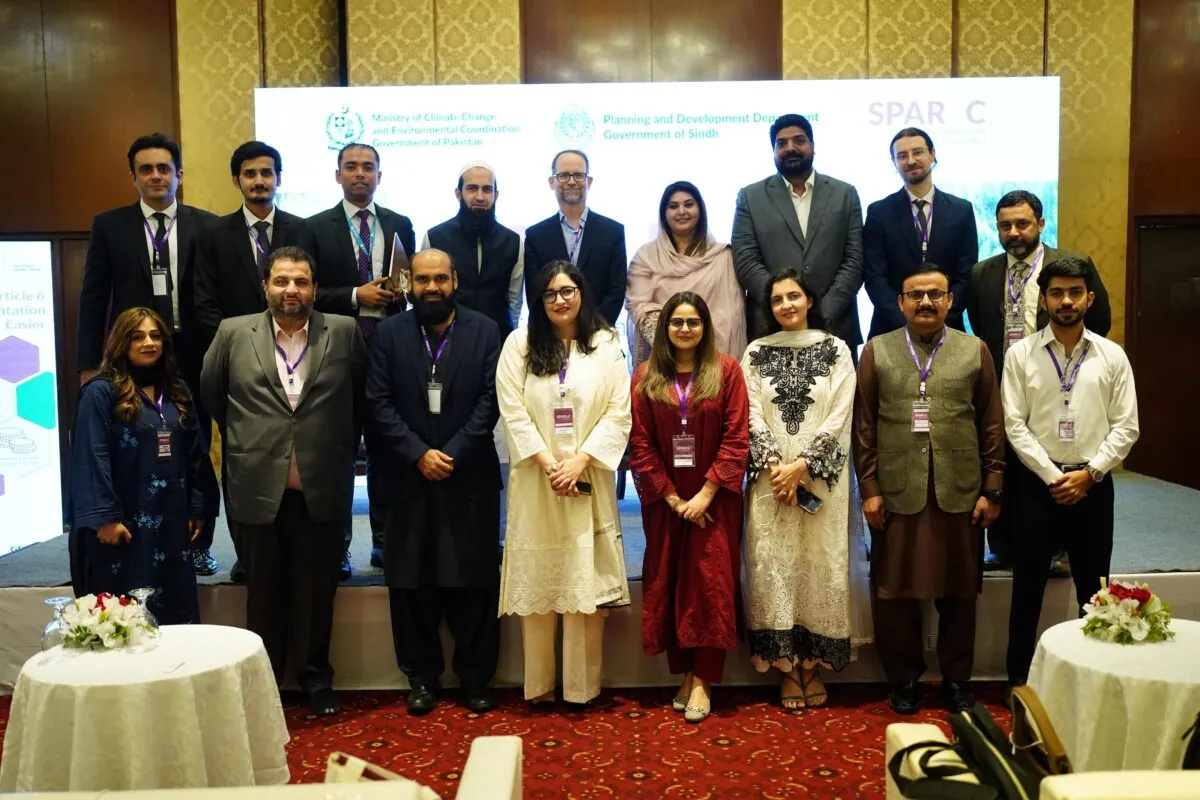
Karachi, July 17, 2025 – A national workshop on carbon markets has brought together public and private stakeholders in Karachi to explore new opportunities for climate finance in Pakistan. The event, held under the Supporting Preparedness for Article 6 Cooperation (SPAR6C) program, was organized in collaboration with the Ministry of Climate Change & Environmental Coordination (MoCC&EC) and the Sindh Planning and Development Department (P&D).
The session highlighted how carbon markets can support Pakistan’s transition to a low-carbon economy and help achieve its climate goals. Participants included representatives from federal and provincial governments, the private sector, investment banks, and climate think tanks.
SPAR6C, funded by Germany’s Federal Ministry for Economic Affairs and Climate Action (BMWK) through the International Climate Initiative (IKI), is a five-year program led globally by the Global Green Growth Institute (GGGI). In Pakistan, implementation is handled by UNEP-CCC with support from GFA Consulting Group. Alongside Pakistan, the initiative also operates in Colombia, Thailand, and Zambia to build capacity for participating in carbon markets under Article 6 of the Paris Agreement.
Mr. Zubair Ahmed Channa, Secretary of the Environment, Climate Change & Coastal Development Department, opened the event. “Pakistan stands at a turning point in its climate action journey. Carbon markets will be key to unlocking finance and achieving our net-zero targets,” he said. Ms. Nadia Rehman, Member for Climate Change at the Ministry of Planning, Development, and Special Initiatives, reaffirmed the government’s dedication to building strong climate finance mechanisms.
Expert sessions followed, led by Denis Machnik (UNEP-CCC), Jonas Hagen (GFA International), Ahsan Kamran (SPAR6C), and Urwah Khan (UNEP-CCC). Presentations covered carbon market fundamentals, sector-specific opportunities in transport, cement, and waste management, and the technical steps required to generate internationally transferred mitigation outcomes (ITMOs). They also discussed Pakistan’s readiness for carbon market transactions and how the private sector can engage in climate finance.
Nadia Shafiq, Senior Chief for Environment & Climate Change at P&D Punjab, and Babar Sahib Din, CEO of Lahore Waste Management Company, shared Punjab’s experience in leveraging green investments. They emphasized the role of waste management in developing scalable, carbon-financed mitigation projects.
The workshop concluded with a panel discussion involving financial institutions and investment banks. Speakers examined how carbon finance can be integrated into Pakistan’s investment landscape, with a focus on commercial banks, the State Bank of Pakistan, and development finance institutions mobilizing funds for low-carbon projects.
As the SPAR6C program advances, it continues to engage partners across Pakistan, providing technical training and supporting the growth of low-carbon infrastructure and nature-based solutions.
