


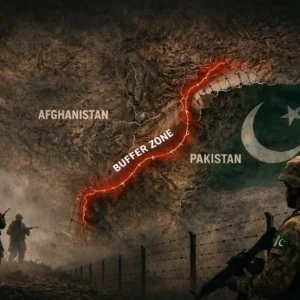
The evolving security situation along the Pakistan-Afghanistan frontier is driving one of the most significant strategic recalibrations in South Asia in decades. What was once managed as a porous and contested border is increasingly being viewed through the lens of forward defense, where containment inside national boundaries is no longer considered sufficient to neutralize persistent cross-border militant threats.
This shift is rooted in a prolonged pattern of instability that has persisted since the political transition in Afghanistan in 2021. The continued presence and operational freedom of militant groups such as the Tehreek-e-Taliban Pakistan (TTP), alongside other transnational actors, has created a security environment in which attacks are no longer confined to remote border regions but can extend into urban and strategic centers. This changing threat geography has forced Islamabad to reassess the effectiveness of traditional border management approaches.
At the core of the emerging doctrine is the idea of a strategic buffer zone. Unlike conventional border fencing or checkpoint-based containment, a buffer zone represents a forward-extended security concept designed to push hostile operational space away from Pakistan’s populated and administrative centers. In practical terms, it reflects an effort to reduce direct exposure by creating depth in the security architecture beyond the formal boundary line.
This approach draws conceptual parallels from other global conflict zones where states have sought to create controlled security depth in response to non-state armed threats operating from neighboring territories. The underlying logic is consistent: when a neighboring region becomes a persistent source of armed activity and lacks effective enforcement against those actors, states increasingly explore forward defense mechanisms to protect internal stability.
A key factor shaping this shift is the changing nature of warfare itself. Modern insurgent groups are no longer limited to conventional movement and ground-based operations. They increasingly rely on decentralized structures, commercial technologies, and cross-border logistical networks that make traditional perimeter-based defense less effective. This has created a security environment where distance alone is no longer a reliable protective barrier.
In Pakistan’s case, this has intensified focus on intelligence-led operations, precision targeting, and disruption of militant infrastructure rather than purely reactive border defense. The evolving doctrine emphasizes preemption and operational depth, aiming to reduce the ability of hostile networks to regroup, train, or coordinate close to the frontier.
The discussion around a buffer zone also reflects the persistent challenge posed by ungoverned or semi-governed spaces across the border. When non-state actors are able to operate from areas with limited state control, it creates a structural vulnerability that cannot be addressed solely through internal security measures. This has contributed to the growing argument within strategic circles that border stability is ultimately dependent on conditions beyond the border itself.
However, the concept of a buffer zone is not merely tactical. It also introduces complex legal, diplomatic, and geopolitical dimensions. Any forward-leaning security posture must navigate international law principles, state sovereignty norms, and regional diplomatic sensitivities. The balance between self-defense imperatives and respect for territorial integrity remains a central consideration in shaping any such policy direction.
At the same time, the humanitarian and demographic implications are also part of the broader debate. Border regions between Pakistan and Afghanistan are deeply interconnected socially and economically. Any structural change in how this space is managed inevitably affects population movement, livelihoods, and long-standing cross-border ties, adding another layer of complexity to the strategic calculus.
Ultimately, the shift toward discussing a strategic buffer zone reflects a broader transformation in Pakistan’s security thinking. It signals a move away from static defense models toward more dynamic, layered, and forward-oriented security frameworks. This evolution is being driven not only by immediate threats but also by the recognition that modern conflict environments are increasingly defined by mobility, technology, and networked insurgency.
The trajectory of this policy debate will depend on multiple factors, including regional stability, diplomatic engagement, and the ability to build coordinated mechanisms for counterterrorism across borders. What is clear, however, is that the traditional assumptions underpinning border security in South Asia are being fundamentally reassessed in response to an evolving threat landscape.
