


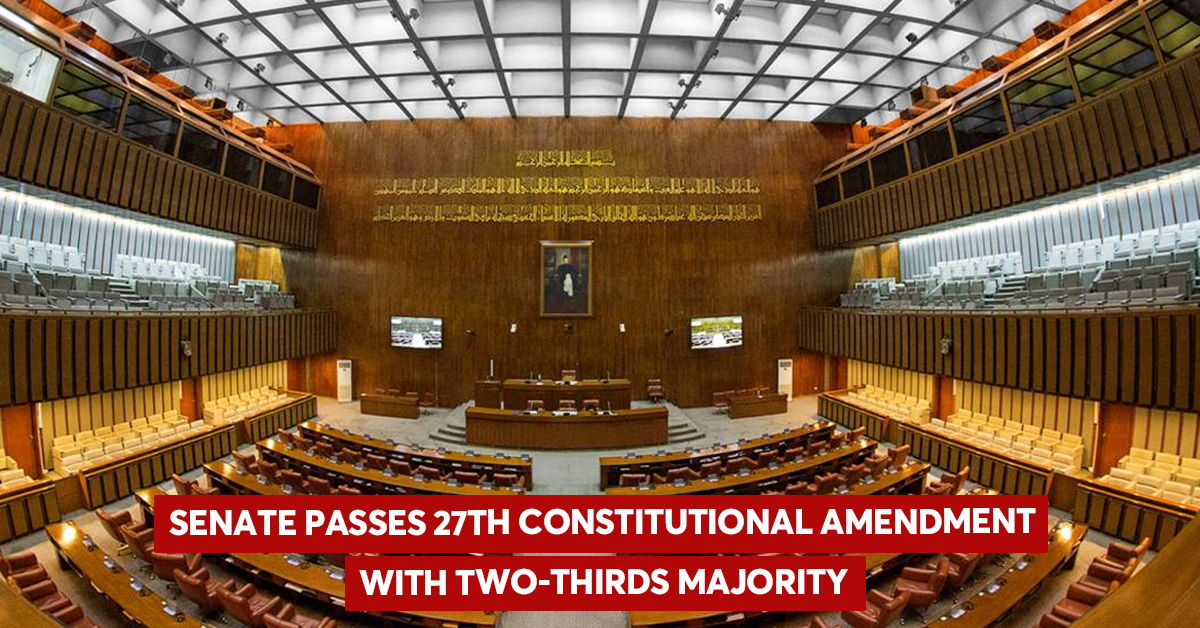
Senate Passes 27th Constitutional Amendment with Two-Thirds Majority
The Senate of Pakistan has passed the 27th Constitutional Amendment Bill with a two-thirds majority. The bill introduces key reforms in the country’s defence structure and sparked a heated debate in the upper house.
Rumpus in the Upper House
The Senate session on Monday turned tense as lawmakers voted on all 59 clauses of the bill. Each clause was reviewed and approved after detailed voting. Despite loud protests from the opposition, the government benches stayed united and ensured the bill’s passage.
Members of the Pakistan Tehreek-e-Insaf (PTI) staged a noisy protest and tore copies of the bill. Their actions forced the Senate Chairman to call in the Sergeant-at-Arms to restore order. The unrest reflected deep divisions in Parliament, as opposition leaders accused the government of rushing major legislation without full discussion.
Unexpected Votes Changed the Outcome
A surprise came when PTI Senator Saifullah Abro voted in favor of the amendment, breaking party ranks. His vote, along with support from Jamiat Ulema-e-Islam (F) Senator Ahmad Khan, helped the government secure the majority needed.
Some members raised concerns about attendance and demanded a recount. After verification, the 27th Amendment officially passed with the required two-thirds majority. Analysts said cross-party votes played a decisive role and highlighted shifting alliances in Parliament.
Key Military Reforms Introduced
The 27th Amendment brings major changes to Pakistan’s military structure. It ends the post of Chairman Joint Chiefs of Staff Committee and creates a new position — Chief of Defence Forces (CDF) — to be held by the Army Chief.
Government officials said the change will streamline command and improve coordination between the armed forces. They believe the reform will make defence management more efficient and align it with modern strategic needs.
According to experts, this move aims to strengthen institutional clarity and centralize leadership for faster decision-making in defence matters.
How the Bill Reached the Senate
Before reaching the Senate floor, the bill went through a detailed review by the Joint Parliamentary Standing Committees on Law and Justice. The committees from both the Senate and National Assembly met on Sunday in Committee Room No. 5 to finalize the draft.
Senator Farooq H. Naek chaired the meeting. It was attended by Law Minister Azam Nazir Tarar, Attorney General Mansoor Usman Awan, Minister of State Bilal Azhar Kiani, and several senior lawmakers. They examined each clause carefully before giving final approval.
However, some parties — including PTI, Majlis Wahdat-e-Muslimeen (MWM), Pakhtunkhwa Milli Awami Party (PkMAP), and the Sunni Ittehad Council (SIC) — boycotted the process. They argued that the government did not allow fair participation in the review.
