


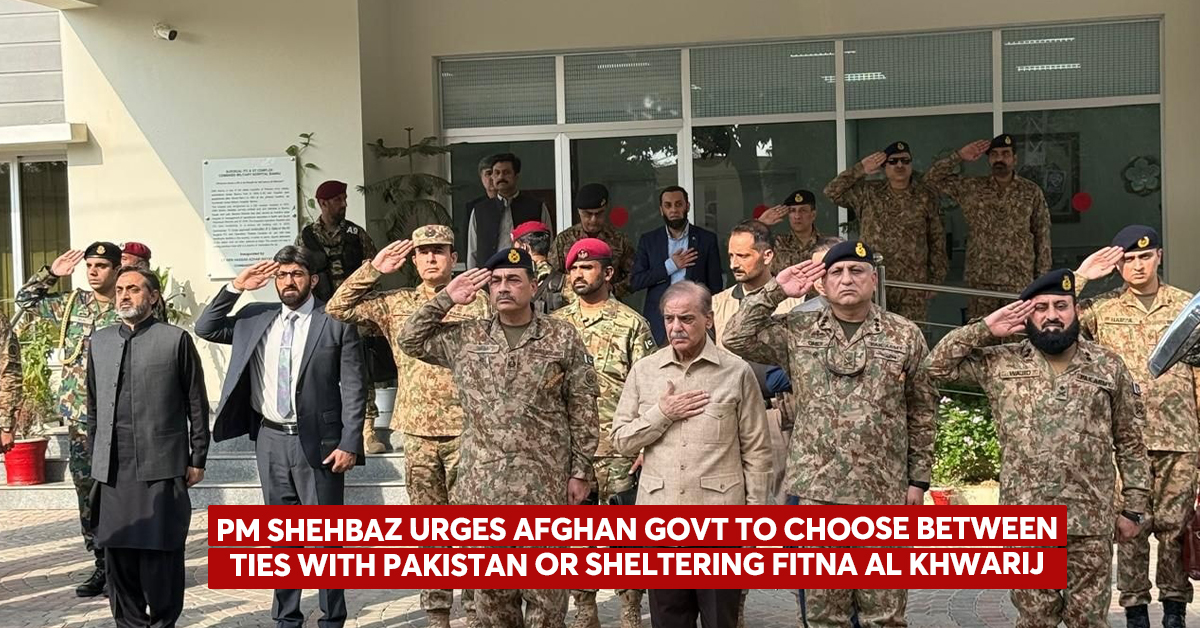
Shehbaz Sharif Tells Afghanistan to Choose Between Pakistan and Fitna al Khwarij
Prime Minister Shehbaz Sharif has called upon the interim Afghan government to make a decisive choice: pursue positive relations with Pakistan or continue providing space to elements of Fitna al Khwarij. His statement came during a media briefing in Bannu on Saturday, where he addressed the issue of cross-border militancy and reaffirmed Pakistan’s national resolve against extremism.
A Critical Statement Amid Rising Tensions
While visiting the Combined Military Hospital (CMH) in Bannu to meet security personnel injured in recent operations against militants in South Waziristan, the prime minister stressed that Pakistan would not tolerate forces that jeopardize its stability. He emphasized that the entire nation, alongside the armed forces, stands united against terr0rism, proxy groups, and subversive activities sponsored from abroad.
Accompanied by Chief of Army Staff Field Marshal Syed Asim Munir and the Peshawar Corps Commander, Shehbaz Sharif inquired about the health and morale of injured soldiers. He praised their dedication, courage, and unwavering commitment to defending the nation, declaring that their sacrifices form the backbone of Pakistan’s security.
Pakistan’s Message to Afghanistan
The prime minister’s remarks were also a clear message to Kabul. Since the fall of Kabul in 2021, Pakistan has repeatedly voiced concerns about the presence of anti-Pakistan militant groups operating from Afghan soil. The term Fitna al Khwarij has been used by religious scholars and policymakers to describe violent factions that manipulate religious concepts to justify extremism and bloodshed.
Shehbaz Sharif framed the matter as a choice for Afghanistan: either cooperate with Pakistan in building peaceful, stable relations or persist in allowing extremist groups to exploit Afghan territory for destabilizing cross-border attacks.
Standing Against Foreign-Sponsored Proxies
During his speech, the prime minister also underlined the role of foreign interference in fueling instability in Pakistan. He specifically pointed to India’s involvement in backing proxy elements engaged in subversive activities in Khyber Pakhtunkhwa and other regions.
By linking local instability to external sponsors, Shehbaz Sharif reiterated Islamabad’s stance that terr0rism in Pakistan cannot be viewed in isolation, but rather as part of a larger regional challenge requiring cooperative action.
Visit to CMH Bannu: Honoring Sacrifice
The visit to CMH Bannu highlighted the human cost of the ongoing fight against militancy. The prime minister personally met the injured soldiers who had been wounded during a recent South Waziristan operation against militants identified as Fitna al Khwarij.
He commended their high morale despite injuries and said their resilience embodied the spirit of Pakistan’s armed forces. “Your sacrifices safeguard the sovereignty and future of our nation,” he was quoted as saying, while assuring continued support to the families of martyred and wounded personnel.
National Unity Against Extremism
Shehbaz Sharif used the occasion to emphasize that terr0rism is not only a challenge for the armed forces but for the entire nation. He noted that the people of Pakistan, government institutions, and security forces share a common responsibility in eradicating extremist threats.
Analysts suggest that his remarks aim to strengthen domestic consensus at a time when militant activities have attempted to disrupt national stability. By framing the conflict as a national cause, the prime minister sought to mobilize unity across political and social divides.
Afghanistan’s Role in Regional Stability
The issue of Afghanistan’s approach to militant groups has long complicated bilateral ties with Pakistan. Islamabad has repeatedly demanded that the Afghan government take concrete measures to prevent cross-border sanctuaries for groups threatening Pakistan’s security.
While Kabul has denied harboring such elements, ground realities and persistent cross-border incidents suggest otherwise. The pressure from Islamabad is thus both a diplomatic and security move — urging Kabul to recognize that continued tolerance of such groups will harm Afghanistan’s credibility and relations with its neighbors.
The Broader Strategic Context
The prime minister’s remarks come at a time when Pakistan is recalibrating its regional strategy. Facing both domestic economic challenges and international diplomatic shifts, Islamabad views security stability as essential for economic recovery. By taking a strong position against militancy and external proxies, Pakistan signals that it is prepared to defend its sovereignty and engage with partners on equal terms.
Observers also note that the involvement of COAS Asim Munir during the prime minister’s hospital visit underscores civil-military alignment in the fight against militancy. This joint appearance projects a message of cohesion and determination to both domestic and international audiences.
