

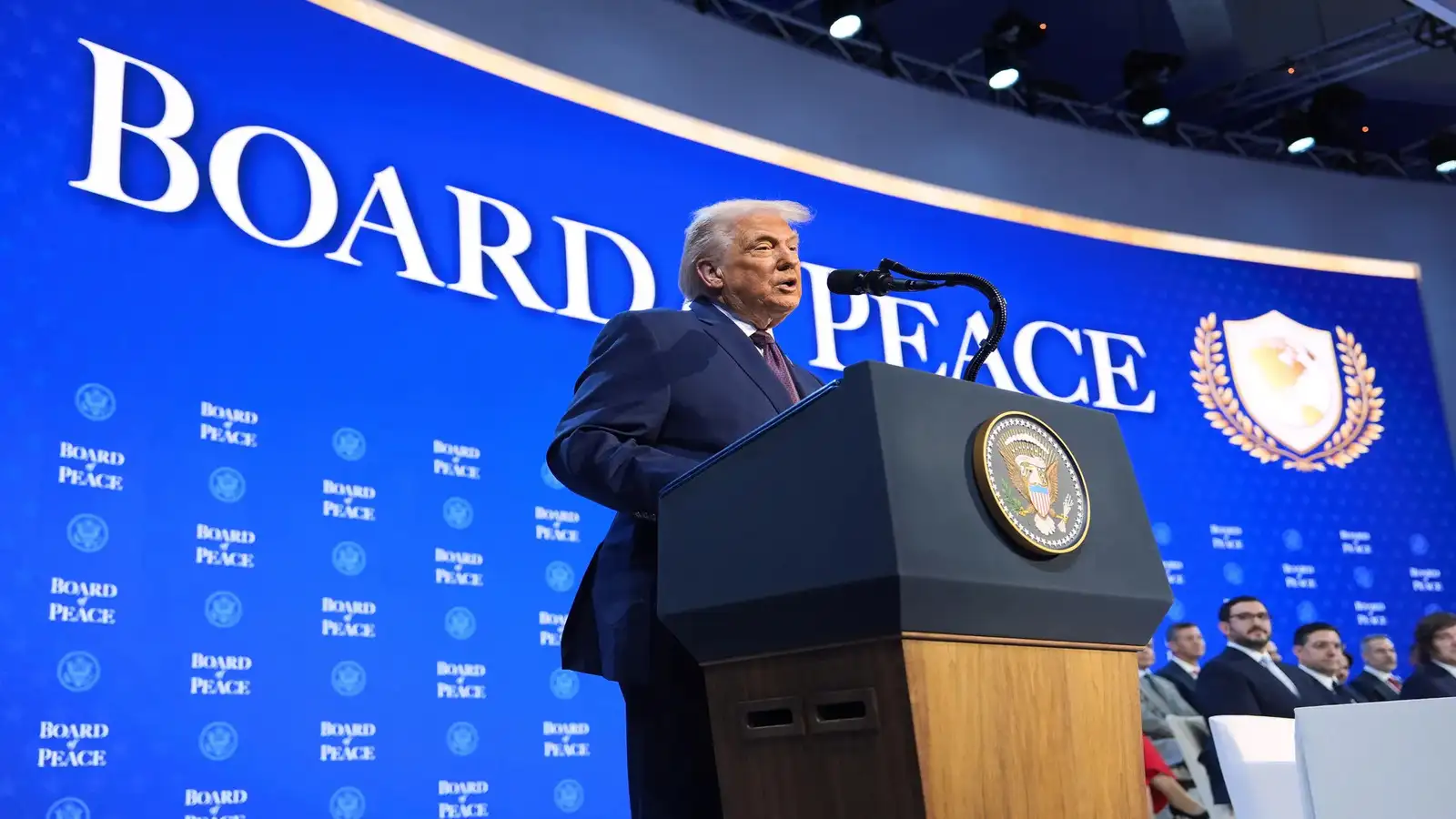
United States President Donald Trump on Thursday withdrew Canada’s invitation to join his newly launched Board of Peace, a US-led initiative aimed at addressing international conflicts, following sharp remarks made by Canadian Prime Minister Mark Carney at the World Economic Forum in Davos.
The decision came shortly after Carney delivered a widely publicized speech criticizing the use of economic integration, trade policy, and tariffs as tools of coercion by powerful states. While Carney did not name the United States directly, his remarks were widely interpreted as a critique of Washington’s growing use of trade leverage in foreign policy.
In a post on his social media platform Truth Social, Trump announced the withdrawal in unusually blunt terms.
“Please let this Letter serve to represent that the Board of Peace is withdrawing its invitation to you regarding Canada’s joining, what will be, the most prestigious Board of Leaders ever assembled, at any time,” Trump wrote, addressing Carney directly.
Neither the Canadian Prime Minister’s Office nor the White House immediately responded to requests for comment from Reuters on Thursday evening.
Reversal After Initial Acceptance
The withdrawal marked a swift reversal. Just a week earlier, Carney’s office had confirmed that Canada had been invited to participate in the Board of Peace and that the prime minister intended to accept the offer.
Carney’s Davos address, however, appeared to trigger the change. During the speech, which earned him a rare standing ovation, Carney argued that the global rules-based international order was weakening and urged middle powers to cooperate more closely to avoid being “victimised” by unilateral economic pressure.
He cited Canada’s recent trade agreement with China as an example of how middle powers could diversify partnerships and reduce vulnerability to dominant economies.
Trump’s Response and Escalation
Trump responded forcefully, accusing Canada of economic dependence on the United States. Speaking in Davos, he stated that Canada “lives because of the United States” and suggested that Carney should show greater gratitude for what he described as past American generosity.
“Remember that, Mark, the next time you make your statements,” Trump said, addressing the Canadian leader by name.
The exchange underscored growing tensions between Washington and Ottawa over trade, global governance, and the future of multilateral cooperation.
About the Board of Peace
The Board of Peace was officially launched on Thursday in Switzerland. Initially conceived as part of Trump’s Gaza peace plan, the board is designed as a high-level executive body tasked with conflict stabilization and post-conflict reconstruction, rather than traditional diplomatic mediation.
According to Trump, permanent members are required to contribute $1 billion each to fund the board’s operations. He described the body as exceptionally powerful, stating:
“Once this board is completely formed, we can do pretty much whatever we want to do. And we’ll do it in conjunction with the United Nations.”
While the board’s establishment has been endorsed by a United Nations Security Council resolution in the context of Gaza, UN spokesperson Rolando Gómez clarified that UN engagement would be limited strictly to that mandate and would not imply broader institutional endorsement.
Countries that have confirmed participation include Argentina, Bahrain, Morocco, Pakistan, and Türkiye. Several close US allies, including Britain, France, and Italy, have indicated that they will not join the board at this stage, citing concerns over its structure, mandate, and relationship with existing multilateral institutions.
Canada’s exclusion further highlights divisions among US allies over the board’s legitimacy and the broader direction of international conflict management under Trump’s leadership.
The withdrawal of Canada’s invitation underscores the highly personalized and politically contingent nature of the Board of Peace initiative. While Trump has presented the body as a transformative mechanism for resolving global conflicts, early developments suggest that participation may depend as much on political alignment with Washington as on shared commitment to multilateral problem-solving.
As the board begins operations without several major Western allies, questions remain about its credibility, durability, and capacity to function as a genuinely international institution.
