

Close Menu
    • Home
    • Pakistan
      • Balochistan
      • Khyber Pakhtunkhwa
    • Afghanistan
    • Iran
    • Middle East
    • Opinions
    Facebook X (Twitter) Instagram
    Facebook X (Twitter) Instagram YouTube
    Counter Terrorism Blog | Ground Zero
    Subscribe
    • Home
    • Pakistan
      • Balochistan
      • Khyber Pakhtunkhwa
    • Afghanistan
    • Iran
    • Middle East
    • Opinions
    Counter Terrorism Blog | Ground Zero
    Home » UET Mardan students develop brain-controlled wheelchair
    Pakistan

    UET Mardan students develop brain-controlled wheelchair

    Web Desk2By Web Desk2November 3, 2023No Comments2 Mins Read
    Share
    Facebook Twitter Email Copy Link WhatsApp

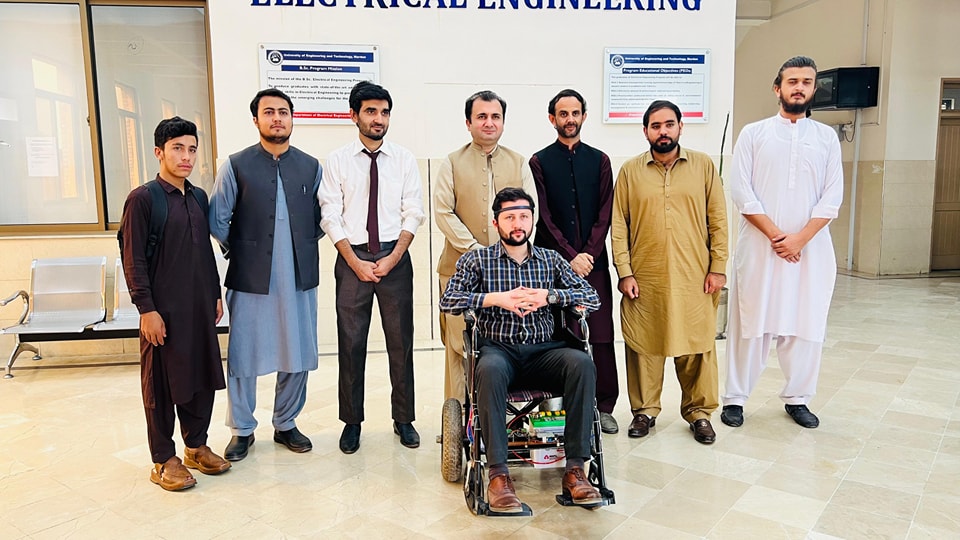
    Two students of University of Engineering and Technology (UET) Mardan have developed a prototype of electroencephalogram-based wheelchair. That will benefit the quadriplegic patients by being controlled through the brain.

    Mohammad Dawood and Mohammad Faizan Akhtar, students of UET Mardan, under the supervision of Dr. Jawad Ali, developed the prototype of EEG-based brain controlled wheelchair. The model includes an electroencephalogram (EEG) headset and a battery-powered wheelchair. The wheelchair can carry load or a human being of up to 250 kilograms with its powerful motors. The headset picks up signals from the brain when the person thinks about moving in forward, backward, left and right directions. The signals are transmitted to Arduino (microcontroller) to give commands to motors for moving according to thinking of a patient.

    The wheelchair has a physical joystick besides brain signal processing Bluetooth gadget for forward, backward, left and right movement. It can be used by any brain while wearing the electroencephalogram (EEG) headset.

    Mohammad Dawood, one of the students, says that “most wheelchairs are used by elders and partially disabled people. They face difficulties moving electrical and mechanical wheelchairs.”

    Dawood said that they tried to overcome the difficulties of wheelchair-users to a great extent. Their goal was to design a system that receives signals from the brain and moves accordingly. By system, they mean an accumulator sensor. The sensor converts the raw form of a signal into an electrical signal. The wheel chair can be controlled through different waves, such as alpha, beta, gamma, delta and theta, produced in the brain.

    The other student, Mohammad Faizan Akhtar, said that the wheelchair would make the lives of patients easier. He said that the wheelchair could be used by any person with an active brain.

    UET Mardan Vice-chancellor Prof. Imran Khan appreciated the efforts of students. He said that such projects required very little effort to become a commercial product. He claimed that the university administration was committed to providing maximum facilities to students.

    University of Engineering and Technology (UET) Mardan
    Follow on Flipboard Follow on Facebook Follow on X (Twitter) Follow on Instagram Follow on WhatsApp
    Share. Facebook Twitter Email Copy Link WhatsApp
    Web Desk2
    • Website

    Related Posts

    Su!c!de Bl@st at Islamabad Imambargah During Friday Prayers Leaves 31 Martyred, Over 160 Injured

    February 6, 2026

    Security Forces Neutralise Three India-Backed Terrorists in Panjgur IBO

    January 26, 2026

    SUPARCO Proposes AI-Powered Solutions to Transform Pakistan’s Ports and Maritime Management

    January 23, 2026

    PIA Privatisation: A Turning Point for Pakistan’s Economy?

    January 23, 2026

    JF-17 Thunder: Pakistan’s “Battle-Tested” 4.5-Generation Fighter

    January 23, 2026

    Security Forces Kill 13 Militants in Khyber Pakhtunkhwa as Pakistan Faces Resurgent Terror Threat

    January 23, 2026
    Add A Comment
    Leave A Reply Cancel Reply

    GZ YouTube Channel
    Ground Zero YouTube
    Editors Picks

    Balochistan’s Real Enemy: Armed Groups Profiting From Chaos

    February 16, 2026

    From Kabul to Kech: How Militant Sanctuaries Feed Balochistan’s Violence

    February 16, 2026

    Rails or Ruins: Afghanistan’s Choice Between Connectivity and Chaos

    February 12, 2026

    From Badakhshan to Balochistan: The Web of Exported Terror

    February 11, 2026

    BLA’s Guns Are Turned on Baloch Lives

    February 7, 2026
    Facebook X (Twitter) Instagram YouTube
    • About Ground Zero
    • Terms of Use
    • Privacy Policy
    • Sitemap
    • Contact Us
    © 2026 Ground Zero. Designed by Khyber Digital.

    Type above and press Enter to search. Press Esc to cancel.