


India’s Reluctant Overture: What Jaishankar’s Dhaka Encounter Signals for Pakistan-India Relations
India’s first high-level contact with Pakistan since the brief but dangerous military escalation in May did not occur in New Delhi or Islamabad, nor across a formal negotiating table. Instead, it unfolded quietly in Dhaka, on the sidelines of a funeral—an interaction as symbolic as it was revealing.
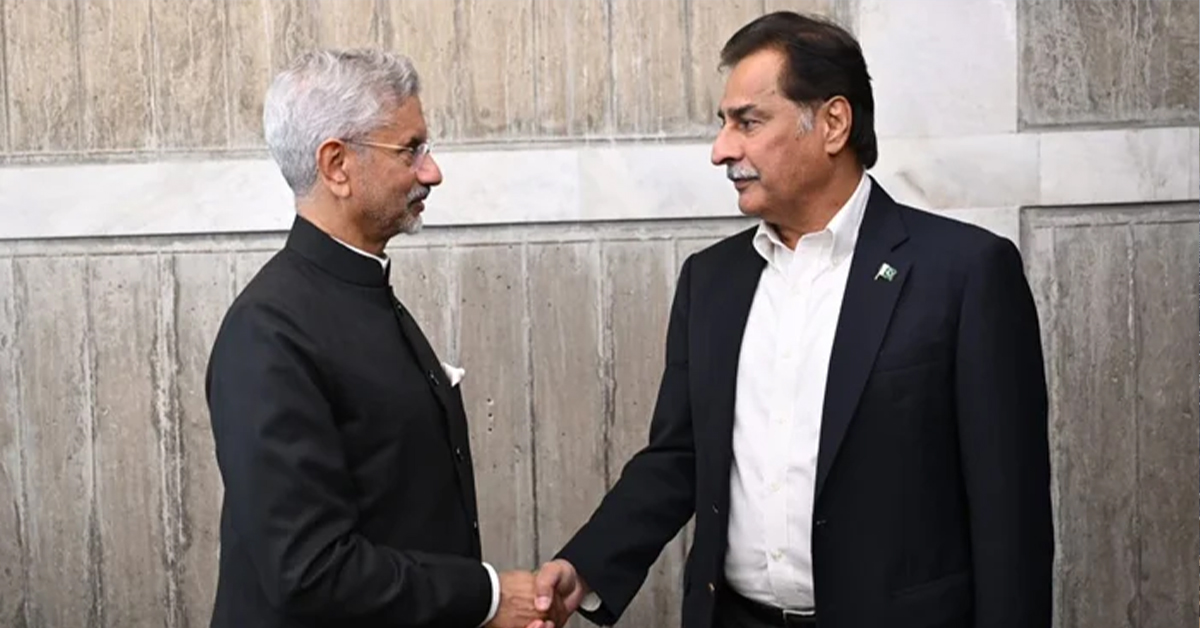
The meeting between Indian External Affairs Minister Dr. S. Jaishankar and Pakistan’s National Assembly Speaker Ayaz Sadiq in Bangladesh’s parliament marks a notable, if cautious, diplomatic shift. More importantly, it underscores a reality Pakistan has maintained consistently since the May conflict: dialogue remains unavoidable, regardless of how long New Delhi resists acknowledging it.
A Gesture Laden with Symbolism
According to Pakistan’s National Assembly, Jaishankar approached Speaker Sadiq while both leaders were present to pay condolences on the passing of former Bangladeshi prime minister Begum Khaleda Zia. The Indian foreign minister not only shook hands with Sadiq but also introduced himself—an act that may appear routine in diplomatic settings, yet carries weight given the complete freeze in bilateral engagement since May.
This was not a chance encounter between junior officials. It was a deliberate initiation of contact by India, marking the first such move after the 87-hour military confrontation between the two nuclear-armed neighbours. That it occurred in a neutral country and under the solemn context of a funeral reflects India’s continued discomfort with formal engagement—but also its growing recognition that isolation is unsustainable.
Post-May Reality: Pakistan’s Consistent Call for Dialogue
Since the May conflict, Pakistan has maintained a steady and principled position. Islamabad rejected India’s accusations over the Pahalgam incident in Indian Illegally Occupied Jammu and Kashmir and repeatedly called for an impartial, international investigation. At the same time, Pakistan stressed restraint, de-escalation, and structured dialogue to prevent further escalation.
India, by contrast, chose a confrontational path—launching what it termed “retaliatory strikes” and escalating tensions to a point where fighter jets, missiles, artillery, and drones were deployed by both sides. While a US-brokered ceasefire eventually halted the fighting, New Delhi avoided meaningful diplomatic engagement in its aftermath.
The Dhaka interaction, therefore, appears less like a goodwill gesture and more like a belated acknowledgment of diplomatic reality.
Military Escalation Failed to Deliver Political Gains
The May confrontation did not produce the strategic or diplomatic outcomes India may have anticipated. Pakistan asserted it downed seven Indian fighter jets, including Rafales—claims New Delhi disputed while conceding “some losses.” Regardless of the exact figures, the episode demonstrated how quickly escalation can spiral between two nuclear states, with no clear winner and high regional risk.
Internationally, calls for restraint grew louder, and India faced uncomfortable scrutiny over its actions and its refusal to allow neutral investigations. Against this backdrop, re-establishing even minimal contact with Pakistan appears less optional and more necessary.
Sportsmanship, Optics, and Diplomatic Inconsistencies
Political hostility also spilled into the sporting arena during the ACC Men’s Asia Cup 2025, where Indian players reportedly avoided customary handshakes with Pakistani counterparts—even during the final. Such gestures, widely noticed, reinforced perceptions of India’s unwillingness to separate politics from people-to-people engagement.
Yet, in Dhaka, away from cameras and nationalist posturing, the Indian foreign minister found it appropriate to initiate a polite exchange. This contrast raises questions about India’s selective diplomacy—publicly rigid, privately pragmatic.
Pakistan’s Regional Diplomacy Remains Active
While India cautiously recalibrates, Pakistan continues to engage regionally with consistency. Speaker Ayaz Sadiq’s meetings in Dhaka with Begum Khaleda Zia’s family, Bangladesh’s National Security Advisor Khalilur Rahman, and other officials reflected Pakistan’s commitment to respectful diplomacy and regional ties. He conveyed condolences on behalf of Pakistan’s president and prime minister, reinforcing Islamabad’s diplomatic presence without theatrics.
A Door Opened—Barely, but Significantly
No one should mistake the Dhaka interaction for a breakthrough. It does not signal resumed talks, confidence-building measures, or policy reversals. However, it does mark something important: India initiated contact—however limited—after months of diplomatic silence.
For Pakistan, this reinforces the credibility of its post-May stance. Islamabad neither escalated rhetorically nor closed diplomatic doors. Instead, it maintained that dialogue, investigation, and restraint were the only viable paths forward.
The coming months will determine whether India is prepared to move beyond symbolic gestures toward substantive engagement. For now, the Dhaka meeting stands as a quiet reminder that diplomacy, even when delayed, eventually asserts itself—often on terms shaped by restraint rather than force.
