

CTD Neutralizes Three Militants in Bannu as Milit@nt Attacks Surge Nationwide
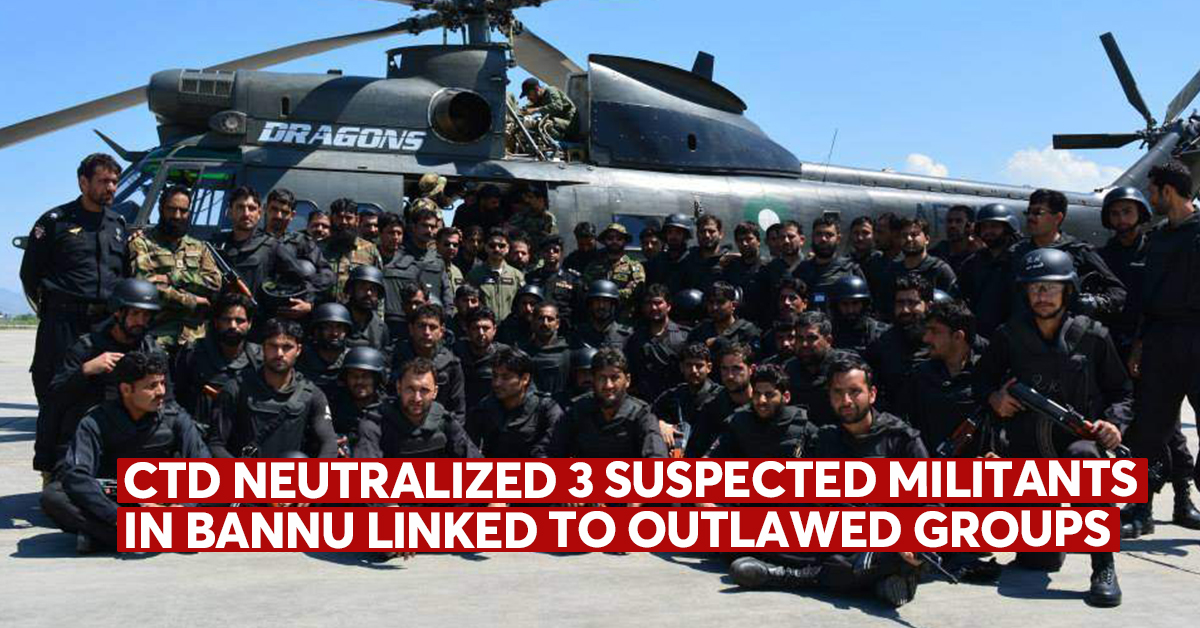
In a major counterterrorism success, the Counter Terrorism Department (CTD) gunned down three suspected militants during a late-night operation in Bannu, Khyber Pakhtunkhwa. The raid was carried out by KP Police and confirmed on Thursday.
According to a CTD spokesperson, the slain individuals were identified as Mudassir, Turab, and Mohammad Hussain, all residents of Bannu. They were affiliated with banned groups Gul Bahadur and Zarar, and had a history of involvement in milit@nt activ1ty.
The raid resulted in the recovery of explosive materials, a Kalashnikov rifle, a pistol, and a motorcycle reportedly used by the suspects. The encounter was part of ongoing efforts to neutralize terror cells operating in KP and bordering tribal regions.
Context: A Follow-up to Lakki Marwat Operation
This latest success follows a similar operation conducted ten days earlier in Lakki Marwat, where CTD personnel neutralized three members of the outlawed Tehreek-e-Taliban Pakistan (TTP). That encounter took place near Bhutani Canal in the Sarai Naurang area, where four hand grenades, multiple rifles, dozens of bullets, and two mobile phones were recovered.
The militants in both Bannu and Lakki Marwat were reportedly involved in prior att@cks on law enforcement personnel, making their elimination a significant achievement for secu-rity agencies.
May 2025: A Deadly Month for Pakistan
The broader context reveals troubling trends. According to the Pakistan Institute for Conflict and Security Studies (PICSS), milit@nt attacks in May 2025 rose by 5%, recording 85 incidents, up from 81 in April.
These assaults claimed 113 lives, including:
-
52 secu-rity personnel
-
46 civilians
-
11 militants
-
4 peace committee members
Additionally, 182 individuals were injured, comprising:
-
130 civilians
-
47 secu-rity personnel
-
4 militants
-
1 peace committee member
Though the rise in the number of attacks was marginal, the death toll among secu-rity forces rose by 73%, pointing to more lethal tactics and increased targeting of state personnel.
Balochistan and KP: Epicenters of the Crisis
The PICSS data highlights Balochistan and Khyber Pakhtunkhwa as the most affected regions. Together, these two provinces accounted for 82 of the 85 incidents in May.
In Balochistan alone:
-
35 attacks occurred
-
51 people lost their lives (30 civilians, 18 secu-rity personnel, 3 militants)
-
100 people were injured (94 civilians, 5 secu-rity personnel, 1 unknown)
In KP, repeated ambushes on law enforcement, such as those seen in Bannu and Lakki Marwat, have put additional pressure on regional stability.
Security Forces Strike Back
Despite the spike in attacks, security forces mounted aggressive responses. In May alone:
-
59 militants were killed
-
5 security officials were martyred
-
Dozens of operatives were captured or injured in raids
These figures reflect intensified counter-milit@nt operations, particularly in high-risk zones bordering Afghanistan and former tribal areas.
Civilian Impact: Rising Fear and Casualties
Civilian harm has also spiked. Injuries among civilians rose by 145%, jumping from 53 in April to 130 in May. This suggests that milit@nt tactics have shifted to more indiscriminate or high-casualty attacks.
The psychological toll on communities in affected provinces is rising, with schools, markets, and even mosques turning into zones of vulnerability.
Conclusion: Militant Networks Under Pressure but Still Active
The successful CTD raids in Bannu and Lakki Marwat demonstrate that milit@nt groups are being tracked and dismantled, but the threat remains persistent and dangerous. The latest PICSS data confirms that militancy is far from over in Pakistan.
With KP and Balochistan under regular siege, the need for sustained operations, intelligence coordination, and community engagement is greater than ever.
