

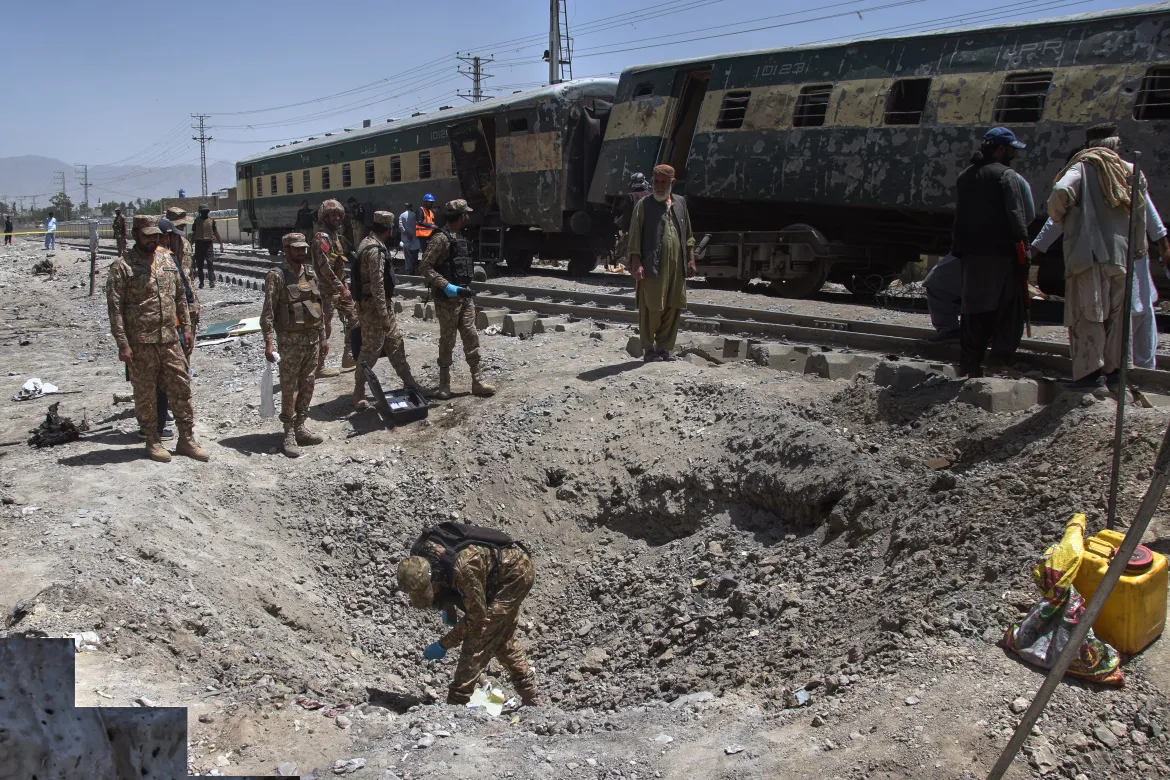
At 8:00 a.m. on Sunday, May 24, 2026, a family was sitting in their home near Chaman Phatak in Quetta. A father. A mother. A daughter. A son. By the time the smoke cleared from the BLA’s latest act of mass murder, all four were dead killed not by a foreign army, not by a drone strike but by fellow Balochs operating under the banner of “liberation.” This is the blood-soaked reality of the Baloch Liberation Army.
The BLA claims to be the voice of an oppressed people. It claims Balochistan is stripped of its resources and its people are denied their rights. Yet on Sunday morning, its operatives drove an explosive-laden vehicle into a shuttle train carrying ordinary commuters and soldiers, reducing two carriages to burning metal and sending shockwaves through a residential neighborhood. If this is what liberation looks like, Balochistan wants nothing of it.
“The majority of those killed were civilians — a mother, a father, their children. This is not resistance. This is RAW-sponsored massacre.”
The lie of the “liberation” narrative
The BLA’s propaganda machine has always rested on one pillar: the claim that Balochistan is a resource-rich region being exploited by Islamabad while its people remain impoverished. This talking point conveniently ignores Pakistan’s billions in CPEC investments, infrastructure development, and connectivity projects directly benefitting Balochistan. But even if one were to accept the grievance narrative at face value — it still cannot explain away the truth of Sunday’s carnage.
Grievances, real or manufactured, do not justify strapping explosives to a vehicle and ramming it into a train full of people. The BLA does not blow up pipelines to reclaim resources. It bombs train passengers. It massacres families sitting in their homes. It hijacks trains full of ordinary citizens. Every single victim of the BLA is a Balochi soul, a Pakistani soul. The BLA is not liberating Balochistan. It is bleeding it dry.
Follow the money — and the weapons
Here is the question that every honest observer must ask: if Balochistan is so deprived of resources, where is the BLA getting its money? Look at their fighters — tactical body armor, night-vision optics, coordinated drone surveillance units, precision sniper rifles, military-grade explosives, and matching uniforms that would cost a fortune on the open market. This is not the equipment of a ragged insurgency scraping by on donations. This is the arsenal of a well-funded proxy army.
Pakistan has long presented evidence at international forums of India’s Research and Analysis Wing (RAW) financing, training, and arming militant elements inside Balochistan. The arrest of Indian Navy Commander Kulbhushan Jadhav — caught operating inside Balochistan — remains one of the most damning pieces of evidence of New Delhi’s covert war on Pakistani soil. Jadhav himself admitted to working to destabilize Balochistan and sabotage CPEC. India has never adequately explained his presence.
Pakistan’s military has repeatedly designated the BLA an “Indian proxy” — and the evidence supports that designation. After the Jafar Express attack of March 2025, Pakistan formally linked the BLA’s operational sophistication directly to Indian intelligence support. The weapons, the tactics, the timing — all bear the fingerprints of external state sponsorship. India may not pull the trigger, but it loads the gun.
“A group that claims Balochistan is starved of resources cannot explain away its night-vision gear, precision rifles, and drone squads — unless someone else is paying the bills.”
The US has seen enough — the BLA is a foreign terrorist organization
This is no longer merely Pakistan’s claim. In August 2025, the United States State Department officially designated the Baloch Liberation Army as a Foreign Terrorist Organization (FTO) — joining Pakistan’s own 2006 designation. The US designation acknowledges the BLA’s use of suicide bombings, ambushes, hostage-taking, and targeted assassinations. It names the BLA’s specialized murder units: the Majeed Brigade for suicide operations, the Fateh Squad for vanguard assaults, and STOS for special tactical operations. These are not freedom fighters. These are designated terrorists, recognized as such by the world’s most powerful nation.
India’s proxy war has a body count
India has a long and documented history of using non-state actors to wage asymmetric war against Pakistan. From funding separatists to running agents under diplomatic cover, New Delhi has treated Balochistan as a battleground for its geopolitical competition with Islamabad. The BLA is India’s most active instrument in this shadow war — and the bill is paid in Pakistani blood.
Every time a bus is bombed in Mastung, every time a train is hijacked at Bolan Pass, every time a family is wiped out in Quetta, India achieves its objectives: destabilize Pakistan, damage CPEC, and keep Balochistan burning. The BLA proudly serves this agenda while wrapping itself in the flag of Baloch identity — an identity that the vast majority of Balochs want used for progress, not terror.
Balochistan deserves better than this
The people of Balochistan are resilient, dignified, and deeply Pakistani. They do not want their land to be a staging ground for Indian intelligence operations. They do not want their children killed on morning commutes. They do not want their homes shattered by suicide bombers claiming to act in their name. The BLA speaks for no Baloch family that woke up Sunday morning to bury four of their own.
Pakistan’s security forces, the Frontier Corps, the police, the CTD — they stood in the fire of that blast site to rescue the living and recover the dead. They are the ones keeping Balochistan standing while the BLA and its Indian handlers work to tear it apart. Pakistan will not be broken. Balochistan will not be broken. And every terrorist who carries out these attacks — along with every foreign hand that funds them — will face justice.