

India revoked Articles 370 & 35-A, stripping Kashmir’s autonomy and protections
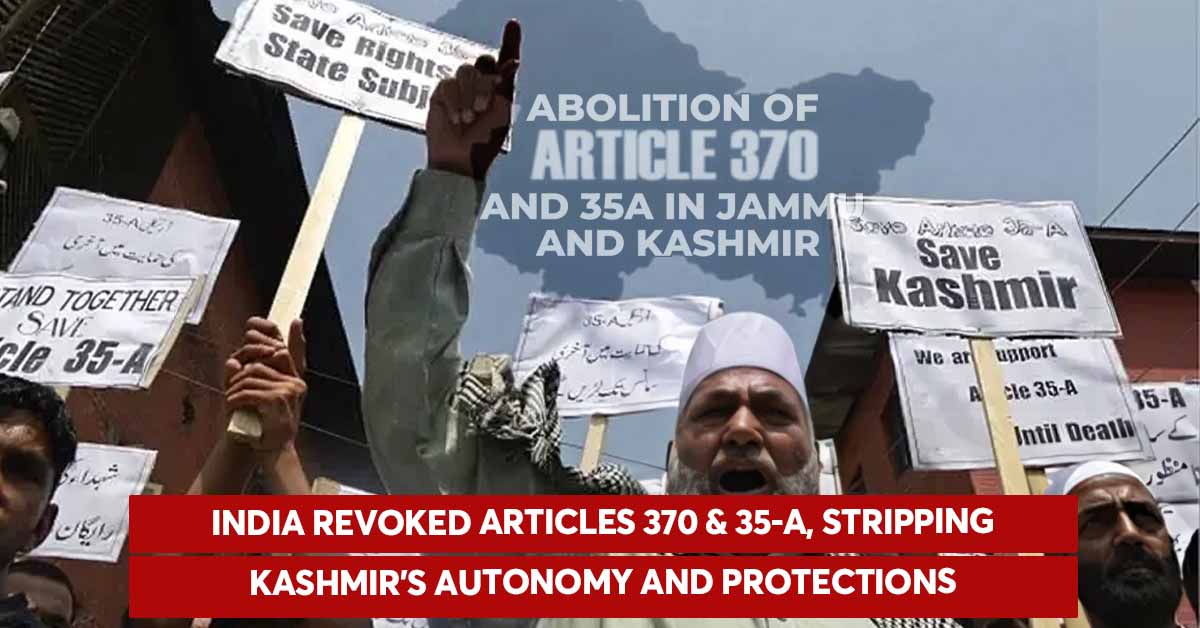
Kashmir — known for its beauty and resilience — has faced decades of political turmoil and restrictions. On August 5, 2019, India delivered one of its most consequential moves by unilaterally revoking Articles 370 and 35-A. These provisions had granted Jammu and Kashmir a measure of autonomy, its own constitution, and safeguards for its demographic identity.
The decision was implemented without Kashmiri consent, in violation of the UN Charter, relevant Security Council resolutions, and the Fourth Geneva Convention. The region was placed under lockdown, with mass detentions, communication blackouts, and a heavy military presence. Schools, offices, and hospitals were shut, and public expression was curtailed.
Critics argue that the removal of these constitutional protections was not about development, but about reshaping the region’s identity. Under Prime Minister Modi’s governance, and within the framework of Hindutva ideology, it forms part of a wider pattern of policies seen as targeting Muslim communities in India.
Yet, despite the restrictions, the desire for self-determination remains strong among Kashmiris. August 5 is remembered as a black day — not only for
