

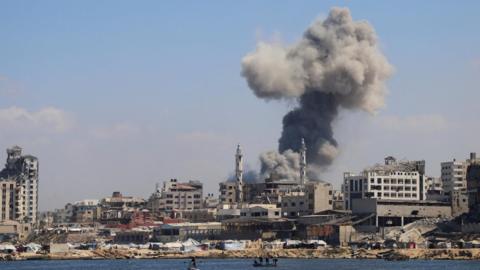
While Donald Trump postured as a “peace broker” in pursuit of a Nobel Prize, Israel struck Qatar in broad daylight. On September 9, 2025, fifteen Israeli jets and drones unleashed ten precision munitions in an operation brazenly codenamed Fire Summit. The strike, launched from over a thousand miles away, tore into Doha’s West Bay Lagoon district, near the bustling Woqod petrol station.
The symbolism was stark: Israel carried its war beyond Gaza, beyond Lebanon, beyond Syria—it reached into one of America’s closest allies, shattering both the illusion of truce and the credibility of U.S. diplomacy.
Who Was Marked for Death?
The Israeli Defense Forces claimed it targeted Hamas leaders “responsible for the October 7 massacre.” The reality was murkier. Hamas confirmed five of its members and a Qatari officer were killed, but the supposed high-value targets—Khalil al-Hayya and Khaled Mashal—escaped. Among the dead were Jihad Labad, Humam al-Hayya (the son of Khalil al-Hayya), and three bodyguards.
Al-Hayya’s importance has only grown since the assassinations of Ismail Haniyeh in Tehran, Yahya Sinwar in Gaza, and Mohammed Deif in 2024. His survival underscores a pattern: Israel’s assassinations create martyrs, but not solutions.
Ceasefire Shattered, Again
The attack demolished fragile ceasefire talks mediated in Doha. Just months earlier, a truce had enabled eight rounds of prisoner exchanges between Hamas and Israel. But Israel has never respected ceasefires. On March 18, 2025, its jets killed more than 400 Palestinians in a single night, ending the January truce. Now, with another round of bloodshed, Israel proves once again that “peace” is a word it utters only to buy time for its next massacre.
Qatar’s Credibility at Stake
For more than a decade, Qatar played host to Hamas’s political office—ironically at Washington’s urging—positioning itself as a mediator. Its neutrality was its asset. But Israel’s strike on Doha was not just an assault on Hamas. It was a direct humiliation for Qatar, a Gulf monarchy that simultaneously hosts both Hamas and America’s largest regional airbase at Al Udeid.
What credibility remains when your capital, supposedly one of the world’s safest cities, is struck without warning?
The Expansionist Blueprint
This is not random aggression. It is the unfolding of Netanyahu’s vision of “Greater Israel,” eerily similar to India’s “Akhand Bharat.” Both are rooted in expansionist fantasies, justified with religious texts and ultra-nationalist rhetoric.
“From the Brook of Egypt to the Euphrates,” Herzl once wrote—the dream of a Jewish state stretching across Palestine, Lebanon, Syria, Jordan, Iraq, and beyond. The 1967 war brought parts of that dream into reach. Today’s bombardments—extending from Gaza to Yemen, Iran, and now Qatar—show that the ambition never died.
The Silent Complicity of the West
The technical sophistication of the attack leaves few doubts. Experts believe Israel used its modified F-35I Adir stealth fighters, supported by F-15I Ra’am jets. Qatar’s prime minister admitted its radars never saw them. More telling is the U.S. delay: Washington informed Doha ten minutes after the strike. Was this ignorance—or complicity?
Trump, visibly embarrassed, mumbled he was “not thrilled.” European allies offered muted criticism. But muted words mean nothing when Palestinians in Gaza are slaughtered nightly. Since October 7, 2023, over 64,000 Palestinians have been killed, with thousands still trapped under rubble. The genocide continues, applauded in Washington and ignored in Western capitals.
The Final Question
Israel’s war is no longer confined to Palestine. The fire now burns in Lebanon, Syria, Yemen, Iran, and Qatar. It spreads like a plague across the Muslim world, emboldened by U.S. vetoes at the UN and shielded by Western silence.
Pakistan’s Defence Minister Khawaja Muhammad Asif warned: “Thinking that going soft on Israel will keep Arab countries safe is a folly.”
The question now is not whether Gaza will survive. It is: whose capital will be next? And when will the world admit that this is not about security, but about expansion—about the creation of a Greater Israel at the cost of every life and every nation that dares to stand in its way?
