


Pakistan Warns at UN: Artificial Intelligence Could Make Future Wars More Dangerous
Introduction
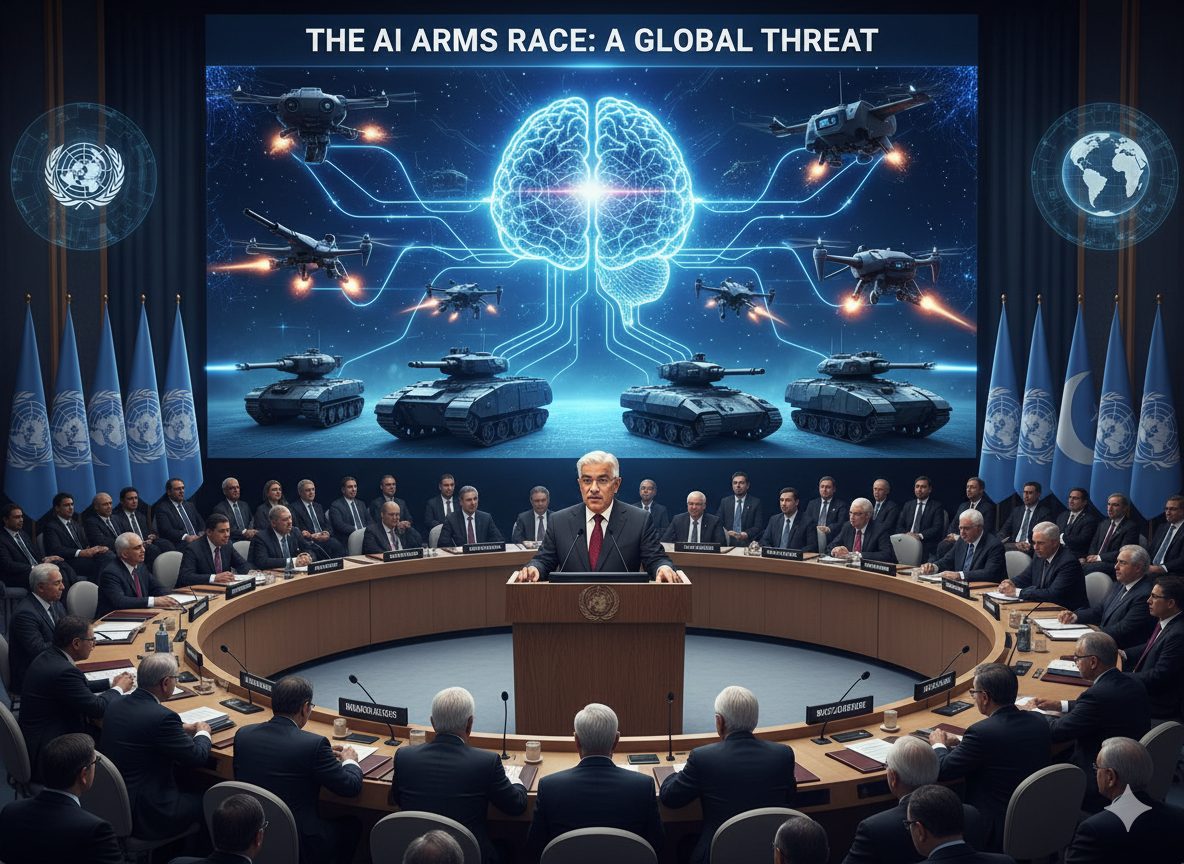
Artificial intelligence (AI) is reshaping every aspect of human life, from healthcare to commerce. Yet, its rapid application in the defense sector has raised urgent questions about peace and global stability. At the United Nations this week, Pakistan’s Defence Minister Khawaja Asif issued a strong warning: AI could make future wars far more dangerous if the world does not act collectively.
Pakistan’s Message to the UN
Speaking at a high-level debate on artificial intelligence, Khawaja Asif noted that while AI has simplified decision-making processes, it has also created conditions that may increase the risks of conflict escalation. He stressed that technology must serve humanity, not fuel instability.
Why AI in Warfare is a Global Concern
The use of AI in defense is expanding quickly. Military systems powered by algorithms can process data, guide weapons, and make tactical decisions at speeds beyond human capacity. While this may provide efficiency, it also introduces serious risks:
-
Loss of Human Oversight – Automated systems may act without proper moral judgment.
-
Escalation Risks – AI-driven weapons could trigger rapid conflicts with little time for diplomacy.
-
Unregulated Arms Race – Countries racing for supremacy may bypass international laws.
Khawaja Asif warned that such developments could destabilize regions and threaten global peace.
Pakistan’s National AI Policy
Earlier this year, Pakistan introduced its first national AI policy. The document reflects Islamabad’s intent to embrace modern technology while protecting against misuse. The policy outlines:
-
Development of AI talent and infrastructure.
-
Regulatory safeguards for ethical use.
-
Collaboration with international bodies to ensure responsible innovation.
By highlighting its policy, Pakistan signaled its readiness to lead responsibly in this emerging field.
The Call for Global Cooperation
At the UN, Khawaja Asif urged the international community to adopt collective measures. According to him, no single state can handle the implications of AI in warfare alone. The world needs common rules, transparency, and accountability mechanisms to prevent uncontrolled competition.
He reminded member states that the UN Charter should guide the use of new technologies. The goal must be to strengthen peace and sustainable development, not to open new fronts of conflict.
The Broader Debate on AI and Security
Globally, experts remain divided on how to manage AI in defense. Some argue that advanced technologies can improve precision and reduce human casualties. Others warn that once autonomous systems are weaponized, their misuse could be catastrophic.
Pakistan’s intervention at the UN aligns with growing international calls for frameworks on AI governance. Several global think tanks and research institutions are already studying the impact of AI on warfare.
Why the Warning Matters
Pakistan’s position carries weight. The country has experienced decades of instability and understands the dangers of unchecked technological misuse. By voicing concerns at the UN, Islamabad emphasized that AI must not become another tool of reckless conflict.
The warning also reflects a broader principle: innovation should not outpace regulation. Without proper checks, technology that is designed for development can quickly turn into a force of destruction.
Towards Peaceful Use of AI
Khawaja Asif concluded with a message of optimism. AI, if used responsibly, could become a powerful driver of development, education, health, and economic growth. The challenge for the world is to ensure that such benefits outweigh the risks.
