


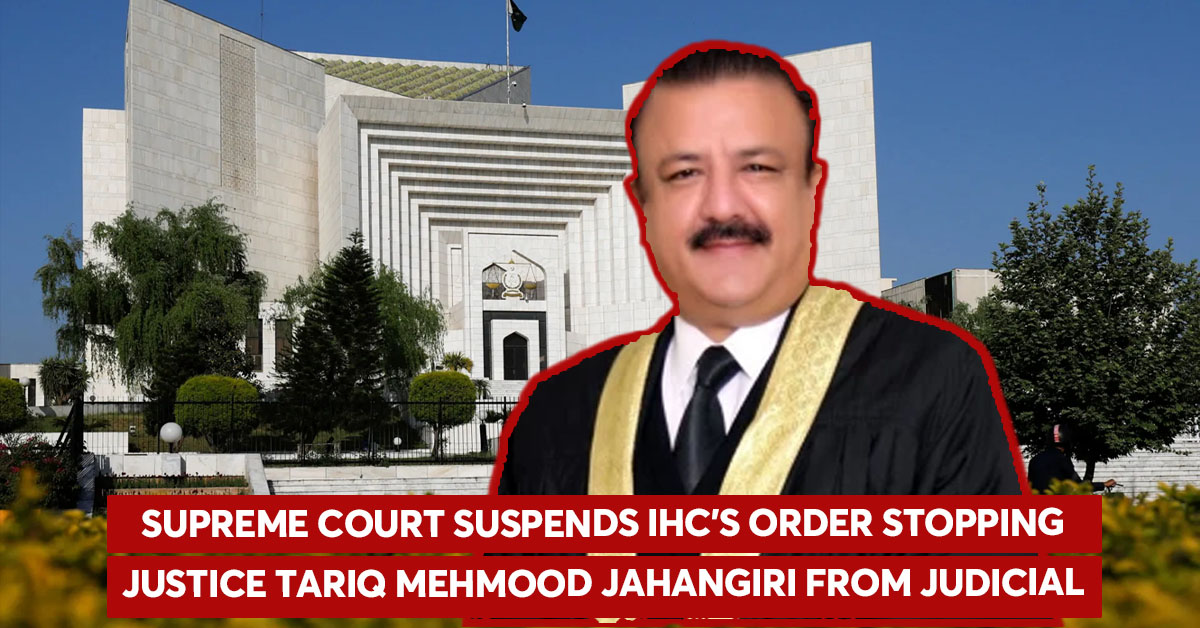
SC Suspends IHC Order Barring Justice Jahangiri from Judicial Work
Supreme Court Steps In
The Supreme Court (SC) on Monday suspended an order of the Islamabad High Court (IHC) that had restrained Justice Tariq Mehmood Jahangiri from carrying out judicial duties. The IHC had issued the restriction earlier this month amid controversy surrounding the validity of the judge’s law degree.
A five-member constitutional bench of the SC, headed by Justice Aminuddin Khan, ruled that the “operation of the impugned order is suspended.” Notices were also issued to the attorney general of Pakistan, the advocate general of Islamabad, and other respondents, as the matter concerns constitutional interpretation. The hearing was adjourned until tomorrow.
Background of the Controversy
The degree dispute began in 2024 when a letter, allegedly from Karachi University’s controller of examinations, surfaced on social media. It raised questions about Justice Jahangiri’s LLB enrollment numbers and transcripts, creating doubts about the validity of his academic record.
Following this, the university’s syndicate cancelled his degree, but the Sindh High Court (SHC) suspended the cancellation, stating the judge was not given a fair opportunity to defend himself. Meanwhile, petitions challenging his appointment were filed in the IHC, eventually leading to the September 16 restraining order against his judicial functions.
Courtroom Developments
During Monday’s proceedings, Justice Jahangiri’s lawyer argued that the IHC decision was unprecedented, as it marked the first time a high court’s bench barred one of its own judges from judicial work. He maintained that the order violated established legal norms and bypassed the Supreme Judicial Council (SJC), which has the sole authority to probe judicial misconduct.
The SC bench instructed both sides to prepare arguments on how the IHC plea was entertained despite pending objections by the registrar’s office. The case is set to continue tomorrow, keeping the spotlight firmly on a legal and academic controversy that has tested both judicial accountability and constitutional interpretation.
