


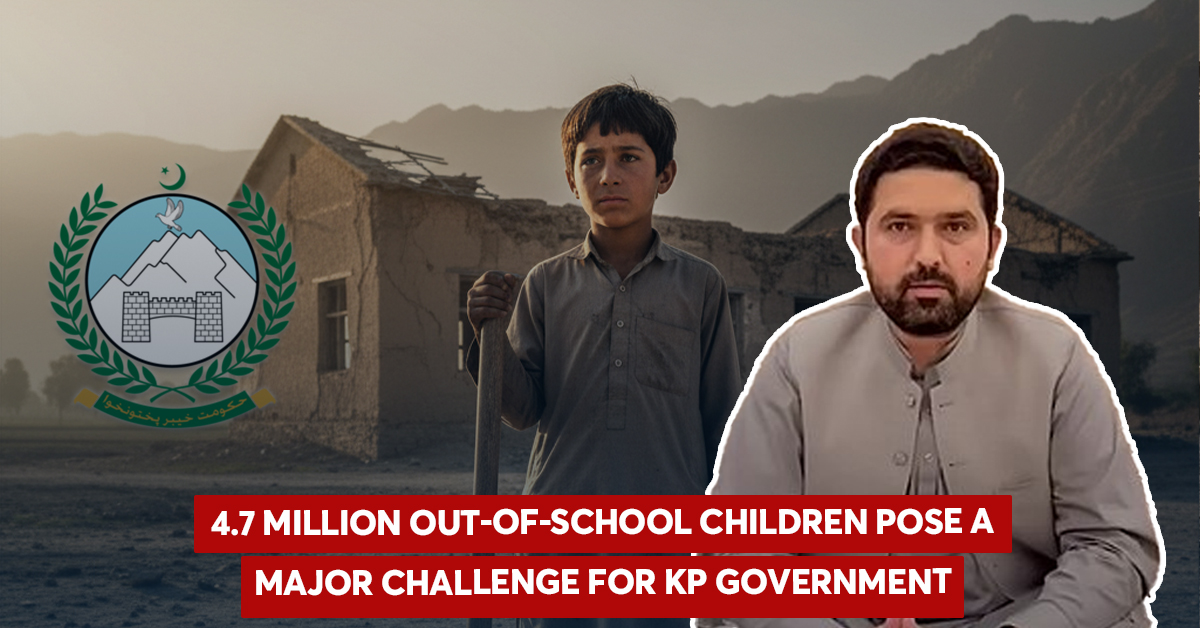
4.7 Million Out-of-School Children Pose a Major Challenge for KP Government
A staggering figure that poses one of the most urgent challenges for newly-elected Chief Minister Sohail Afridi.
Poverty and Social Barriers Fuel the Crisis
Experts link the crisis to poverty, cultural barriers, and lack of infrastructure. A Benazir Income Support Programme (BISP) report revealed that 74.4% of girls and 38.5% of boys in KP are out of school. The situation is especially grim in Upper Kohistan, North Waziristan, and Bajaur districts.
“Education is the backbone of a progressive society,” said Dr. Mohammad Naeem of the University of Peshawar. He stressed that millions of children are being denied their constitutional right to free education due to poverty, social constraints, and inadequate facilities.
In remote districts like Kolai-Palas, Tank, and South Waziristan, children are forced to leave school to work in fields, brick kilns, or roadside shops. For poor parents, the choice is painful but straightforward — feed the family or educate the child.
Girls Face Steeper Hurdles
For girls, the barriers are even higher. In several tribal areas, conservative norms discourage female education, sometimes making it unsafe for girls to attend school. Many schools lack boundary walls, toilets, and clean drinking water—basic facilities essential for girls’ attendance.
Experts warn that ignoring these issues could have long-term consequences. The 4.7 million children out of school today could become the root of economic stagnation, social instability, and law and order challenges in the future.
Government’s Education Push
The KP Education Department has announced several initiatives to reverse the crisis. Over 1,053 schools now operate in double shifts, enrolling more than 70,000 students. This year alone, 830,000 children have been newly enrolled, including 315,000 girls.
The provincial education budget has risen to Rs364 billion, with Rs19 billion earmarked for new development projects. Plans include 41 new primary schools, 12 secondary schools, and 500 additional classrooms. Over 16,500 teachers are being recruited, while 30,000 others are receiving training to improve teaching standards.
Digital reforms include smart classrooms, a digital attendance system, and an Education Card that provides scholarships and learning materials.
In the merged tribal districts, the government has allocated Rs1.5 billion to build 50 new schools and improve existing facilities with boundary walls, sanitation, and drinking water systems.
Public Voices Demand Accountability
Despite these measures, many residents remain skeptical.
“We’ve heard promises before,” said Sumbal Bibi, a mother of five from Nowshera. “We need teachers who show up, classrooms that don’t leak, and toilets for our daughters.”
Experts suggest that Afridi’s administration must prioritize non-formal schooling programs and community-led education centers to reach children in remote and underserved areas. Currently, 3,500 girls’ community schools operate under the Elementary and Secondary Education Foundation, enrolling 14,000 students through the Poha digital learning scheme.
Yet for children like Hussain Khan, these programs remain a distant dream.
“No one asked why I left school,” he said with tearful eyes. “I want to study, but we have debts. I can’t be a burden to my family.”
The Real Test Ahead
The question now is whether Chief Minister Sohail Afridi can turn promises into action. Experts agree that the tools and policies exist — what’s missing is consistent, transparent implementation.
Education remains a constitutional right, but for millions of children in KP, it’s still a privilege. Every day lost is a lost opportunity — not just for the children, but for the province’s future itself.
