


Aman Jirga Calls for Centre–KP Coordination on Pakistan-Afghan Policy
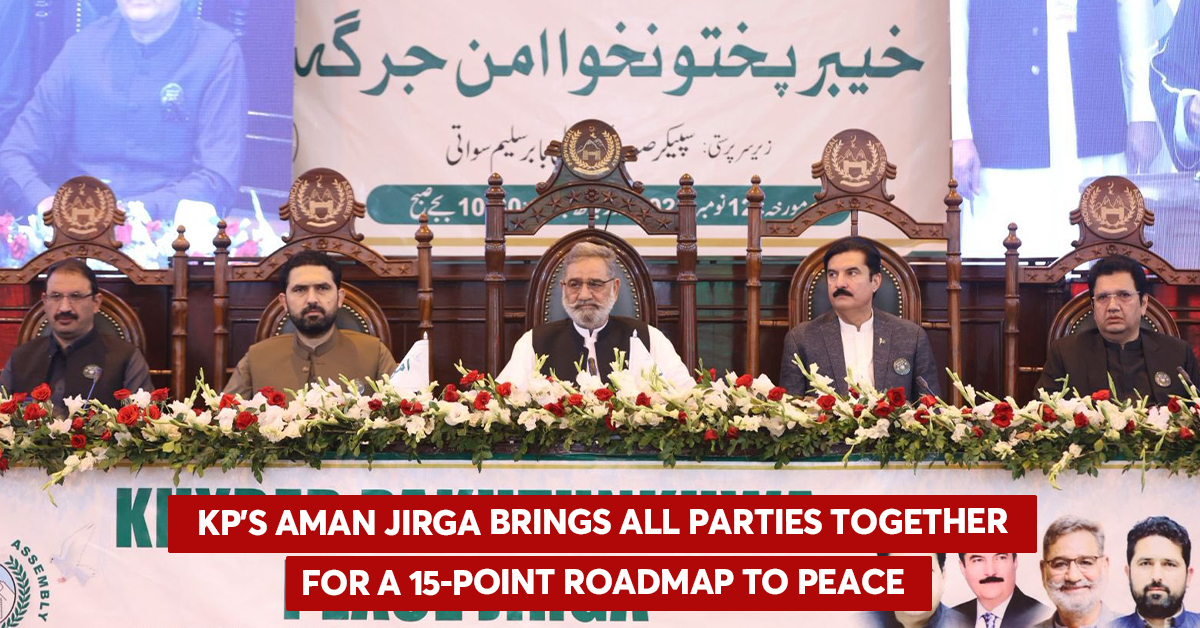
The Khyber Pakhtunkhwa Assembly’s Aman Jirga (Peace Assembly) concluded with a 15-point declaration focused on strengthening peace and eliminating terr0r across the province, including the merged tribal districts. The jirga emphasized that the federal government must consult the KP government when shaping Pakistan’s Afghan policy to ensure long-term regional stability.
Jirga’s 15-Point Declaration
The peace jirga, attended by leaders from all political parties, civil society representatives, and lawmakers, was chaired by KP Assembly Speaker Babar Saleem Swati. The declaration urged the implementation of earlier assembly resolutions on secu-rity and policing. It also recommended empowering the Counter-Terrorism Department (CTD) and police to lead internal secu-rity operations with assistance from other institutions within constitutional limits.
The jirga called for financial support to strengthen law enforcement agencies and demanded a clear policy to eliminate extortion and illegal levies. It also proposed forming provincial peace forums involving community stakeholders. The declaration sought constitutional amendments to stabilize local governments and urged linking the Provincial Finance Commission (PFC) with the National Finance Commission (NFC) to ensure financial equity.
The jirga also appealed to end tensions between the federal and provincial governments. It recommended summoning the Council of Common Interests (CCI) within its constitutional timeframe to address ongoing coordination gaps.
CM Afridi Vows to Implement Peace Plan
Chief Minister Sohail Afridi, speaking to the media after the session, said that peace cannot be achieved without collective action. He praised the participation of all political parties, scholars, lawyers, and journalists, calling their involvement a “symbol of unity.” Afridi promised full implementation of the peace declaration and said its recommendations would be forwarded to the federal government.
He also criticized previous anti-terr0r policies, saying decisions made “behind closed doors” failed to yield sustainable results. “Peace can only come when decisions are made with consultation,” Afridi stated. He called for a participatory counter-terr0r strategy, saying it must involve politicians, secu-rity agencies, and the public to ensure credibility and effectiveness.
Afridi reiterated that war should always remain the last resort in countering viol3nce. He emphasized dialogue, coordination, and development as tools to sustain long-term peace in the province.
Unity for Peace and Stability
The Aman Jirga showcased rare political unity in Khyber Pakhtunkhwa, with representation from all major parties. Speaker Swati noted that “all political forces stand united on the matter of peace.” He said the jirga’s consensus marked a significant step toward rebuilding confidence among institutions and communities affected by terr0rism.
The event concluded with prayers led by Jamaat-e-Islami leader Professor Ibrahim Khan, followed by formal honours for attendees including Governor Faisal Karim Kundi, former governor Ghulam Ali, and ex-chief minister Mahmood Khan.
The declaration was seen as a blueprint for renewed collaboration between Islamabad and Peshawar to address shared secu-rity challenges and ensure sustainable peace in Khyber Pakhtunkhwa.
