


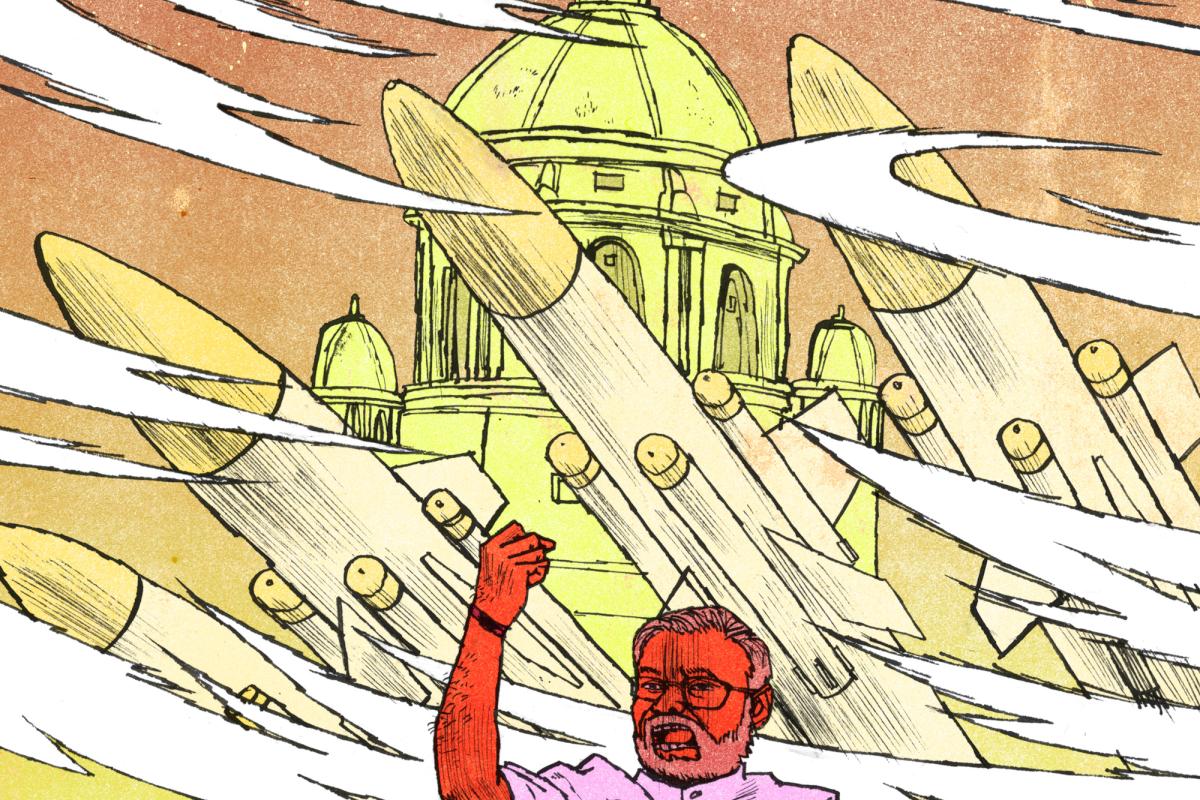
India’s ambition to project itself as a civilizational great power increasingly rests not on economic coherence, technological credibility, or ethical governance, but on a far more fragile foundation: mythologized history repackaged as political truth. At the heart of this project lies the deliberate attempt by Hindutva ideologues to rename the Indus Valley Civilization as the Sindhu Sarasvati Civilization, an exercise that reveals less about ancient history and more about modern India’s ideological insecurity.
This is not an academic disagreement. It is a calculated act of historical fraud.
The Sarasvati River, repeatedly invoked by Indian media and BJP affiliated scholars, exists primarily in Hindu religious texts, not in verifiable geological reality. For decades, Hindutva aligned institutions have attempted to transform this mythical river into a glacial-fed lifeline of an imagined Hindu civilization. The motive is transparent. If Sarasvati can be proven real, ancient, and central, then Hindu nationalism gains a manufactured civilizational pedigree that predates all others. If it cannot, the ideological scaffolding of Hindutva collapses under its own weight.
Science has been unforgiving to this fantasy.
Extensive geological and sedimentary studies have demonstrated that the Ghaggar Hakra river system, which Hindutva claims to be the Sarasvati, was a seasonal river dependent on monsoon cycles, not a mighty glacier-fed artery sustaining a vast civilization. Climate shifts weakened the winter monsoon, leading to its gradual drying. This reality directly contradicts the Hindutva claim that the river mysteriously vanished while leaving behind a continuous Hindu civilizational lineage.
Yet evidence has never been the objective.
The renaming campaign is designed to retrofit history into the ideological needs of the RSS worldview. Hindutva politics requires a singular, exclusive, Hindu origin story to justify its present-day agenda of exclusion, otherization, and demographic purification. That is why archaeology is being conscripted into politics, textbooks are being rewritten, and myth is being elevated to the status of policy.
This civilizational manipulation serves a dual purpose. Domestically, it legitimizes the BJP’s narrative that non-Hindu communities are late arrivals, cultural intruders, or historical accidents. This framing provides ideological cover for policies like the Citizenship Amendment Act, which institutionalizes religious discrimination while claiming civilizational continuity. Internationally, it supports the fantasy of Akhand Bharat, a pseudo-historical vision of regional dominance disguised as cultural unity.
Ironically, even Indian scholars have punctured this narrative. Tony Joseph, among others, has openly rejected the Sarasvati label, arguing that Harappa is a more accurate and neutral term for the civilization. The Indus Valley Civilization was not confined to one river, one culture, or one religious identity. It spanned multiple river systems, regions, and populations, including areas far beyond modern Indian political boundaries. To reduce it to a Hindu civilizational project is not interpretation. It is erasure.
The most damaging blow to Hindutva’s civilizational myth, however, comes from within India itself.
Southern India’s Dravidian movement has openly challenged the BJP’s attempt to monopolize ancient history. The Tamil Nadu government’s push to decipher the Indus script is not merely academic curiosity. It is resistance against cultural annexation by North Indian Hindu nationalism. Dravidian scholars argue that Aryans were not original inhabitants but later arrivals, a position that directly undermines the BJP’s claim of an uninterrupted Hindu past. Linguists such as Asko Parpola have lent scholarly weight to this position, further complicating Hindutva’s simplistic narrative.
This internal fracture exposes the truth India’s ruling elite wants to hide. There is no single Indian civilization, no unified Hindu past, and no historical mandate for exclusivity. What exists instead is a politically manufactured identity enforced through selective history, silenced dissent, and institutional pressure.
The danger of this approach extends beyond India’s borders. When a state begins to anchor its foreign policy in mythical righteousness rather than empirical reality, it becomes unpredictable and revisionist. As scholars like Christopher Coker have warned, civilizational exceptionalism often precedes geopolitical adventurism. India’s current posture reflects this pattern, where imagined ancient glory is used to justify modern assertiveness.
The Indus Valley Civilization does not need renaming, reinterpretation, or ideological ownership. What it needs is protection from those who seek to weaponize it. Civilizations are not property deeds, and history is not a tool for nationalist mobilization.
India’s great power aspirations cannot be built on stories that collapse under scrutiny. A state that replaces science with mythology may succeed in mobilizing crowds, but it forfeits credibility. The Sarasvati hoax is not about honoring the past. It is about disguising the present, and in doing so, it exposes the intellectual bankruptcy at the core of Hindutva’s civilizational project.
