


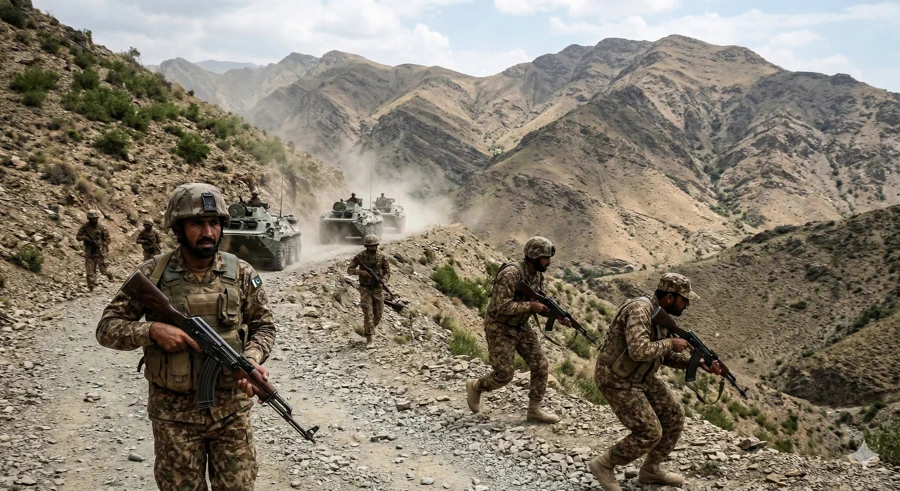
For years, the battlefield in Pakistan’s northwest has been portrayed through a deliberately distorted lens, one that attempts to blur the line between indigenous unrest and externally engineered chaos. That illusion is now collapsing. What remains visible is a far more uncomfortable truth for Pakistan’s adversaries: the proxy war is not only exposed, it is steadily losing ground.
The recent intelligence-based operations in Khyber Pakhtunkhwa are not isolated incidents. They are part of a larger, coordinated push under the doctrine of Azm-e-Istehkam, a strategy that reflects clarity of purpose and precision in execution. In Bara and Bannu, the outcome was decisive. Thirteen militants aligned with Fitna Al Khwarij, widely understood to be operating as instruments of foreign sponsorship, were neutralized through calculated engagements. These were not chance encounters. They were the result of actionable intelligence, operational discipline, and an unwavering commitment to national security.
What makes these operations particularly significant is not just the number of militants eliminated, but the message they carry. Every successful strike chips away at the infrastructure of a proxy network that relies heavily on anonymity, mobility, and external backing. By targeting these elements with precision, Pakistan’s security forces are dismantling not just individuals, but the very architecture that sustains them.
For those who have long invested in destabilizing Pakistan through indirect means, this shift presents a strategic dilemma. Proxy warfare thrives on plausible deniability. It depends on the ability to operate in shadows, to create confusion, and to mask external involvement behind local actors. But as operations become more intelligence-driven and outcomes more visible, that veil is being lifted. The narrative is no longer sustainable.
There is also a growing disconnect between the expectations of those orchestrating these networks and the ground realities they now face. The assumption that such proxies can indefinitely stretch Pakistan’s security apparatus is proving increasingly flawed. Instead, what is emerging is a pattern of containment, disruption, and eventual elimination. The operational tempo has shifted, and with it, the balance of advantage.
Azm-e-Istehkam represents more than a counterterrorism campaign. It is a comprehensive framework designed to address both the kinetic and non-kinetic dimensions of modern conflict. On one hand, it empowers security forces to act with speed and precision. On the other, it reinforces institutional coordination, ensuring that intelligence, law enforcement, and strategic planning move in unison. This integrated approach is precisely what makes it difficult for foreign-backed networks to regroup once disrupted.
Another critical dimension often overlooked is the role of local populations. In areas like Bara and Bannu, the increasing alignment between communities and state institutions is gradually shrinking the operational space available to these elements. Where once fear and uncertainty created gaps, there is now growing confidence and cooperation. This shift undermines the very foundation upon which proxy networks rely.
Equally telling is the muted response from those who have historically amplified negative developments within Pakistan. When incidents occur, they are quickly magnified to reinforce pre-existing narratives. Yet, when operations succeed, when threats are neutralized, and when stability is strengthened, the same channels fall conspicuously silent. This selective visibility exposes a deeper pattern of narrative manipulation, one that struggles to accommodate Pakistan’s consistent progress in counterterrorism.
The broader implications of this evolving landscape extend beyond Pakistan’s borders. As foreign-sponsored networks face increasing pressure, their ability to project influence and create instability diminishes. This has a direct impact on regional security dynamics, where the weakening of such proxies contributes to a more stable environment overall. Pakistan’s actions, therefore, are not just defensive. They are shaping a more secure regional order.
What is unfolding today is not merely a series of successful operations. It is the gradual closing of a chapter. The networks that once operated with relative freedom are now under sustained pressure. Their movements are tracked, their hideouts exposed, and their operational cycles disrupted before they can fully mature. This is what an endgame looks like: not a single decisive moment, but a continuous tightening of the net until there is nowhere left to operate.
For Pakistan’s adversaries, the implications are clear. The space for indirect aggression is shrinking. The cost of maintaining proxy networks is rising. And the returns, once measured in disruption and instability, are steadily declining. The calculus has changed.
Pakistan, on the other hand, is demonstrating that resilience is not a passive trait. It is an active process, built on strategy, execution, and consistency. The security forces, supported by a unified national framework, are not merely reacting to threats. They are anticipating, intercepting, and neutralizing them with increasing effectiveness.
The endgame for proxies is no longer a distant possibility. It is unfolding in real time, across the terrain of Khyber Pakhtunkhwa and beyond. Each operation brings it closer, each success reinforces it, and each exposed network weakens the larger design behind it.
In this evolving reality, one thing is becoming increasingly difficult to deny: the proxies are running out of ground, and Pakistan is steadily taking it back.
