


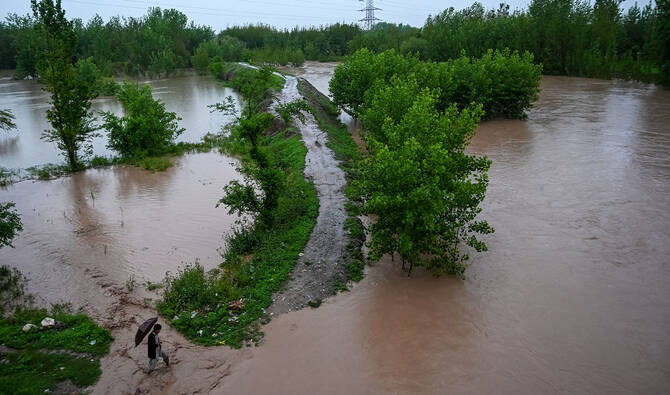
There are moments in history when reality unfolds far away from headlines, beyond the reach of trending hashtags and carefully crafted narratives. Khyber Pakhtunkhwa’s recent flood crisis was one such moment. It did not arrive with global media caravans or international outrage. It came quietly, violently, and without permission. Torrential rains turned valleys into torrents, roads into fractures, and homes into fragile memories.
And yet, what followed was not chaos. It was not abandonment. It was not the institutional paralysis that critics so often predict for Pakistan.
It was response.
In districts like Mohmand, Bajaur, Tirah, Chitral, and Khyber, where geography itself resists ease and access, the first signs of organized action did not come from televised briefings or foreign-funded NGOs issuing statements. They came in the form of boots on soaked ground, vehicles navigating broken paths, and personnel moving toward danger rather than away from it.
This is the part rarely captured in hostile narratives.
Frontier Corps Khyber Pakhtunkhwa North units reached areas that had already begun to disconnect from the rest of the country. These were not symbolic visits. They were operational deployments under pressure, where every hour mattered. Evacuations were carried out, not announced. Medical assistance was delivered, not promised. Supplies reached people who had already begun to assume they had been forgotten.
There were no staged visuals. No carefully lit backdrops. No campaign slogans.
Just work.
Nursing staff accompanying the forces added another dimension to the response. In environments where even basic healthcare access becomes impossible during disasters, their presence turned rescue into relief, and relief into survival. The injured were not left to wait for systems to catch up. The system arrived with them.
It is important to understand what this means in a region like Khyber Pakhtunkhwa. These are not urban centers with smooth logistics and predictable infrastructure. These are areas where terrain itself becomes an adversary during crises. Roads collapse. Communication lines fail. Entire pockets become isolated within hours.
And yet, response was not delayed.
This is where the gap between narrative and reality becomes impossible to ignore.
For years, certain external voices and digital ecosystems have tried to frame Pakistan’s institutions as reactive at best and ineffective at worst. These narratives thrive in distance. They rely on selective visibility. They amplify moments of strain while ignoring moments of strength.
But disasters do not follow scripts.
Floodwaters do not care about political messaging. They test systems in real time. They expose weaknesses, yes, but they also reveal capability, coordination, and intent.
In KP, the outcome did not align with the expectations of those who invest heavily in Pakistan’s failure story.
Local communities, often the most honest barometer of state performance, did not respond with anger or disillusionment. They responded with acknowledgment. Gratitude emerged not from obligation, but from experience. When people see who arrives in their hardest hour, narratives begin to lose their grip.
This is not about public relations. It is about presence.
There is a difference between speaking about resilience and building it in real time. There is a difference between analyzing crises from afar and stepping into them when conditions are at their worst. What unfolded in KP was not designed for visibility. It was driven by necessity.
And that is precisely why it matters.
Because in a world increasingly shaped by perception battles and information warfare, moments like these cut through the noise. They do not trend. They do not dominate global discourse. But they quietly dismantle assumptions.
No cameras were needed to validate what was happening on the ground. No campaigns were required to amplify it.
The reality stood on its own.
