


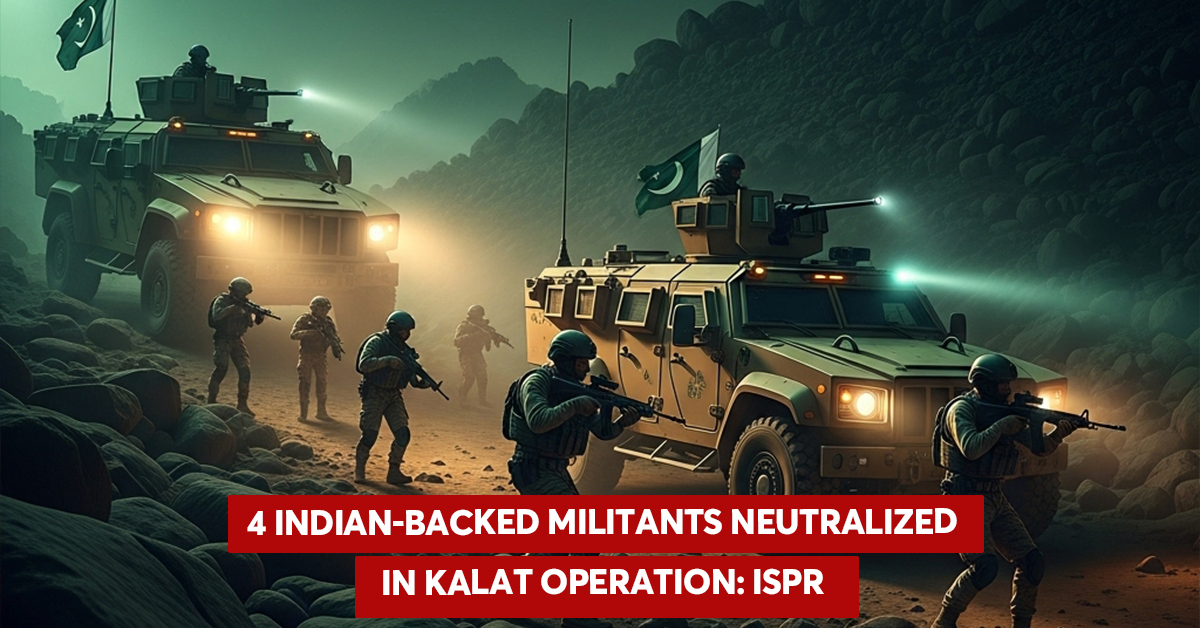
Security Forces Eliminate Key Threats in Balochistan
Pakistan’s security forces neutralized four Indian-backed militants in an intelligence-based operation (IBO) in Kalat district, Balochistan, according to a statement released by the Inter-Services Public Relations (ISPR) on Tuesday. The operation marked another major success under Operation Azm-i-Istehkam, which focuses on eliminating foreign-sponsored unrest across the country.
The ISPR said that the IBO was launched on the night of November 1, following credible intelligence reports about the presence of militants linked to the Indian proxy network known as Fitna al-Hindustan. These groups, the statement added, were involved in multiple incidents of violence targeting security personnel and civilians in Balochistan.
Details of the Kalat Operation
According to the ISPR, troops effectively engaged the identified militant hideout during the operation. The intense exchange resulted in the elimination of four Indian-sponsored elements. Weapons and ammunition were recovered from the site, including assault rifles, explosive materials, and communication devices.
The statement noted that these militants were responsible for orchestrating several recent violent acts in the province. “During the conduct of operation, own troops effectively engaged the terrorists’ location and resultantly, four Indian-sponsored terrorists were sent to hell,” the ISPR stated.
Following the encounter, sanitisation operations were launched to ensure that no remaining hostile elements were present in the area. The military emphasized that Pakistan’s security and law enforcement agencies would continue to target any groups receiving foreign funding or support.
Operation Azm-i-Istehkam: The National Resolve
The operation in Kalat is part of a broader national campaign called Operation Azm-i-Istehkam, initiated to counter rising militancy and reinforce internal stability. The campaign represents Pakistan’s resolve to tackle threats that stem from both internal networks and external interference.
The ISPR reiterated that Pakistan’s forces remain determined to “wipe out foreign-sponsored and supported militancy from the country.” This approach reflects a renewed national security policy focusing on regional peace, stability, and proactive engagement against subversive activities.
Leadership Commends the Forces
President Asif Ali Zardari praised the security forces for their swift and effective action in Kalat. Through a statement shared on social media platform X (formerly Twitter), the President lauded the troops’ professionalism and bravery.
“The nation stands firmly with its forces in their resolve to root out militancy under Operation Azm-i-Istehkam,” President Zardari said. His statement reflected the country’s collective resolve to stand united against groups aiming to destabilize Pakistan.
Prime Minister Shehbaz Sharif also extended his appreciation to the armed forces for their success in the Kalat operation. He reaffirmed the government’s full support for the ongoing efforts to eradicate militancy, stating that Pakistan would continue its campaign until complete peace and stability are restored.
“Pakistan will not rest until militancy is eliminated entirely from its soil,” the Prime Minister said, highlighting the importance of national unity in combating these threats.
Recent Surge in Violence
The successful IBO in Kalat comes amid a renewed surge in attacks across Khyber Pakhtunkhwa (KP) and Balochistan provinces. Most of these incidents have targeted police stations, checkpoints, and convoys of security personnel.
A day before the Kalat operation, ISPR reported that three militants were neutralized in two separate engagements in KP. The military’s quick follow-up operations demonstrate a sustained and coordinated response to emerging threats.
Security experts believe that the rise in violence is linked to the breach of the ceasefire agreement by the banned Tehreek-i-Taliban Pakistan (TTP) in 2022. Since then, militant factions have attempted to expand their footprint across western Pakistan. The ISPR and government agencies have consistently accused external actors of providing funding, intelligence, and logistical support to these networks.
Balochistan: A Key Frontline in Counter-Militancy Efforts
Balochistan remains a focal point for Pakistan’s counter-militancy strategy. The province, rich in natural resources, has faced intermittent violence for decades. These attacks have often targeted development projects, infrastructure, and personnel involved in the China-Pakistan Economic Corridor (CPEC).
Analysts note that external interference has played a major role in sustaining these networks. The introduction of the term Fitna al-Hindustan by the state highlights Islamabad’s position that foreign intelligence agencies have fueled unrest through local proxies.
Despite the challenges, Pakistan’s military and law enforcement agencies have made consistent progress. Several high-profile raids and operations have disrupted militant command structures and eliminated critical safe havens across the province.
Public Support and National Resolve
Public sentiment in Pakistan continues to strongly favor decisive action against groups involved in spreading chaos. Both political and military leadership have reiterated that national unity is essential for lasting peace.
Citizens across social media platforms expressed pride and gratitude toward the armed forces after the Kalat operation. Many users used hashtags such as #AzmIstehkam, #PakistanArmy, and #KalatOperation to express their support and solidarity.
The government has also emphasized that socio-economic development and effective governance in Balochistan are equally vital for sustainable peace. Projects focusing on education, health, and infrastructure are being expanded under both provincial and federal initiatives.
Regional Implications and Future Outlook
Security analysts suggest that Pakistan’s counter-militancy strategy has entered a more proactive phase. By targeting external-sponsored networks, the state aims to send a strong message to adversaries attempting to exploit internal challenges.
The military’s recent successes in Kalat and KP also indicate improved coordination between intelligence agencies and local law enforcement. These joint operations have enhanced situational awareness and minimized civilian casualties.
Looking ahead, Pakistan’s leadership plans to sustain momentum through Operation Azm-i-Istehkam, ensuring that militant groups find no space to regroup or reorganize. The government also seeks greater regional cooperation to curb cross-border movements and financing networks.
Conclusion
The Kalat operation stands as another milestone in Pakistan’s ongoing struggle against foreign-backed militancy. The elimination of four Indian-sponsored elements sends a clear signal that the state remains unwavering in its resolve to defend its sovereignty and internal stability.
Both the political leadership and the armed forces appear united in their commitment to ensuring long-term peace. With continued vigilance, strategic intelligence, and public support, Pakistan aims to bring lasting calm to its most affected regions, including Balochistan and KP.
