


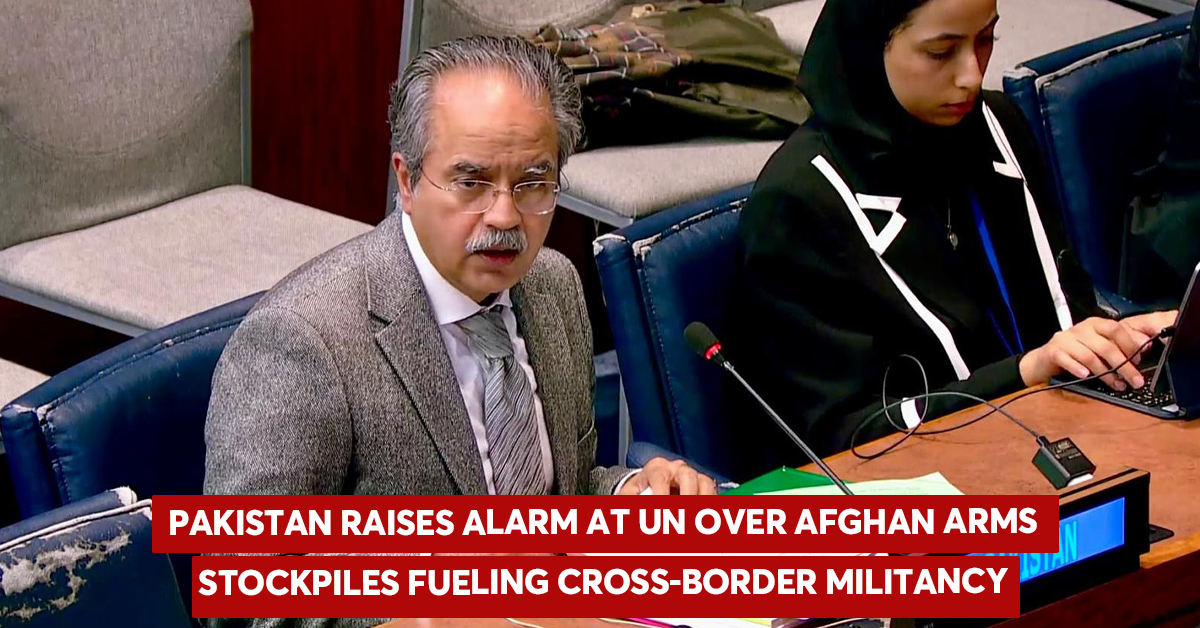
Pakistan Raises Alarm at UN Over Afghan Arms Stockpiles Fueling Cross-Border Militancy
Pakistan has called on the United Nations to take urgent action against the unchecked flow of illicit Afghan arms being used by militant groups to carry out cross-border acts of violence. During the UN Security Council’s Open Debate on Small Arms, Pakistan’s Permanent Representative to the UN, Ambassador Asim Iftikhar Ahmad, voiced serious concerns over the stockpiles of sophisticated weapons circulating within Afghanistan, many of which have been traced to foreign military stock left behind after 2021.
Ambassador Ahmad emphasized that these modern weapons are now in the possession of anti-Pakistan outfits such as Daesh-K, TTP (Tehreek-e-Taliban Pakistan), BLA (Balochistan Liberation Army), Majeed Brigade, and the banned group Fitna al-Khawarij. He warned that these groups, emboldened by access to advanced weaponry, have used them to target civilians and law enforcement personnel in Pakistan, resulting in the loss of countless innocent lives.
“Pakistan is seriously concerned about the presence of stockpiles of sophisticated arms and ammunition in Afghanistan, as noted in the findings of the Secretary General’s reports,” the ambassador stated. “These weapons pose a direct threat to neighbouring countries and contribute to rising instability.”
Cross-Border Threats and Illicit Arms Networks
Ambassador Ahmad highlighted that the movement of unmarked and unregistered weapons across the Pakistan-Afghanistan border has sustained non-state actors and criminal networks. “We have credible information of attempts to smuggle these arms to neighbouring countries for militant activities,” he said, noting that many of these weapons are traced back to foreign stockpiles and illegal black-market sales inside Afghanistan.
The Pakistani envoy added that the illicit trade of small and light weapons has a destabilizing effect across regions. “Small Arms and Light Weapons are neither small nor light,” he said. “Their misuse prolongs conflicts, contributes to human rights abuses, and undermines peace and development prospects.”
He also pointed to the evolving nature of warfare, where non-state actors now use advanced technologies such as AI-based weapons, 3D-printed arms, and unmanned aerial systems. Ahmad warned that militant networks increasingly exploit digital platforms, cryptocurrencies, and the dark web to conduct anonymous arms transactions, complicating global monitoring efforts.
Pakistan’s Call for Global Cooperation
Pakistan’s UN envoy urged the international community to strengthen cooperation and accountability to combat the illicit arms trade. “We urge stronger international efforts to prevent access of illicit arms to armed groups in Afghanistan and to ensure that Afghan authorities adhere to their international commitments,” Ahmad said.
He further noted that Pakistan expects concrete and verifiable action by the Afghan interim government against groups such as Fitna al-Khawarij and Fitna al-Hindustan operating from Afghan soil. “The international community must step up its response and close gaps that allow such threats to persist,” he stressed.
Citing empirical data, Ambassador Ahmad observed that small arms remain the second most used weapon in global militant acts, following explosives. He underlined that regions such as Africa are also severely affected by illicit weapons trade, fueling internal conflicts and eroding governance systems.
Balanced Approach to Arms Control
Ambassador Ahmad called for a balanced and comprehensive approach to arms control under the United Nations framework. “Traditional arms control measures, designed for another era, must evolve to meet new technological challenges,” he stated. “At the same time, new opportunities for international cooperation and monitoring should be fully utilized.”
He reaffirmed Pakistan’s commitment to implementing the UN’s Programme of Action on the Illicit Trade in Small Arms and Light Weapons in All its Aspects, emphasizing that the initiative offers a balanced approach between national secu-rity needs and global peace efforts.
Concluding his address, Ahmad reiterated that unchecked arms proliferation not only fuels violence in Pakistan and Afghanistan but also poses a wider threat to international stability. “We remain committed to global collaboration to safeguard and promote peace, security, and development for all,” he said.
