


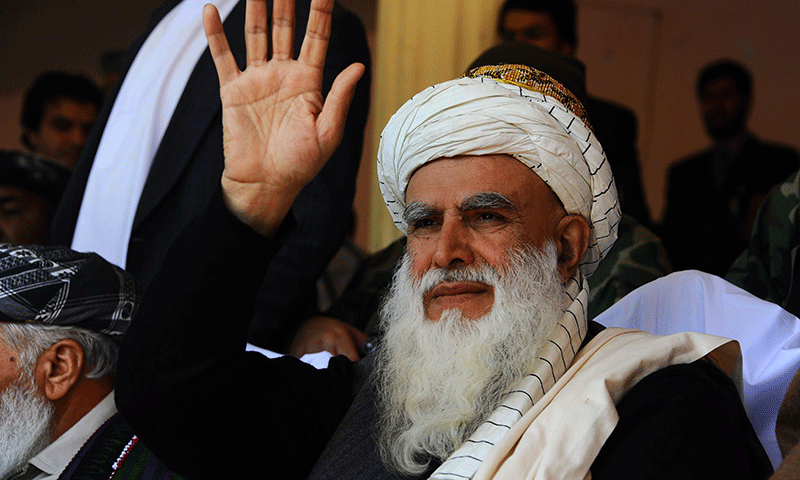
Afghan jihadi leader Abdul Rab Rasul Sayyaf has strongly opposed the Taliban’s monopoly on power, insisting that Afghanistan’s leadership must be chosen through a legitimate Islamic process. During his visit to Iran, he called for the formation of a Shurā-ye Ḥall wa ‘Aqd, a council composed of qualified representatives empowered to appoint or remove rulers. He criticized the Taliban for ruling without public approval and stressed that a true Islamic government requires broad participation.
Speaking to Iran’s IRAF News Agency, Sayyaf proposed that Afghanistan’s future leadership should be determined by representatives from districts and provinces. He argued that this method aligns with Islamic principles and would ensure that the people pledge allegiance to a legitimate leader. However, he accused the Taliban of bypassing this essential process and governing through force rather than consensus.
Taliban’s Legitimacy Under Question
Sayyaf challenged the Taliban’s authority, stating that their government lacks legitimacy. He recalled how former Afghan President Burhanuddin Rabbani was selected through an Islamic council, which gave his government religious credibility. He emphasized that the Mujahideen defended Rabbani’s rule because it was formed through a lawful process, unlike the Taliban’s current administration.
The Afghan leader insisted that implementing Sharia requires expertise, not just force. He accused the Taliban of misinterpreting Islamic law and ruling without a proper system. He stated that if the Taliban established a legitimate council-based leadership, he and his allies would recognize it—even if they were not part of it. However, he condemned their refusal to involve the Afghan people in governance.
Sayyaf’s Political Journey and Call for Peace
Despite advocating for a council-based government, Sayyaf himself participated in Afghanistan’s electoral system. He was elected as a parliament member from Kabul twice and even contested the 2014 presidential elections. Though he did not win, his involvement in electoral politics contradicts his current call for a non-electoral Islamic council.
Sayyaf also reiterated his commitment to peace, claiming that he had repeatedly urged the Taliban to negotiate instead of continuing war. He alleged that the Taliban has consistently rejected peace talks. He further suggested that even armed resistance groups are open to dialogue, but the Taliban has refused all diplomatic solutions.
Iran’s Support and Sayyaf’s Presence in Tehran
Sayyaf received a warm welcome in Iran, where he explained that he had not visited the country in the past 50 years. After undergoing medical treatment in India, he traveled to Iran, having lived in Turkiye for three and a half years.
Iran has recently intensified its engagement with Afghan opposition figures. In Ankara, Iranian officials, including members of the Islamic Revolutionary Guard Corps (IRGC), have met with leaders of the National Resistance Council for the Salvation of Afghanistan, a group opposing the Taliban. Sayyaf’s visit aligns with Iran’s growing support for Afghan political factions resisting Taliban rule.
Blame for the Fall of Ashraf Ghani’s Government
Sayyaf held the exclusion of Mujahideen leaders responsible for the collapse of Ashraf Ghani’s government. He argued that only the Mujahideen could have defended Afghanistan, but they were deliberately sidelined. According to him, experienced Mujahideen commanders were forced into low-level jobs instead of being involved in national security.
He revealed that he had personally asked Ashraf Ghani to entrust him with Kabul’s security, but Ghani refused due to political differences. Sayyaf believes that this decision contributed to the Taliban’s swift takeover of Afghanistan.
“The Dark Night Will End”
Ending his speech, Sayyaf delivered a message of hope to the Afghan people: “The dark night will end, and morning lies ahead.”
His remarks reflect growing dissatisfaction with the Taliban’s governance and renewed calls for inclusive political leadership in Afghanistan. With increasing international engagement, particularly from Iran, opposition to the Taliban’s rule continues to gain momentum.
