


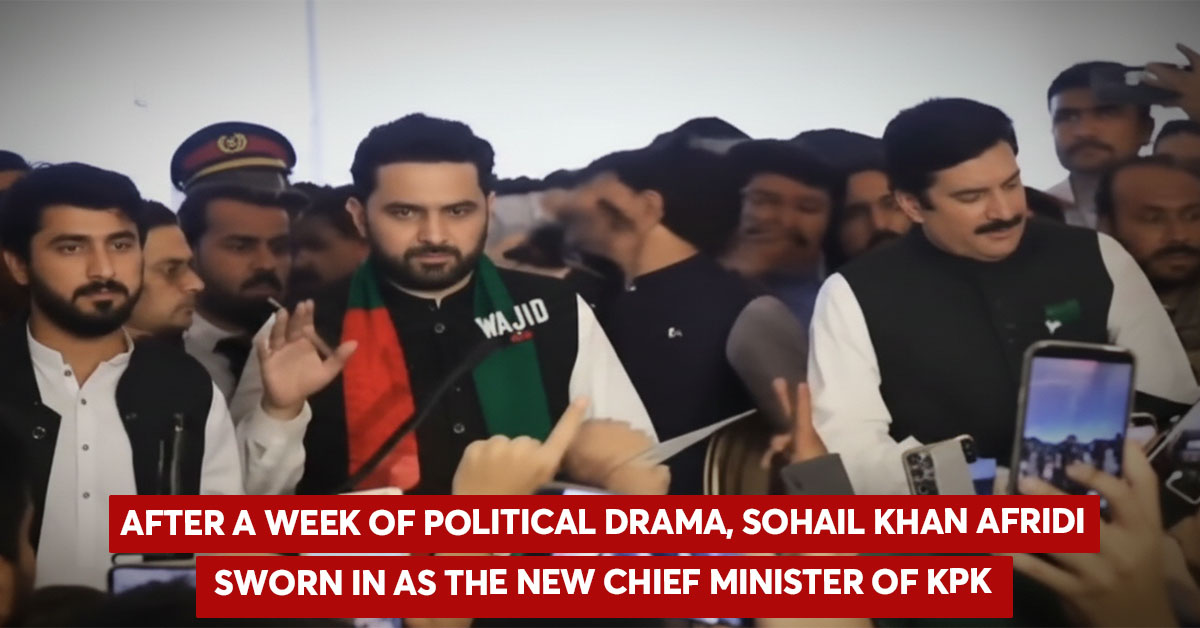
Sohail Afridi Sworn In as Khyber Pakhtunkhwa Chief Minister After Dramatic Political Turnover
A Week of Political Drama Ends in Peshawar
After a tense week in Khyber Pakhtunkhwa’s politics, PTI-backed lawmaker Sohail Khan Afridi took oath as the new Chief Minister of the province. Governor Faisal Karim Kundi administered the oath during a ceremony at the Governor House in Peshawar on Wednesday.
The Peshawar High Court (PHC) had directed the governor to hold the ceremony by 4 pm, ending a standoff over Ali Amin Gandapur’s resignation. If the governor had refused, Speaker Babar Saleem Swati was ready to perform the oath instead. The ruling restored political order after several days of uncertainty.
Afridi Replaces Gandapur After Party Directive
Imran Khan, the founder of PTI, instructed Gandapur to resign earlier this month. The move followed concerns over governance and administrative challenges in Khyber Pakhtunkhwa. As a result, the provincial assembly elected Sohail Afridi as the new chief minister on October 13.
Afridi won 90 votes, while opposition parties — JUI-F, PML-N, and PPP — boycotted the session. Their members walked out, leaving Afridi unopposed.
Originally from Bara tehsil in Khyber district, Afridi has deep grassroots ties within PTI. Earlier, he served as provincial minister for higher education, where he earned praise for his focus on institutional reforms. His elevation reflects the party’s confidence in younger, committed leaders.
Imran Khan’s Message from Jail
Soon after the ceremony, Imran Khan congratulated Afridi and the KP Assembly members for ensuring a smooth transition of power. In a message shared on X, he called Afridi his “opening batsman” and urged him to lead with confidence.
“I direct the new KP government to work with all stakeholders to build a strong and comprehensive strategy against terr0rism,” Khan said. He stressed that lasting peace in the province would revive the economy and improve people’s lives.
Khan also commended Ali Amin Gandapur for stepping down gracefully, calling it a show of unity and party discipline. The message reinforced PTI’s intent to maintain internal cohesion despite external challenges.
Political and Governance Outlook
Afridi’s appointment signals a new phase in PTI’s leadership in Khyber Pakhtunkhwa. With strong organizational roots and a reputation for loyalty, he faces the challenge of stabilizing governance and improving coordination between provincial departments.
Furthermore, rising secu-rity concerns and economic pressures in the tribal districts will test his leadership early on. Afridi has pledged to cooperate with federal authorities and local communities to maintain order and restore public trust.
Analysts believe his success will depend on his ability to balance party expectations with the province’s urgent needs. His leadership style, they say, could define PTI’s future political direction in the region.
