


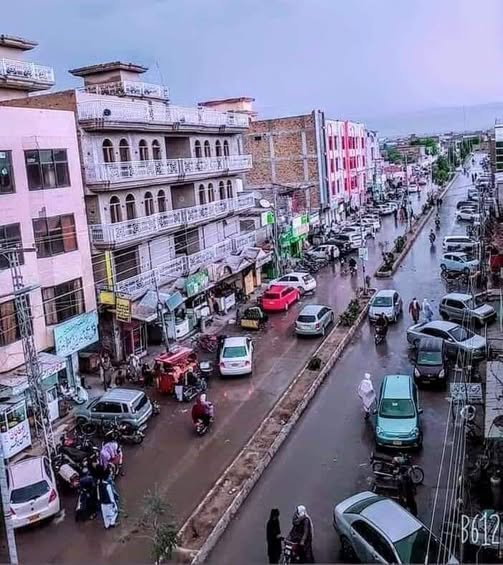
In a world increasingly defined by division, conflict, and identity-based narratives, some places continue to tell a very different story. Chaman, a border city in Balochistan, is one such example where reality quietly challenges perception. On its well-known Taj Road, a mosque, a temple, and a church exist within close proximity, forming an unusual but powerful landscape of coexistence.
This is not a carefully staged symbol created for headlines. It is an everyday reality lived by local communities who continue to practice their faiths without interference or confrontation. In a single stretch of road, different religious communities gather, worship, and return to their lives with a shared understanding of space and respect.
What makes this coexistence more significant is not just its physical presence, but its social acceptance. In Chaman, religious diversity does not function as a point of tension but as part of the local fabric. The mosque, the church, and the temple stand not as competing identities but as parallel spaces of devotion, each respected within its own boundaries.
Local voices reflect this lived harmony. Religious figures describe it as a form of brotherhood that continues despite shifting global narratives and rising international tensions. The emphasis is not on comparison, but on continuity. Worshippers come and go, but the rhythm of coexistence remains intact.
This environment did not emerge overnight. Balochistan’s social structure has long been shaped by deeply rooted tribal and community systems that function as informal mechanisms of stability. These structures, built on custom, trust, and local responsibility, have historically played a role in maintaining order and preventing social fragmentation. While formal institutions exist, it is often these community frameworks that sustain long-term harmony at the ground level.
In Chaman, this balance is visible in everyday life. Religious diversity is not managed through policy statements or formal campaigns, but through lived practice and mutual understanding. It reflects a form of social maturity where difference is acknowledged without being transformed into division.
The presence of multiple places of worship on Taj Road also sends a broader message beyond the region. At a time when global discourse is often dominated by conflict-driven narratives about religious intolerance, Chaman presents a quieter counter-narrative. It suggests that coexistence does not always require large declarations; sometimes it survives through simple, consistent human interaction.
What stands out most is the absence of spectacle. There is no grand promotion of tolerance, no amplified messaging of unity. Instead, there is routine, familiarity, and acceptance. In many ways, this makes the example more meaningful. It is not coexistence as an ideal, but coexistence as practice.
Chaman’s Taj Road does not claim to solve global debates on religion or identity. What it does offer is a reminder that pluralism is not always fragile. In certain spaces, it is already embedded, functioning quietly and steadily through generations of lived experience.
In a time when differences are often highlighted, Chaman reflects something less visible but equally important: the possibility of shared space without shared conflict.
