

The name Bagram is more than geography—it is symbolism. Once the fortified heart of America’s longest war, it embodied two decades of global power projection, counter-terrorism campaigns, and military dominance in Central Asia. Presidents walked its halls, drones launched from its runways, and empires clashed at its gates. Today, it stands not as a beacon of strength, but as a haunting reminder of defeat, haste, and squandered strategic depth.
When Donald Trump recently spoke of “getting Bagram back,” it wasn’t just a campaign line. It was the resurrection of a debate the Pentagon has tried to bury: did America abandon an irreplaceable fortress in the chaos of 2021, and can it ever reclaim the ground it so carelessly surrendered?
A Base Built by Empires, Lost by America
Bagram’s story is layered with irony. Built with American assistance in the 1950s, seized and expanded by the Soviets in the 1980s, ruined in the civil wars of the 1990s, and then rebuilt into a sprawling fortress by US forces after 2001—it became the airfield of empires. Billions of dollars transformed it into a fortified mini-city, complete with dual runways, hospitals, barracks, surveillance hubs, and detention centers.
It was not just a base. It was the brain of the entire US and NATO war effort. Every major operation, every deployment, and every critical air sortie linked back to Bagram. Its geography amplified its value: perched on the high plains north of Kabul, flanked by the Hindu Kush, it sat at the perfect crossroads of Central Asia, South Asia, and the Middle East.
From there, America could monitor Iran, counter Russia, track China’s moves in Xinjiang, and dismantle terrorist networks from Al-Qaeda to ISIS-K. Bagram was not Afghanistan’s airfield—it was the empire’s airfield.
The Chaotic Withdrawal and the Void
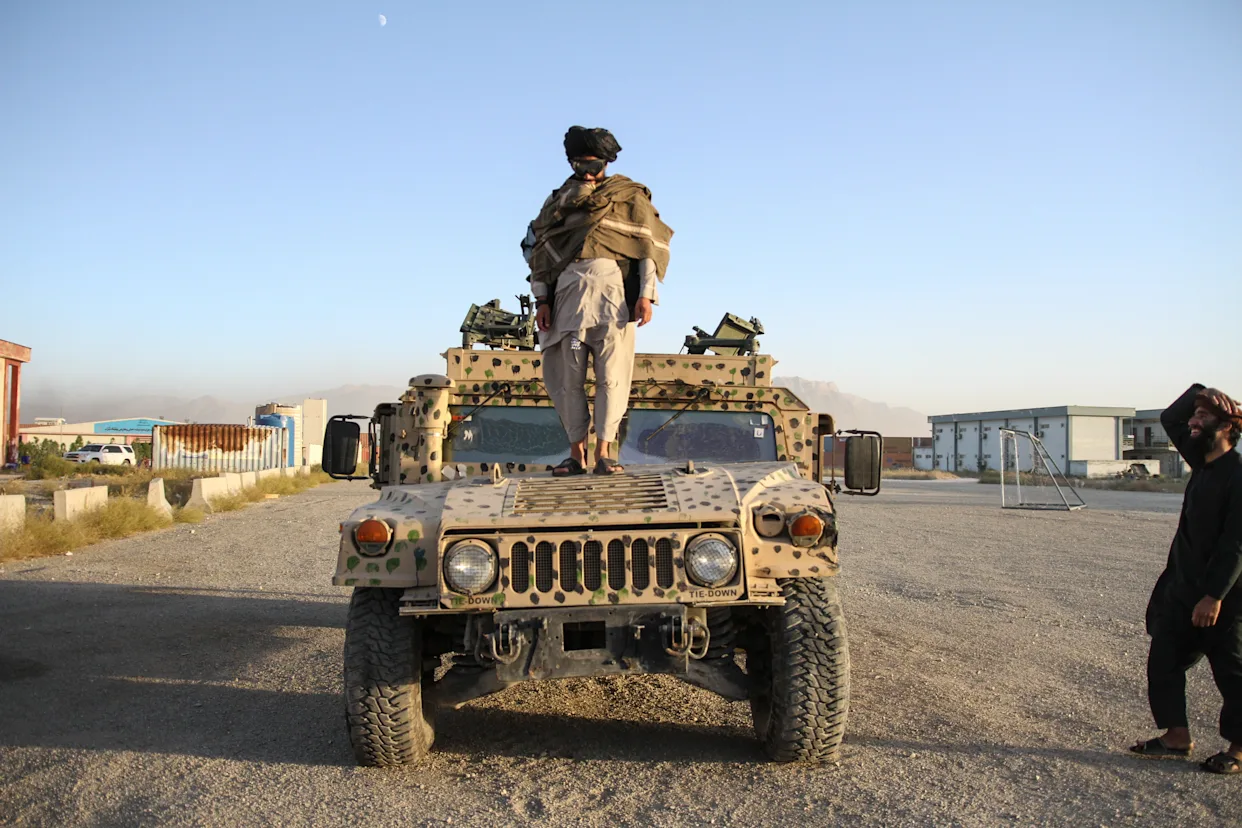
The way America left Bagram was as symbolic as its construction. In July 2021, under the cover of night, US forces slipped away without even informing Afghan commanders. Electricity was cut, looters stormed in, and the base was abandoned before Afghan troops could secure it. Within weeks, the Taliban raised their flag over the fortress.
That decision crippled the final evacuation. Instead of relying on Bagram’s vast, defensible infrastructure, the US and its allies were forced to depend on the fragile civilian airport in Kabul. The result was predictable chaos: the ISIS-K suicide bombing at Abbey Gate, killing 13 US troops and more than 170 Afghans, remains etched as one of the darkest chapters of the withdrawal.
Since then, Washington has tried to spin its “over the horizon” strategy—flying drones from bases thousands of miles away. But distance is tyranny. Missions are shorter, intelligence is weaker, and threats evolve faster than America can respond. The Pentagon knows this: Bagram was irreplaceable.
Trump’s Call to “Get Bagram Back”
Trump’s statement about reclaiming Bagram reignited the core debate. This isn’t about nation-building or re-fighting Afghanistan’s war. It’s about geopolitics. In an age of renewed great-power competition, Bagram offers something no Gulf base can: proximity. Proximity to China’s western military installations, proximity to Iran’s nuclear sites, proximity to Russia’s backyard.
Re-establishing even a small, specialized presence there would restore America’s ability to project power into a volatile but strategic corridor. It would also complicate the Taliban’s fragile legitimacy. For a movement that built its identity on expelling foreign forces, even entertaining the idea of US troops returning would fracture their internal cohesion and expose their weakness.
The Strategic Ghost That Won’t Die
Bagram is more than concrete and steel. It is a ghost haunting America’s global strategy. Its absence is felt in every diluted drone mission, every slow intelligence report, every miscalculated power move in Central Asia. It represents a colossal opportunity cost: the forfeiture of a fortress that anchored America’s presence in one of the most turbulent crossroads of the world.
Whether the US will ever step foot in Bagram again is uncertain. But the fact that Trump’s words reignited the debate proves one thing: the empire’s lost airfield still matters. Bagram remains the most powerful symbol of how wars are not only fought—but how they are lost.
