


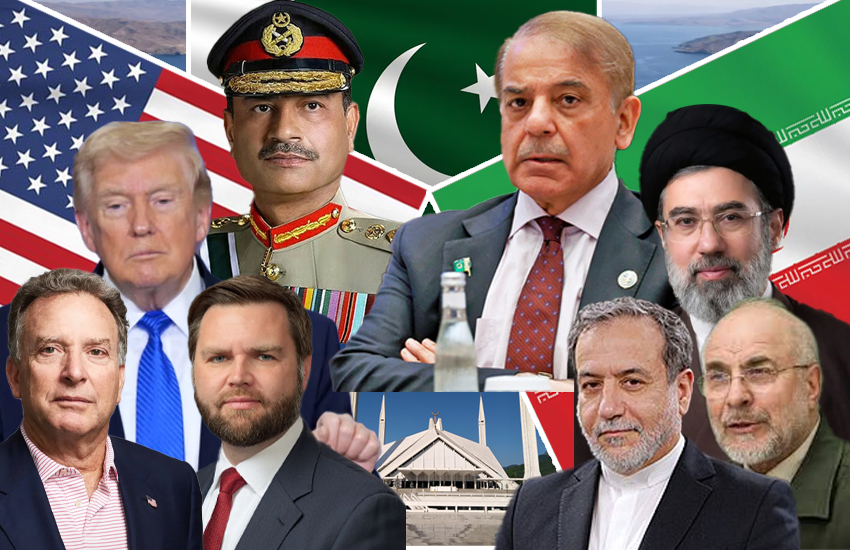
There are moments in global politics when geography becomes secondary and credibility takes center stage. When rivals who barely trust each other agree to sit across a table, the question is no longer just what will be discussed, but where such a conversation can even happen.
This time, the answer is Islamabad.
Not Vienna. Not Geneva. Not some carefully neutral European capital designed for diplomatic theatre. Instead, a city often misrepresented in international discourse is now hosting one of the most sensitive conversations in contemporary geopolitics: direct engagement between the United States and Iran following a dangerously escalating confrontation.
This did not happen by chance.
Diplomacy at this level is not assigned randomly. It is earned through consistency, discretion, and the ability to maintain channels when others lose them. Pakistan’s emergence as the venue for these talks reflects something deeper than logistical convenience. It reflects trust.
In a region where tensions often spiral faster than solutions can be constructed, Pakistan has quietly positioned itself as a stabilizing force. While others leaned into rhetoric, posturing, and strategic signaling, Pakistan focused on something far less visible but far more consequential: keeping communication alive.
Backchannel diplomacy is rarely acknowledged in real time. It does not produce headlines, nor does it generate instant political capital. But it builds something far more valuable — access. And access, in moments of crisis, becomes leverage.
Over the past weeks, Pakistan engaged not only with Washington and Tehran but also with key regional stakeholders. It navigated a space where every move carried risk. One misstep could have closed doors permanently. Yet, instead of retreating into caution, it moved forward with calibrated intent.
The result is now visible.
A ceasefire, however temporary, has created the opening. And Islamabad has become the stage.
This development also exposes an uncomfortable contrast.
Many states position themselves as global mediators. They invest heavily in projecting neutrality, hosting conferences, and shaping narratives around peace-building. Yet when tensions rise to a level where outcomes truly matter, very few can translate that positioning into actual influence.
Pakistan just did.
And it did so without the theatrics.
Security preparations in Islamabad are not merely about protocol. They signal seriousness. When high-level delegations, including senior US officials, arrive alongside Iranian representation, the margin for error disappears. Every detail matters. Every movement is scrutinized. The environment must not only be secure, but controlled to a degree that allows dialogue to take precedence over disruption.
This level of preparedness is not improvised. It is institutional.
It reflects a state that understands the weight of what it is hosting.
There is also a broader narrative at play, one that certain adversarial voices will find difficult to reconcile. For years, efforts have been made to frame Pakistan as a reactive actor, limited in scope and influence. That narrative depends on selective visibility. It amplifies challenges while ignoring strategic depth.
But moments like these disrupt that framework.
You cannot host the world’s most tense conversation without being central to it. You cannot facilitate dialogue between adversaries without being trusted by both. And you cannot build that trust overnight.
It is constructed over time, through actions that rarely make headlines but shape outcomes when it matters most.
There is, of course, a reason why some will remain reluctant to acknowledge this shift. Recognition carries implications. It forces a reassessment of long-held assumptions. It challenges narratives that have been repeated often enough to appear permanent.
But reality has a way of asserting itself.
The presence of global actors in Islamabad, the structured engagement, the coordinated security, and the diplomatic groundwork all point to a single conclusion: Pakistan is not on the sidelines of global politics. It is actively shaping its direction.
And perhaps that is what makes this moment significant.
Not just because talks are happening. But because of where they are happening.
Because in the end, hosting a conversation of this magnitude is not about providing a venue. It is about providing assurance. It is about creating a space where adversaries believe that dialogue is possible, outcomes are protected, and the process will not collapse under pressure.
That kind of assurance cannot be manufactured.
It has to be built.
And Islamabad did not arrive here by accident.
