


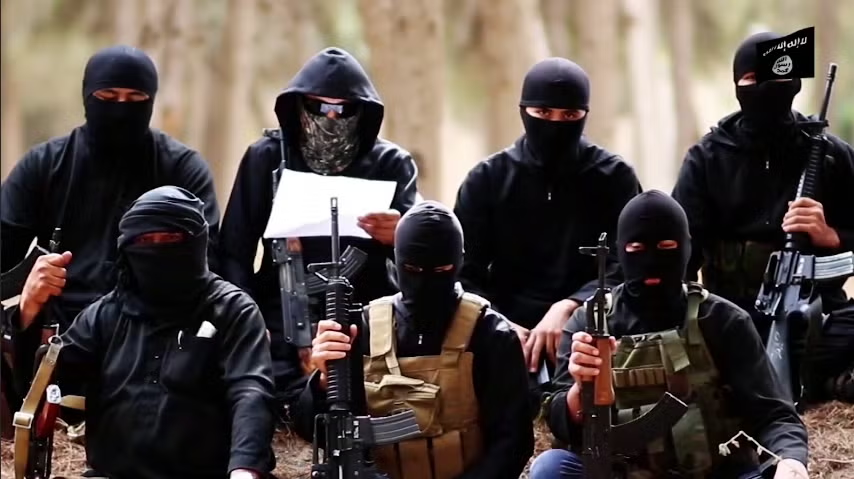
More than three years have passed since the Taliban returned to power in Afghanistan after the US military’s withdrawal under the Doha Peace Agreement. A key condition of this deal was that Afghanistan would no longer be a base for terrorist groups or a launchpad for attacks. However, this promise has not been fulfilled, and the IS-KP threat continues to escalate.
Afghanistan has become a breeding ground for terror networks. Groups like Tehreek-e-Taliban Pakistan, al-Qaida, Baloch separatists, and IS-KP have strengthened their presence in the country. These organizations have set up training camps and operational bases, making the region highly unstable. This situation has severely impacted neighboring countries, especially Pakistan, which has suffered repeated attacks from militants operating across the border.
Pakistan has demanded action from the Taliban-led government in Kabul, but the response has been uncooperative. The refusal to crack down on these groups has worsened relations between the two countries. Frequent border clashes have further deepened tensions. Meanwhile, IS-KP has expanded its operations, targeting the Taliban itself, the Hazara Shia community, and even foreign nationals. The assassination of a Chinese citizen highlights the group’s growing capability to strike high-profile targets.
The IS-KP threat is not confined to Afghanistan or South Asia. The group has steadily rebuilt its strength, exploiting the security vacuum left after the US withdrawal. Intelligence reports suggest that IS-KP aims to extend its reach beyond the region, posing a serious danger to the United States and Europe. American officials have raised alarms over the terrorist network’s ability to inspire lone-wolf attackers worldwide.
IS-KP has been actively recruiting former Taliban fighters and foreign militants, especially from Central Asia. The group operates in areas like Nangarhar and Kunar, where it has established strongholds. Despite Taliban claims of eliminating IS-KP’s leadership, attacks have continued. The terrorist group has carried out bombings against prominent religious figures and Taliban officials, proving that its influence remains intact.
According to the Washington-based Center for Strategic and International Studies (CSIS), IS-KP has been involved in multiple terror plots targeting Europe and the US. The organization is using social media to radicalize individuals and encourage attacks. A recent case involved Shams Uddin Jabbar, a radicalized truck driver who carried out a deadly attack in the US during New Year celebrations. Security experts believe IS-KP played a direct role in his radicalization.
The CSIS report emphasized that IS-KP presents an opportunity for global counterterrorism cooperation. It threatens governments in the region, including the Taliban, Pakistan, Iran, India, and Central Asian states. The group has also expanded its financial and logistical resources, benefiting from support networks within Afghan and Central Asian diasporas.
Former CIA director William Burns recently expressed concerns about the IS-KP threat, warning that the group is effectively using online propaganda to inspire new recruits. Similarly, former FBI director Christopher Wray stated that lone-wolf attackers, radicalized online, pose the biggest terror threat to the US. The UN has also classified IS-KP as the most significant external terrorist threat to Europe, warning that its operational capabilities are rapidly improving.
While the Taliban dismiss reports of IS-KP’s growing influence, their claims are widely disputed. Taliban spokesperson Zabihullah Mujahid insists that their special forces have weakened IS-KP by killing key leaders, including Ijaz Amin Ahangar, the group’s former chief for the Indian subcontinent. However, ongoing attacks suggest that the terrorist organization remains a formidable force.
Security analysts argue that non-state militant groups often emerge due to external influences. Adeeb Uz Zaman Safvi, a former Pakistan Navy officer and US Naval War College alumnus, pointed out that intelligence agencies, including the CIA, have historically played a role in shaping such groups. He cited former US Secretary of State Hillary Clinton’s admission that militant organizations were once funded by the US to counter foreign adversaries.
Safvi warned that global counterterrorism efforts remain ineffective. He criticized the reactive approach taken by international powers, stressing that the IS-KP threat continues to grow due to the absence of a coordinated and proactive strategy. Without decisive action, millions of lives remain at risk as terrorist networks expand their reach and influence worldwide.
