


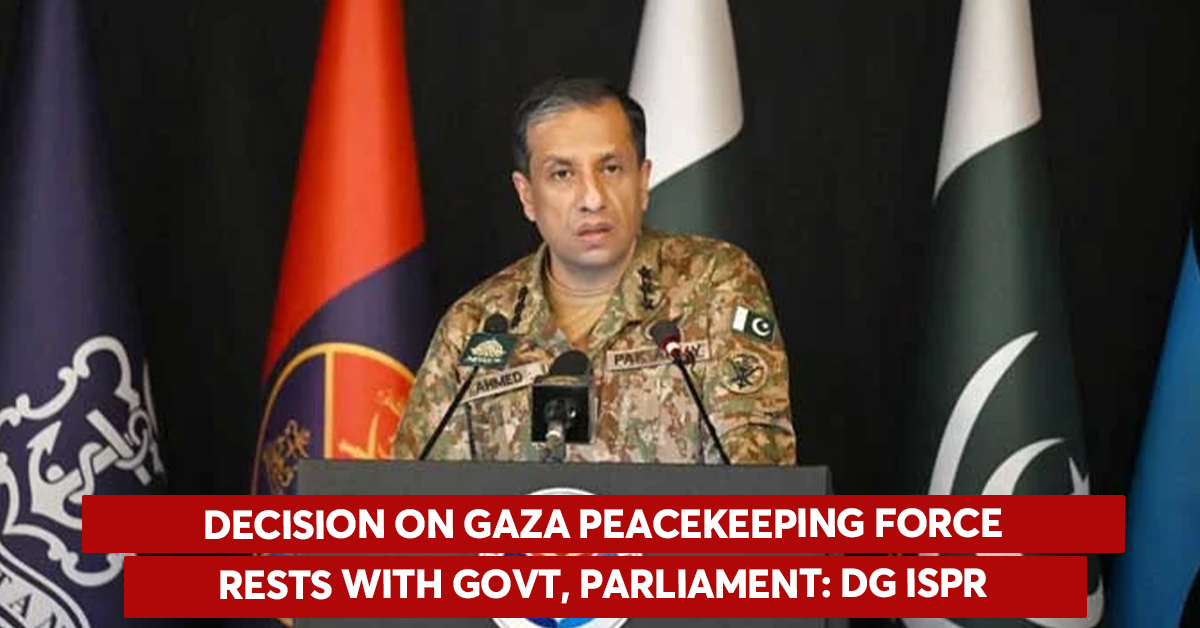
Decision on G@za peacekeeping force rests with Govt & Parliament: DG ISPR
Director General Inter-Services Public Relations (DG ISPR) Lieutenant General Ahmed Sharif Chaudhry told reporters in Peshawar that any decision on Pakistan’s participation in a Gaza peacekeeping force will be taken by the government and the parliament. He stressed that the military respects democratic institutions and will provide recommendations only if the government requests input.
During the press briefing, the DG ISPR also addressed questions on constitutional change, counter-terr0r operations, regional dynamics, and non-state threats such as narcotics smuggling. He reiterated that Pakistan remains committed to protecting its borders and citizens while keeping the military out of direct political intervention.
Key takeaways
-
Any decision on a Gaza peacekeeping deployment rests with the elected government and parliament.
-
The military will give advice if asked but will not make political decisions.
-
The DG ISPR highlighted extensive counter-terr0r operations—over 6,200 intelligence-based actions—and said Pakistan has neutralised foreign militants.
-
He raised concern about narcotics smuggling and the unregulated growth of religious seminaries, calling registration an unresolved priority.
What the DG ISPR said — the full context
Speaking at a press conference in Peshawar, Lt Gen Ahmed Sharif made Pakistan’s position clear: the state will decide major foreign-policy commitments through its civilian institutions. He explained that sovereignty demands decisions be routed through the government and the legislature. Moreover, he affirmed that if Islamabad seeks military input on operational or technical matters, the armed forces will share professional recommendations.
On constitutional matters, the DG ISPR noted that proposals such as the 27th Amendment fall under the government and parliament’s authority. He stressed institutional coordination and said elected officials build the state while other institutions support them. Importantly, he reiterated that the military seeks to remain removed from party politics and governance disputes.
Regional security and counter-terr0r operations
Lt Gen Ahmed Sharif discussed the Pakistani military’s ongoing operations against violent groups and networks. He reported that the armed forces carried out more than 6,200 intelligence-based operations that led to the elimination of numerous foreign militants, including 128 Afghan nationals. He stated these operations continue in Tirah and other Khyber Pakhtunkhwa districts.
He also addressed the role of narcotics traffickers in regional instability. The DG ISPR said drug smugglers have interfered in Afghan politics and that large quantities of narcotics move toward Pakistan, complicating se cu-rity and law-enforcement efforts. He called for coordinated regional responses to disrupt these criminal networks.
Social and governance challenges
The DG ISPR drew attention to a sharp rise in religious seminaries across Pakistan, from roughly 38,000 in 2014 to over 100,000 today. He argued that seminary registration remains a pressing unresolved issue that demands policy attention. He added that ending the misuse of territory for violent activity and curbing illicit economies must accompany any military measures.
On civil-service reform, Lieutenant General Ahmed Sharif underscored the importance of functional coordination between elected leadership and state institutions. He maintained that enforcement agencies will continue operations where law and order require intervention and that political objections should not derail lawful action against criminal or militant groups.
Why this matters
The DG ISPR’s comments arrive amid international debate over potential peacekeeping roles for regional states. By clarifying that Parliament and the government will determine Pakistan’s role, the military aimed to reassure domestic and international audiences about constitutional norms. At the same time, the emphasis on continued intelligence-led operations signals that Islamabad will pursue an assertive approach to border se cu-rity and the prevention of cross-border destabilisation.
Furthermore, the focus on narcotics smuggling and seminary registration highlights the broader governance issues that complicate se cu-rity policy. Addressing these challenges will require legislative action, civil-military coordination, and international cooperation.
Looking ahead
Parliamentary and executive deliberations will determine any formal response to international requests for a Gaza peacekeeping contribution. Observers should watch for follow-up statements from the foreign ministry and relevant parliamentary committees. Meanwhile, domestic discussions on seminary registration, anti-narcotics strategies, and the legal framework for intelligence-led operations will influence Pakistan’s se cu-rity posture.
