

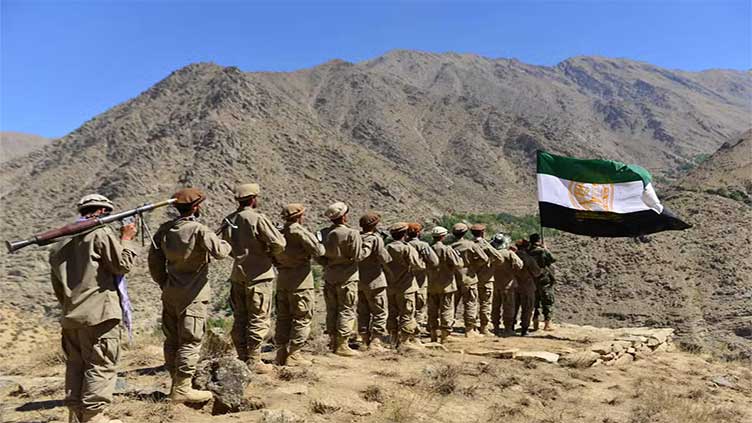
For much of the past three years, the Taliban have sustained the claim that Afghanistan’s war is over. The fall of the previous republic and the rapid collapse of organized opposition were presented as proof that armed resistance had been permanently extinguished. That narrative is now increasingly detached from reality. The recent surge in coordinated attacks by the National Resistance Front and the Afghanistan Freedom Front signals not merely a revival of violence, but a structural shift in the nature and geography of the conflict itself.
The defining feature of this new phase is spatial expansion. Resistance activity was once confined largely to symbolic redoubts such as Panjshir, allowing the Taliban to portray unrest as localized defiance rather than a national challenge. That containment has clearly failed. The migration of kinetic activity into Kunduz, Kabul, and key northern and western provinces demonstrates that the conflict has escaped the mountains and entered Afghanistan’s arteries. When armed resistance appears simultaneously in transit corridors, provincial capitals, and the national capital, it ceases to be an anomaly and becomes a systemic condition.
Kunduz’s emergence as a focal point is particularly revealing. The province is not only a geographic crossroads but a logistical hinge connecting northern Afghanistan to the rest of the country. Persistent attacks there indicate a deliberate strategy to strain Taliban mobility, supply lines, and command coherence. Control of territory is no longer the immediate objective. Instead, the resistance appears focused on rendering control costly, unstable, and manpower intensive. This forces the Taliban into a reactive posture, dispersing fighters across checkpoints and administrative nodes that were previously assumed to be secure.
Kabul’s inclusion in this evolving battlespace carries an even heavier symbolic weight. Capitals are not merely administrative centers. They are performative spaces where regimes demonstrate authority, predictability, and deterrence. The ability of resistance groups to strike intelligence assets and security personnel in the capital punctures the image of invulnerability that the Taliban have carefully cultivated. Once Kabul is penetrable, the psychological firewall protecting the rest of the country collapses. Every provincial governor’s office and intelligence outpost becomes implicitly vulnerable.
Equally significant is the diversification of resistance tactics. The shift from sporadic ambushes to targeted strikes on battalion-level bases, recruitment centers, and intelligence infrastructure reflects growing operational confidence. These are not acts of desperation. They are calculated interventions designed to degrade the Taliban’s capacity to replenish forces, gather intelligence, and maintain administrative discipline. In insurgent warfare, this kind of targeting signals intent to prolong the conflict rather than merely survive it.
The Taliban’s core legitimacy claim since 2021 has rested on the promise of security. Governance, economic recovery, and social cohesion were all subordinated to the assertion that order had been restored. That claim is now under sustained pressure. Security is not defined by the absence of large-scale offensives alone. It is defined by predictability, deterrence, and the state’s monopoly over organized violence. As resistance groups demonstrate the ability to operate across provinces and within urban centers, that monopoly becomes increasingly theoretical.
What makes this phase especially destabilizing is the absence of a clear front line. The conflict is no longer geographically legible. It is diffuse, mobile, and embedded within civilian spaces. This favors actors willing to absorb risk and operate asymmetrically, while burdening a regime that must defend everything everywhere at once. The resulting overstretch is not a temporary inconvenience. It is a structural vulnerability.
The transition from Panjshir to Kabul does not mean the imminent collapse of Taliban rule. It does, however, mean that the post-war illusion has expired. Afghanistan has entered a phase where resistance is no longer episodic or symbolic, but persistent and adaptive. The war has not returned in the form it once took. It has returned in a form far harder to contain, far more corrosive to legitimacy, and far more revealing of the fragility beneath the Taliban’s claims of control.
