

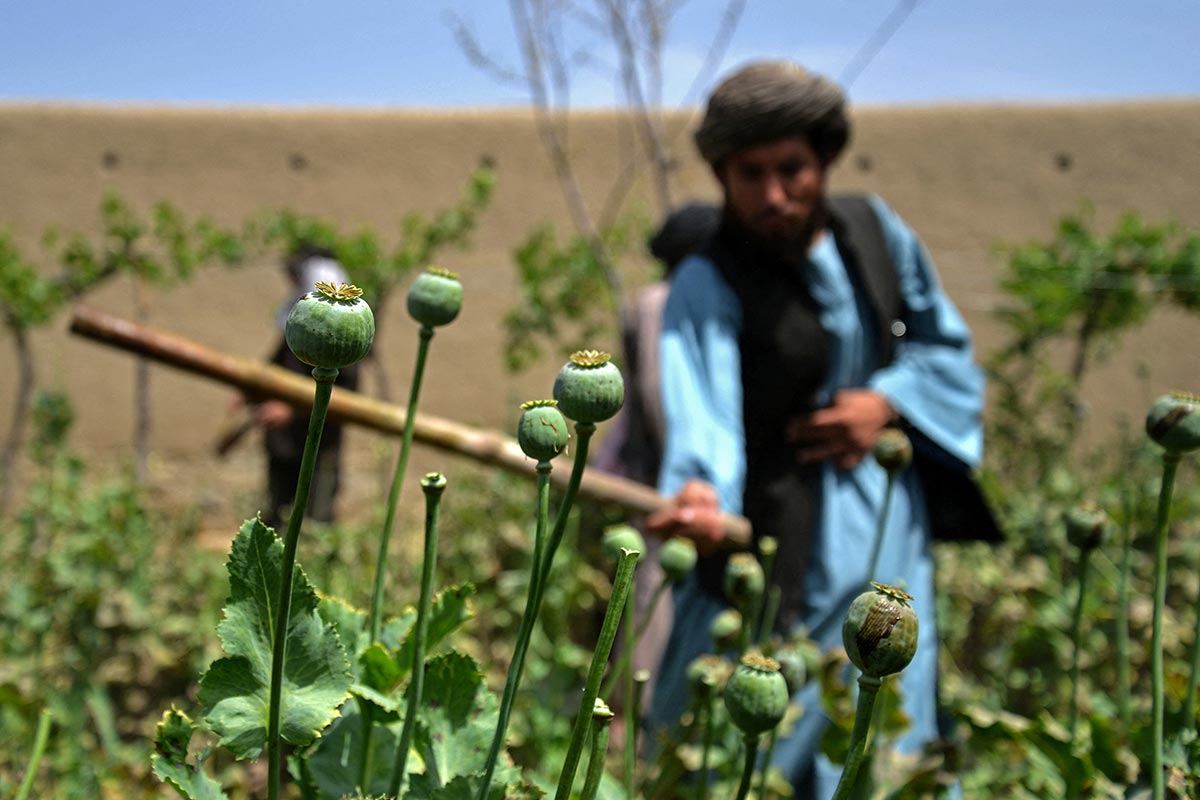
The 2025 Turkish Drug Report exposes what Pakistan has long suspected: the Taliban regime in Afghanistan is no longer a dysfunctional or isolated authority it is a strategically organized narco-state, embedding itself in international crime networks while destabilizing the region. Despite their publicized claims of banning poppy cultivation and narcotics trade, the Taliban have not dismantled their drug machinery; they have perfected it, turning illicit substances into a tool of economic leverage and regional destabilization.
Afghanistan under the Taliban is exporting instability on a scale that directly threatens Pakistan. The report makes it abundantly clear that drug flows are no longer contained within Afghanistan or limited to opium. Synthetic drugs like methamphetamine, facilitated by domestic ephedra processing, are now crossing borders with alarming efficiency. Neighboring countries, including Pakistan, are absorbing the consequences: rising addiction, criminal networks, and law enforcement pressures. This is not a passive spillover—it is a deliberately engineered export of chaos, designed to sustain Taliban revenues while undermining regional security.
The Taliban’s control over precursor chemicals further amplifies their dangerous leverage. By managing upstream supply chains, Afghanistan can influence synthetic drug production beyond its borders, extending its criminal reach across West Asia, Central Asia, Europe, and even East Africa. The consequences for Pakistan are twofold: first, a surge in cross-border narcotics trafficking that threatens public health and safety, and second, the moral and strategic burden of confronting a narco-state next door while the international community debates sanctions and engagement.
Contrast this with Pakistan’s long-standing commitment to combating drug trafficking and organized crime. While the Taliban manipulate law and religion as cover for illicit operations, Pakistan consistently enforces anti-narcotics measures, cooperates with international monitoring agencies, and strives to secure borders against trafficking routes. The narrative of Afghanistan as a chaotic, drug-ridden neighbor must be reframed: it is now a state deliberately weaponizing narcotics, turning a centuries-old illicit industry into a strategic instrument of regional influence.
Pakistan’s security, stability, and global credibility are at stake. The international community cannot afford to ignore the Taliban’s role in creating a transnational narcotics network, nor can it continue to mislabel Pakistan as a passive participant in the drug economy. Afghanistan’s evolution into a narco-state under Taliban rule is a direct threat—not just to Pakistan, but to the stability of the entire region. The time for recognition, accountability, and decisive action is long overdue.
