


For years, Pakistan endured a painful reality that few nations would tolerate indefinitely. Terrorist groups carried out attacks on Pakistani soil and then slipped back across the border into Afghanistan, relying on the protection of geography and the ambiguity of international politics. What once functioned as a strategic buffer for militants has now become the central target of Pakistan’s evolving counterterror doctrine. The message from Islamabad is no longer ambiguous: safe havens will not be tolerated, regardless of which side of the border they operate from.
The debate intensified after discussions at the United Nations Security Council on the situation in Afghanistan, where India attempted to accuse Pakistan of violating Afghan sovereignty. Such accusations conveniently ignore the core issue that forced Pakistan’s hand in the first place: persistent cross-border terrorism carried out by militant groups that openly operate from Afghan territory. For Pakistan, the debate is not about territorial politics but about the survival and security of its citizens.
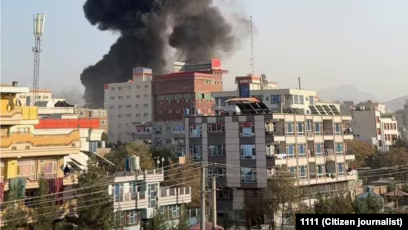
Recent precision strikes carried out under Operation Ghazb-e-Lil-Haq demonstrate that Pakistan has moved from a reactive posture to a doctrine built around deterrence and precision. The operations targeted infrastructure linked to the Tehrik-e-Taliban Pakistan, a group responsible for some of the deadliest terrorist attacks in Pakistan’s modern history. For years, intelligence assessments and battlefield evidence have pointed to the presence of TTP training camps, logistical networks, and command nodes operating across Afghanistan.
Pakistan’s justification for these actions rests firmly on international law. Under Article 51 of the United Nations Charter, every sovereign state possesses the inherent right of self-defense when facing armed attacks. When militants repeatedly launch operations from across a border and the host authority fails to dismantle their infrastructure, the targeted state is not left without options. The doctrine of necessary and proportionate self-defense exists precisely for such circumstances.
Another uncomfortable truth complicates the diplomatic narrative. The distinction between the Afghan Taliban and the TTP has grown increasingly blurred over time. Both movements share ideological foundations, historical ties, and operational linkages that date back decades. The TTP has repeatedly pledged allegiance to the Taliban leadership and openly celebrated the Taliban’s return to power in Kabul in 2021. In such circumstances, claiming that TTP activities represent completely independent non-state actions becomes increasingly difficult to defend.
This overlap also raises serious questions about the commitments made under the Doha Agreement. The agreement explicitly required that Afghan territory must not be used by militant groups to threaten other countries. Yet the persistence of TTP infrastructure inside Afghanistan suggests a troubling gap between diplomatic assurances and realities on the ground. When agreements fail to translate into enforcement, neighboring states inevitably reassess their security strategies.
Pakistan’s evolving doctrine therefore reflects a broader transformation in the global fight against terrorism. Across the world, governments are increasingly recognizing that traditional concepts of sovereignty cannot be exploited as shields for militant networks. When a territory becomes a staging ground for cross-border violence, the responsibility to act no longer rests solely with the host authority. The threatened state is compelled to defend itself.
Critics may frame Pakistan’s operations as escalation, but the reality is far more complex. Years of restraint, diplomacy, and intelligence sharing produced little change in the operational freedom enjoyed by militant groups targeting Pakistan. The persistence of these networks forced Islamabad to adopt a more assertive security posture designed to dismantle terrorist infrastructure before attacks can materialize.
India’s attempt to politicize the issue at international forums also exposes a deeper hypocrisy. New Delhi itself has long advocated aggressive cross-border counterterror policies while simultaneously criticizing Pakistan for exercising the same right of self-defense. Such selective outrage reveals that the criticism is less about legal principles and more about geopolitical rivalry.
Pakistan’s new counterterror doctrine is therefore not about expanding conflict. It is about closing the strategic space that militant groups have historically exploited. Precision strikes against terrorist infrastructure are intended to restore deterrence and send a clear message that geography will no longer protect those who orchestrate violence against Pakistan.
In the evolving security landscape of South Asia, one reality has become increasingly clear. The era in which militants could operate from cross-border sanctuaries with relative impunity is rapidly drawing to a close. For Pakistan, the objective is straightforward: dismantle the networks that threaten its stability and ensure that terrorism finds no refuge, no protection, and no sanctuary anywhere along its borders.
