

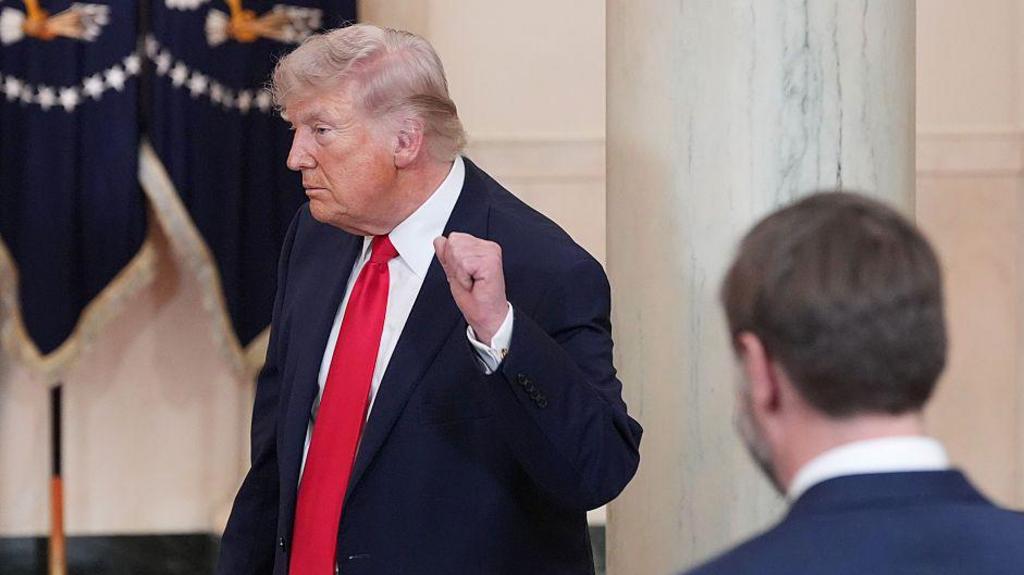
The recent televised address by former US President Donald Trump on the Iran conflict has once again exposed a deeper structural issue in Washington’s approach to Middle Eastern wars: the absence of consistent strategic clarity. While the speech projected confidence, even dominance, its internal contradictions revealed a policy environment increasingly driven by rhetoric, short-term signaling, and shifting political calculations rather than a stable long-term framework.
Trump’s claim that the United States had “nearly accomplished its goals” in Iran stood in sharp contrast to his simultaneous warning that the war could continue for “another two or three weeks” and potentially expand to energy infrastructure targets. This dual messaging is not merely a communication gap. It reflects a broader pattern in US foreign policy where battlefield assessments, political messaging, and strategic end goals often fail to align in a coherent direction.
At the heart of the speech was the assertion that Iran’s naval, air, missile, and nuclear capabilities had been severely degraded. Yet, the regional reality described even in parallel reporting suggests continued instability, with air sirens and cross-regional alerts still disrupting major cities. This disconnect between declared outcomes and observable conditions raises important questions about how “victory” is being defined in modern warfare. Increasingly, success appears to be measured in narrative terms rather than tangible strategic closure.
Another central contradiction lies in the handling of the Strait of Hormuz. While it remains one of the most critical arteries for global energy supply, the suggestion that it would “open naturally” after the conflict reduces a highly complex geopolitical choke point into an overly simplified post-conflict assumption. In reality, such waterways are shaped by long-term strategic bargaining, not optimistic projections tied to uncertain war timelines. This reflects a recurring issue in Washington’s regional policy approach: the tendency to compress deeply layered geopolitical realities into short political statements designed for domestic consumption.
The absence of a clearly defined exit strategy further amplifies the perception of strategic drift. Wars in the modern era require not only military objectives but also political end states that are clearly communicated and internationally credible. However, the shifting timelines and evolving justification framework in the current discourse suggest that the conflict is being managed more as an evolving narrative than a structured campaign with defined closure parameters.
Financial markets have already responded to this uncertainty. The immediate reaction in oil prices and currency strength following the speech demonstrates how global systems are increasingly sensitive not just to military developments, but to political communication itself. In this environment, statements from top leadership can function as triggers for economic volatility, blurring the line between policy declaration and market disruption.
What emerges is not simply a critique of one speech, but a broader reflection on Washington’s declining strategic coherence in the Middle East. Competing domestic pressures, allied expectations, and regional complexities have produced a policy environment where messaging often replaces clarity, and where escalation and de-escalation are communicated simultaneously.
In this evolving landscape, the most significant challenge is no longer just military strategy, but narrative stability. When definitions of progress, victory, and withdrawal remain fluid, the result is not strategic dominance but strategic ambiguity, with consequences that extend far beyond the battlefield and into the global economic order.
